Department of Biological Chemistry and Molecular Pharmacology, Harvard Medical School, Boston, MA, USA.
Liangzhu Laboratory, Zhejiang University, Hangzhou, China.
Nature. 2023 Jun;618(7965):625-633. doi: 10.1038/s41586-023-06140-2. Epub 2023 May 31.
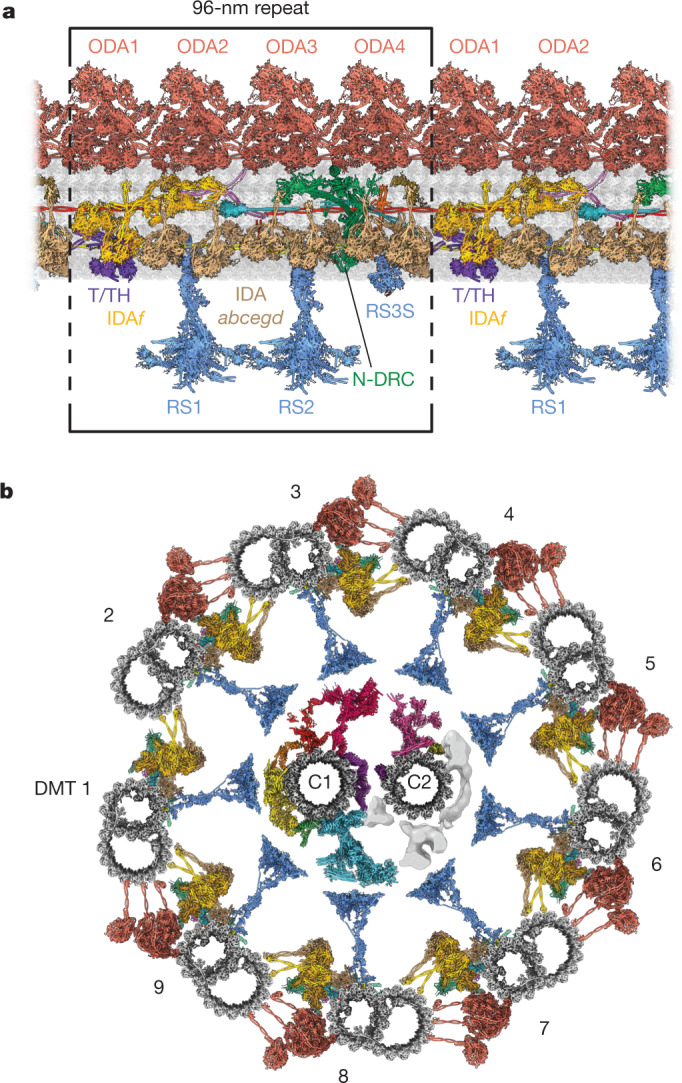
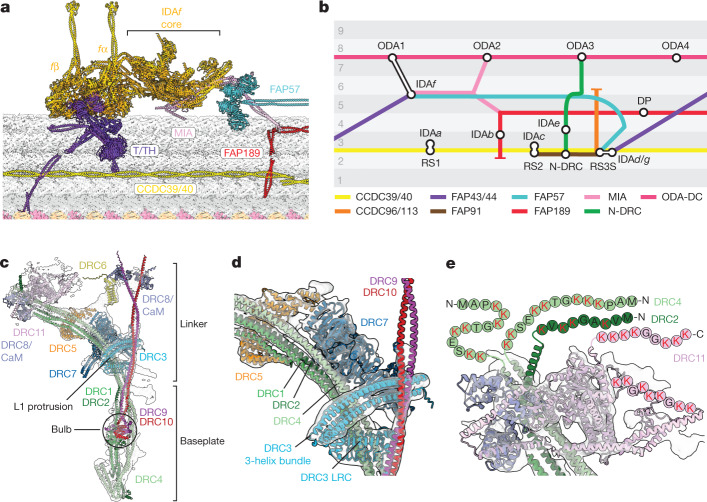
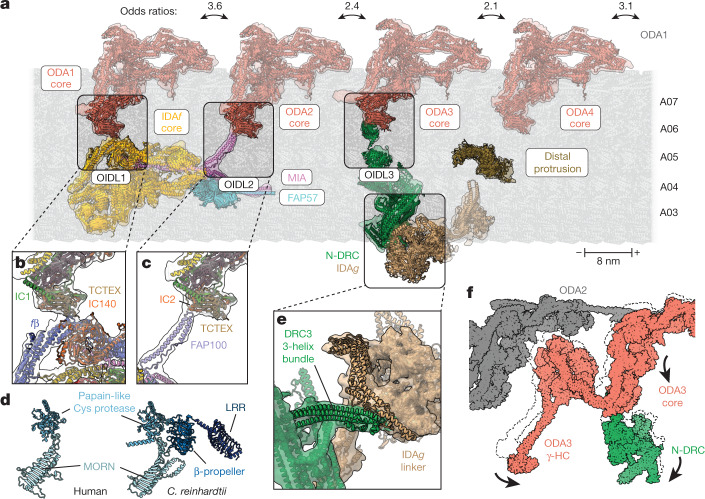
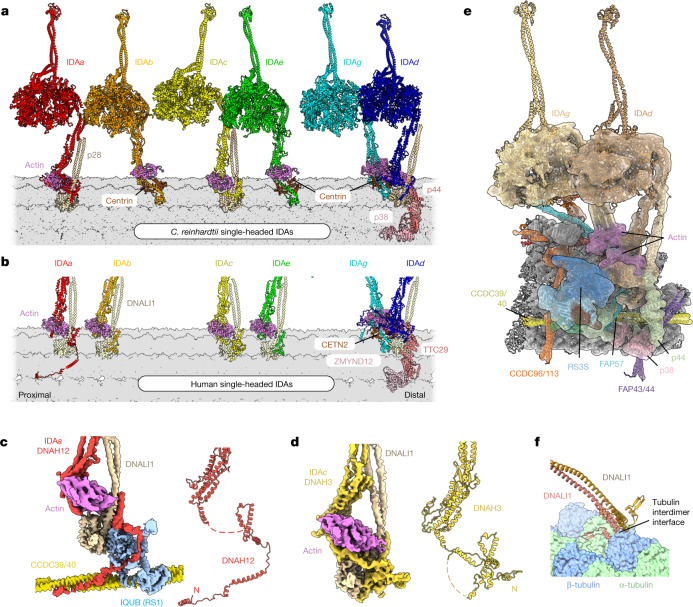
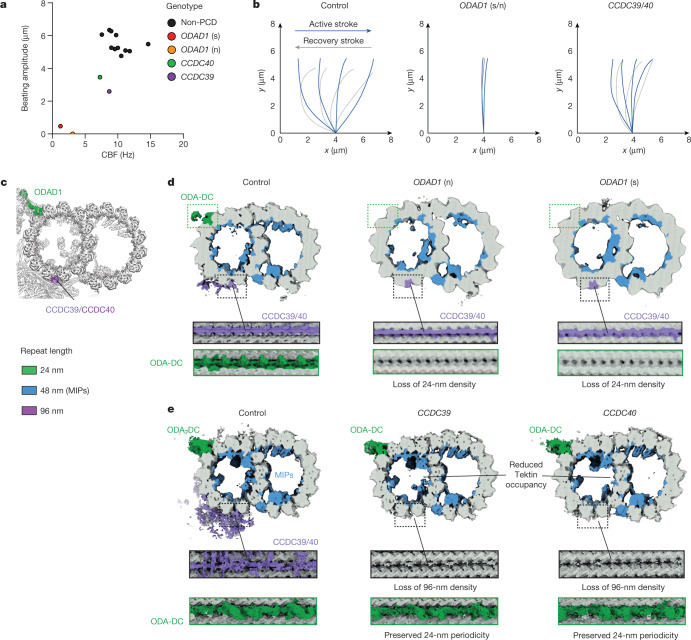
Motile cilia and flagella beat rhythmically on the surface of cells to power the flow of fluid and to enable spermatozoa and unicellular eukaryotes to swim. In humans, defective ciliary motility can lead to male infertility and a congenital disorder called primary ciliary dyskinesia (PCD), in which impaired clearance of mucus by the cilia causes chronic respiratory infections. Ciliary movement is generated by the axoneme, a molecular machine consisting of microtubules, ATP-powered dynein motors and regulatory complexes. The size and complexity of the axoneme has so far prevented the development of an atomic model, hindering efforts to understand how it functions. Here we capitalize on recent developments in artificial intelligence-enabled structure prediction and cryo-electron microscopy (cryo-EM) to determine the structure of the 96-nm modular repeats of axonemes from the flagella of the alga Chlamydomonas reinhardtii and human respiratory cilia. Our atomic models provide insights into the conservation and specialization of axonemes, the interconnectivity between dyneins and their regulators, and the mechanisms that maintain axonemal periodicity. Correlated conformational changes in mechanoregulatory complexes with their associated axonemal dynein motors provide a mechanism for the long-hypothesized mechanotransduction pathway to regulate ciliary motility. Structures of respiratory-cilia doublet microtubules from four individuals with PCD reveal how the loss of individual docking factors can selectively eradicate periodically repeating structures.
纤毛和鞭毛在细胞表面有节奏地运动,推动液体流动,并使精子和单细胞真核生物能够游动。在人类中,纤毛运动功能缺陷可导致男性不育和一种称为原发性纤毛运动障碍(PCD)的先天性疾病,其中纤毛清除黏液的能力受损导致慢性呼吸道感染。纤毛运动是由轴丝产生的,轴丝是一种由微管、ATP 驱动的动力蛋白马达和调节复合物组成的分子机器。轴丝的大小和复杂性迄今为止阻止了原子模型的发展,阻碍了对其功能的理解。在这里,我们利用人工智能辅助结构预测和冷冻电子显微镜(cryo-EM)的最新进展,确定了来自衣藻 Chlamydomonas reinhardtii 和人类呼吸纤毛的轴丝 96nm 模块化重复的结构。我们的原子模型提供了对轴丝的保守性和专业化、动力蛋白及其调节剂之间的互联性以及维持轴丝周期性的机制的深入了解。机械调节复合物与其相关的轴丝动力蛋白之间的相关构象变化为长期假设的机械转导途径提供了一种调节纤毛运动的机制。来自四个 PCD 个体的呼吸纤毛二联体微管的结构揭示了失去单个对接因子如何选择性地消除周期性重复结构。