Universidad de Buenos Aires, Facultad de Ciencias Exactas y Naturales, Departamento de Física, Buenos Aires, Argentina.
CONICET - Universidad de Buenos Aires, Instituto de Física de Buenos Aires (IFIBA), Buenos Aires, Argentina.
BMC Bioinformatics. 2023 Jun 3;24(1):230. doi: 10.1186/s12859-023-05284-2.
In tissues and organisms, the coordination of neighboring cells is essential to maintain their properties and functions. Therefore, knowing which cells are adjacent is crucial to understand biological processes that involve physical interactions among them, e.g. cell migration and proliferation. In addition, some signaling pathways, such as Notch or extrinsic apoptosis, are highly dependent on cell-cell communication. While this is straightforward to obtain from membrane images, nuclei labelling is much more ubiquitous for technical reasons. However, there are no automatic and robust methods to find neighboring cells based only on nuclear markers.
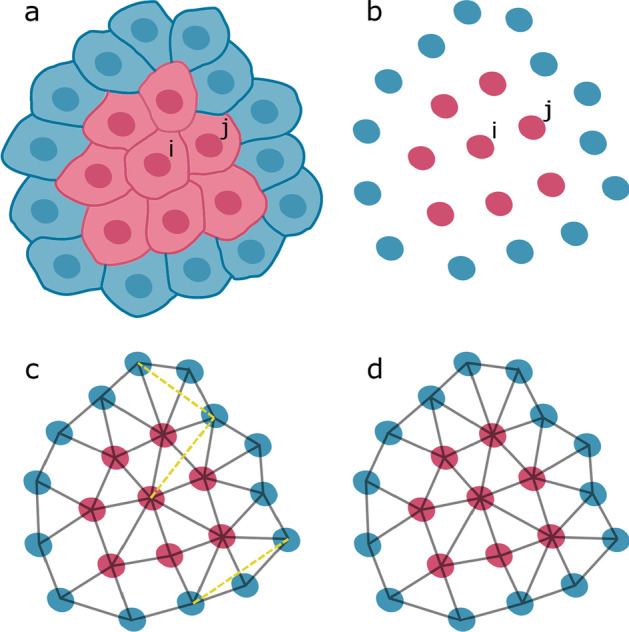
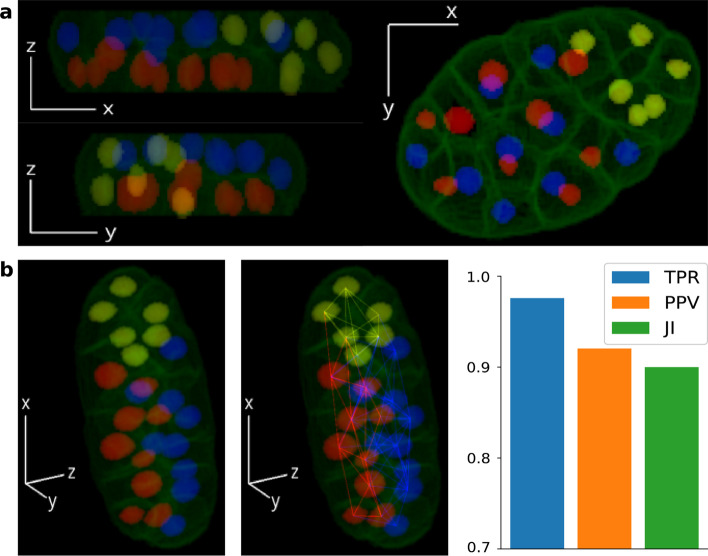
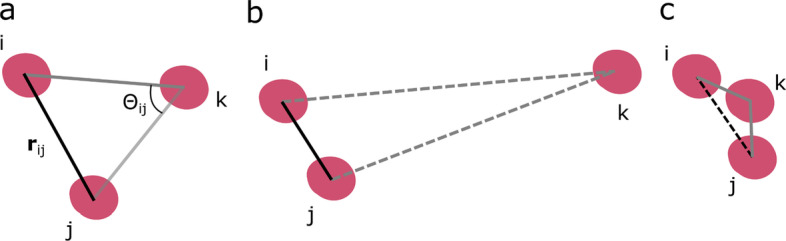
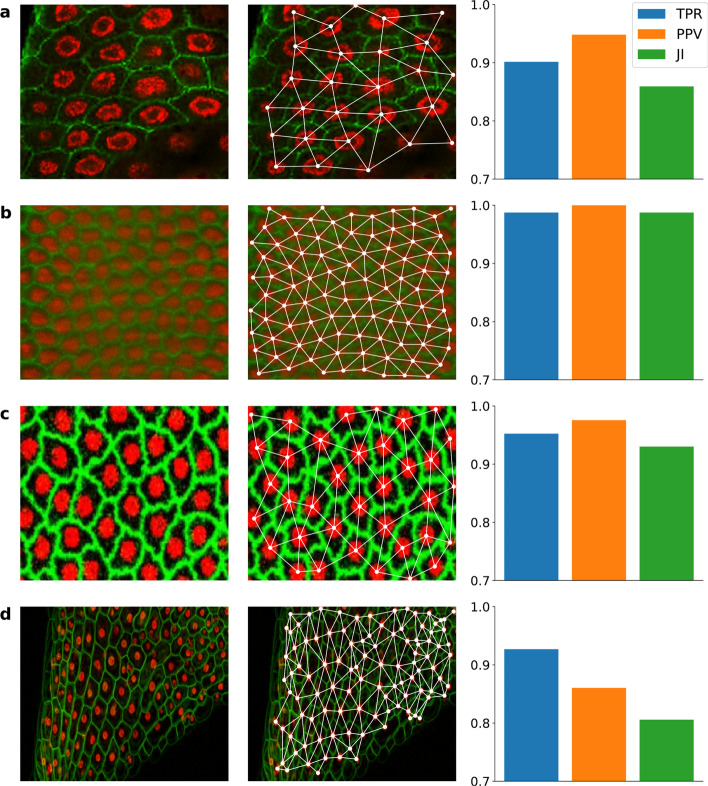
In this work, we describe Nfinder, a method to assess the cell's local neighborhood from images with nuclei labeling. To achieve this goal, we approximate the cell-cell interaction graph by the Delaunay triangulation of nuclei centroids. Then, links are filtered by automatic thresholding in cell-cell distance (pairwise interaction) and the maximum angle that a pair of cells subtends with shared neighbors (non-pairwise interaction). We systematically characterized the detection performance by applying Nfinder to publicly available datasets from Drosophila melanogaster, Tribolium castaneum, Arabidopsis thaliana and C. elegans. In each case, the result of the algorithm was compared to a cell neighbor graph generated by manually annotating the original dataset. On average, our method detected 95% of true neighbors, with only 6% of false discoveries. Remarkably, our findings indicate that taking into account non-pairwise interactions might increase the Positive Predictive Value up to + 11.5%.
Nfinder is the first robust and automatic method for estimating neighboring cells in 2D and 3D based only on nuclear markers and without any free parameters. Using this tool, we found that taking non-pairwise interactions into account improves the detection performance significantly. We believe that using our method might improve the effectiveness of other workflows to study cell-cell interactions from microscopy images. Finally, we also provide a reference implementation in Python and an easy-to-use napari plugin.
在组织和生物体中,相邻细胞的协调对于维持其特性和功能至关重要。因此,了解哪些细胞是相邻的对于理解涉及它们之间物理相互作用的生物学过程至关重要,例如细胞迁移和增殖。此外,一些信号通路,如 Notch 或外在凋亡,高度依赖于细胞间的通讯。虽然这可以从细胞膜图像中直接获得,但由于技术原因,细胞核标记更为普遍。然而,目前还没有基于核标记仅自动且稳健地找到相邻细胞的方法。
在这项工作中,我们描述了 Nfinder,这是一种从具有核标记的图像中评估细胞局部邻域的方法。为了实现这一目标,我们通过核质心的 Delaunay 三角剖分来近似细胞-细胞相互作用图。然后,通过自动阈值过滤细胞-细胞距离(细胞间相互作用)和一对细胞与共享邻居形成的最大角度(非细胞间相互作用)的链接。我们通过将 Nfinder 应用于来自果蝇、赤拟谷盗、拟南芥和秀丽隐杆线虫的公开可用数据集来系统地表征检测性能。在每种情况下,算法的结果都与通过手动注释原始数据集生成的细胞邻接图进行了比较。平均而言,我们的方法检测到了 95%的真实邻居,只有 6%的错误发现。值得注意的是,我们的发现表明考虑非细胞间相互作用可以将阳性预测值提高到+11.5%。
Nfinder 是第一个仅基于核标记且无需任何自由参数即可在 2D 和 3D 中估计相邻细胞的稳健且自动的方法。使用此工具,我们发现考虑非细胞间相互作用可以显著提高检测性能。我们相信,使用我们的方法可能会提高从显微镜图像研究细胞-细胞相互作用的其他工作流程的有效性。最后,我们还提供了 Python 的参考实现和易于使用的 napari 插件。