Knapstad Mari Kalland, Naterstad Ingvill, Bogen Bård
Department of Health and Function, Western Norway University of Applied Sciences, Bergen, Hordaland, Norway.
Department of Otorhinolaryngology & Head and Neck Surgery, Haukeland University Hospital, Bergen, Hordaland, Norway.
Front Aging Neurosci. 2023 May 18;15:1092990. doi: 10.3389/fnagi.2023.1092990. eCollection 2023.
Gait speed has been found to be associated with cognitive function. However, gait speed is an unspecific measure that may not be informative about gait patterns. The Walk ratio (step length divided by step frequency) can be measured without specialized equipment, and has been suggested as an indicator of central gait control. However, the association with cognitive function is unknown.
Is there a relationship between Walk ratio and cognitive function, and gait speed and cognitive function?
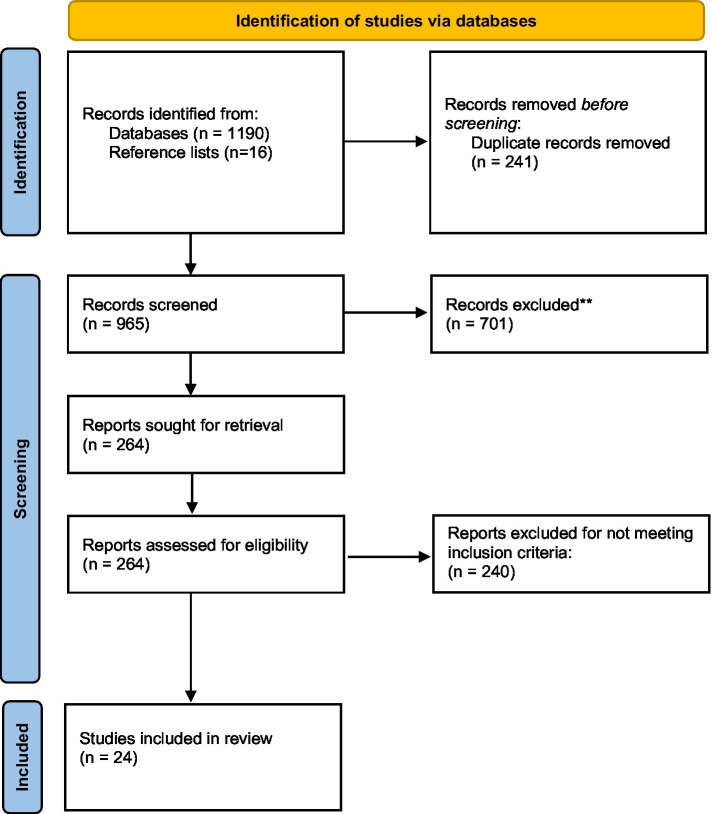
This was a systematic literature review of studies where spatiotemporal gait parameters was reported in populations with cognitive impairment. The search was performed through PubMed, PEDro, AMED, Cochrane, Embase, MEDLINE, and PsycINFO. The studies had to contain either the Walk ratio, or report average step length and average step frequency. In the latter case, the average step length was divided by the average step frequency. The studies also had to report gait speed and the minimal mental state examination (MMSE). Studies testing patients on treadmills or that did not state the exclusion of patients with neurologic or orthopedic diseases, possible affecting gait ability, were excluded.
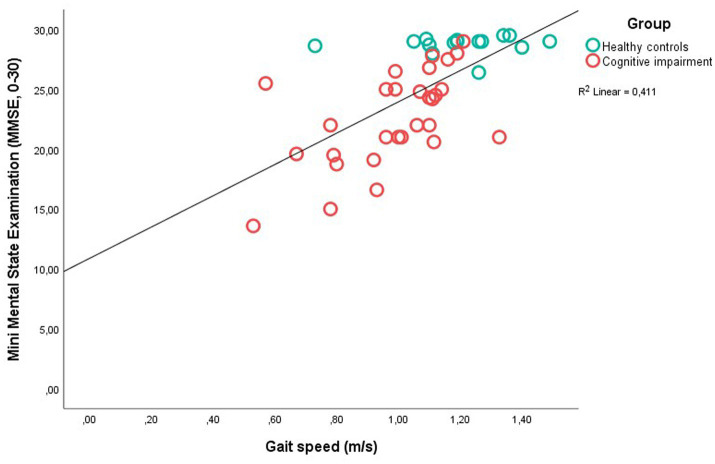
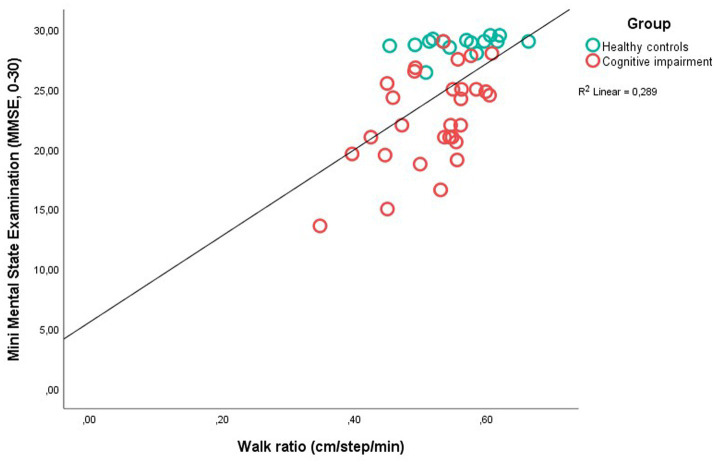
A total of 24 studies were included, consisting of 909 patients with cognitive impairment and 4,108 healthy controls. The patient group had a lower Walk ratio (mean difference 0.07, ≤ 0.001) and gait speed (mean difference 0.26, ≤ 0.001) than the healthy controls. Using linear regression models, we found an association between the MMSE and the Walk ratio ( = 0.29, < 0.001) and gait speed ( = 0.41, < 0.001) in separate, unadjusted models. In a final model with Walk ratio, gait speed and age, Walk ratio was not significantly associated with MMSE, while gait speed was.
Our results suggest that preferred gait speed may be preferable to the Walk ratio when assessing older adults with cognitive impairment.
研究发现步速与认知功能有关。然而,步速是一种非特异性指标,可能无法提供有关步态模式的信息。步幅比(步长除以步频)无需专门设备即可测量,有人提出它可作为中枢步态控制的指标。然而,其与认知功能的关联尚不清楚。
步幅比与认知功能之间、步速与认知功能之间是否存在关联?
这是一项对报告了认知障碍人群时空步态参数的研究进行的系统文献综述。通过PubMed、PEDro、AMED、Cochrane、Embase、MEDLINE和PsycINFO进行检索。这些研究必须包含步幅比,或者报告平均步长和平均步频。在后一种情况下,用平均步长除以平均步频。这些研究还必须报告步速和简易精神状态检查表(MMSE)。排除了在跑步机上测试患者的研究,以及未说明排除可能影响步态能力的神经或骨科疾病患者的研究。
共纳入24项研究,包括909名认知障碍患者和4108名健康对照者。患者组的步幅比(平均差异0.07,P≤0.001)和步速(平均差异0.26,P≤0.001)低于健康对照组。使用线性回归模型,我们发现在单独的未调整模型中,MMSE与步幅比(r=0.29,P<0.001)和步速(r=0.41,P<0.001)之间存在关联。在包含步幅比、步速和年龄的最终模型中,步幅比与MMSE无显著关联,而步速与MMSE有显著关联。
我们的结果表明,在评估有认知障碍的老年人时,首选步速可能比步幅比更合适。