Harvard John A. Paulson School of Engineering and Applied Sciences, 9 Oxford Street, Cambridge, MA, 02138, USA.
Nanophotonics Research Center, Korea Institute of Science and Technology, Seoul, 02792, Republic of Korea.
Nat Commun. 2023 Jun 5;14(1):3237. doi: 10.1038/s41467-023-39072-6.
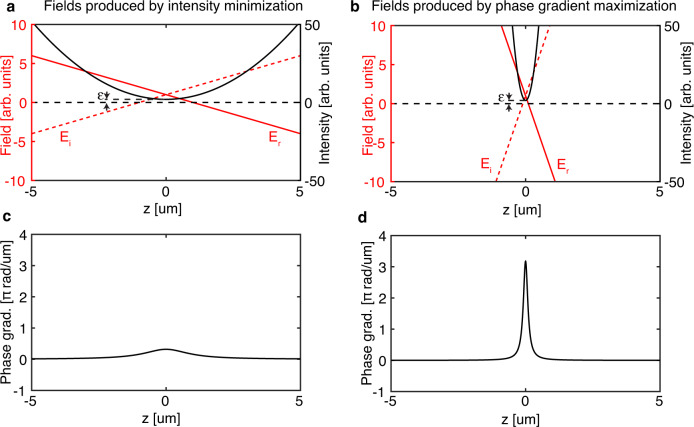
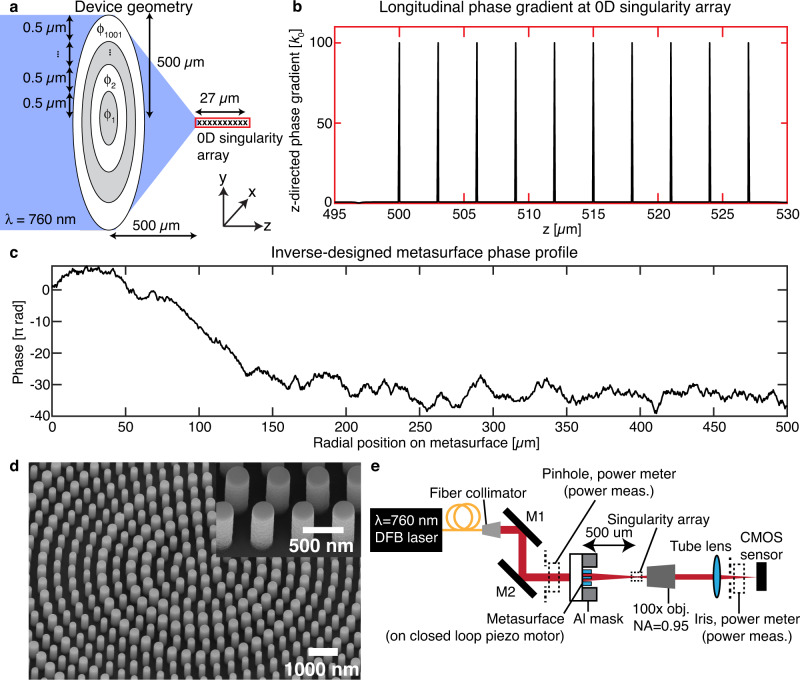
Phase singularities are loci of darkness surrounded by monochromatic light in a scalar field, with applications in optical trapping, super-resolution imaging, and structured light-matter interactions. Although 1D singular structures, like optical vortices, are common due to their robust topological properties, uncommon 0D (point) and 2D (sheet) singularities can be generated by wavefront-shaping devices like metasurfaces. With the design flexibility of metasurfaces, we deterministically position ten identical point singularities using a single illumination source. The phasefront is inverse-designed using phase-gradient maximization with an automatically-differentiable propagator and produces tight longitudinal intensity confinement. The array is experimentally realized with a TiO metasurface. One possible application is blue-detuned neutral atom trap arrays, for which this field would enforce 3D confinement and a potential depth around 0.22 mK per watt of incident laser power. We show that metasurface-enabled point singularity engineering may significantly simplify and miniaturize the optical architecture for super-resolution microscopes and dark traps.
相位奇点是标量场中被单色光包围的暗点,在光学捕获、超分辨率成像和结构化光物质相互作用中有应用。尽管一维奇异结构,如光学涡旋,由于其鲁棒的拓扑性质而很常见,但通过像超表面这样的波前整形器件可以产生不常见的 0 维(点)和 2 维(面)奇点。由于超表面的设计灵活性,我们使用单个照明源就能确定地定位十个相同的点奇点。相位前沿使用具有自动微分传播器的相位梯度最大化来逆向设计,产生紧密的纵向强度限制。该阵列通过 TiO2 超表面实验实现。一个可能的应用是蓝失谐中性原子阱阵列,对于该应用,该场将提供 3D 限制和大约 0.22 mK/每瓦特入射激光功率的潜在深度。我们表明,超表面实现的点奇异点工程可能会显著简化和小型化超分辨率显微镜和暗陷阱的光学架构。