• 文献检索
  • 文档翻译
  • 深度研究
  • 学术资讯
  • Suppr Zotero 插件Zotero 插件
  • 邀请有礼
  • 套餐&价格
  • 历史记录
应用&插件
Suppr Zotero 插件Zotero 插件浏览器插件Mac 客户端Windows 客户端微信小程序
定价
高级版会员购买积分包购买API积分包
服务
文献检索文档翻译深度研究API 文档MCP 服务
关于我们
关于 Suppr公司介绍联系我们用户协议隐私条款
关注我们

Suppr 超能文献

核心技术专利:CN118964589B侵权必究
粤ICP备2023148730 号-1Suppr @ 2026

文献检索

告别复杂PubMed语法,用中文像聊天一样搜索,搜遍4000万医学文献。AI智能推荐,让科研检索更轻松。

立即免费搜索

文件翻译

保留排版,准确专业,支持PDF/Word/PPT等文件格式,支持 12+语言互译。

免费翻译文档

深度研究

AI帮你快速写综述,25分钟生成高质量综述,智能提取关键信息,辅助科研写作。

立即免费体验

基于扩散模型的端到端蛋白质-配体复合物结构生成。

End-to-end protein-ligand complex structure generation with diffusion-based generative models.

机构信息

Graduate School of System Informatics, Kobe University, Kobe, Japan.

出版信息

BMC Bioinformatics. 2023 Jun 5;24(1):233. doi: 10.1186/s12859-023-05354-5.

DOI:10.1186/s12859-023-05354-5
PMID:37277701
原文链接:https://pmc.ncbi.nlm.nih.gov/articles/PMC10240776/
Abstract

BACKGROUND

Three-dimensional structures of protein-ligand complexes provide valuable insights into their interactions and are crucial for molecular biological studies and drug design. However, their high-dimensional and multimodal nature hinders end-to-end modeling, and earlier approaches depend inherently on existing protein structures. To overcome these limitations and expand the range of complexes that can be accurately modeled, it is necessary to develop efficient end-to-end methods.

RESULTS

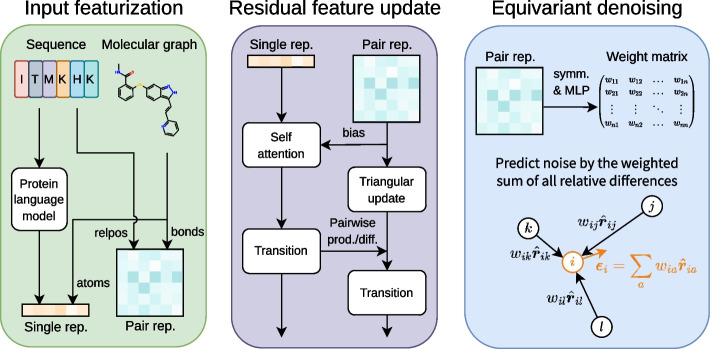
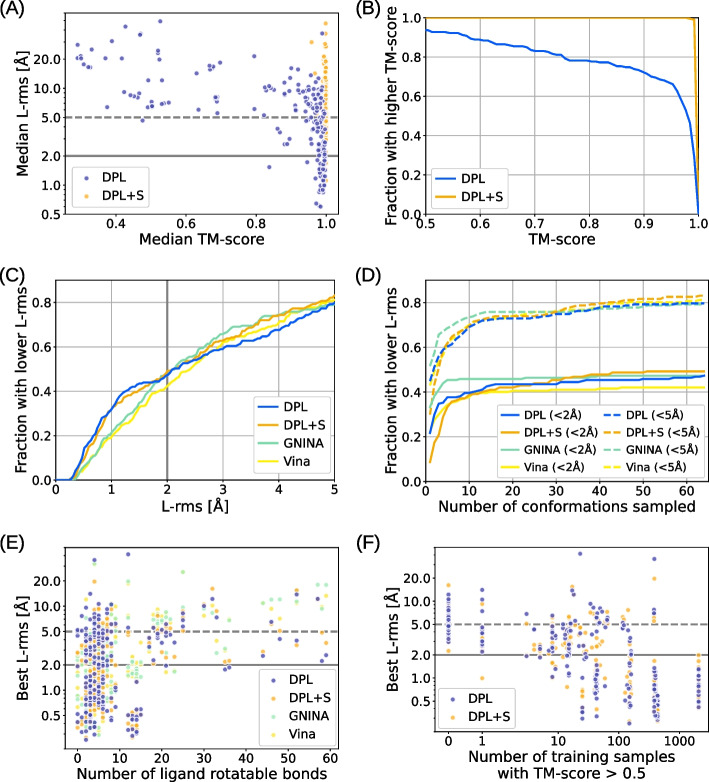
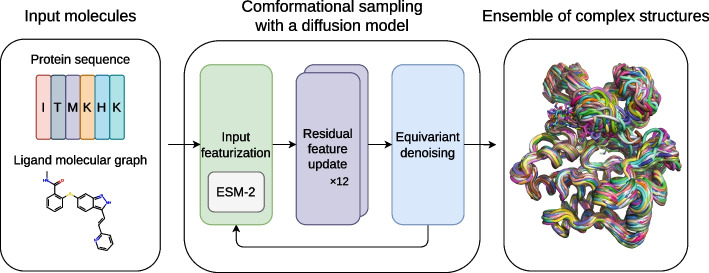
We introduce an equivariant diffusion-based generative model that learns the joint distribution of ligand and protein conformations conditioned on the molecular graph of a ligand and the sequence representation of a protein extracted from a pre-trained protein language model. Benchmark results show that this protein structure-free model is capable of generating diverse structures of protein-ligand complexes, including those with correct binding poses. Further analyses indicate that the proposed end-to-end approach is particularly effective when the ligand-bound protein structure is not available.

CONCLUSION

The present results demonstrate the effectiveness and generative capability of our end-to-end complex structure modeling framework with diffusion-based generative models. We suppose that this framework will lead to better modeling of protein-ligand complexes, and we expect further improvements and wide applications.

摘要

背景

蛋白质-配体复合物的三维结构提供了对其相互作用的有价值的见解,对于分子生物学研究和药物设计至关重要。然而,它们的高维性和多模态性质阻碍了端到端建模,早期的方法本质上依赖于现有的蛋白质结构。为了克服这些限制并扩大可以准确建模的复合物范围,有必要开发高效的端到端方法。

结果

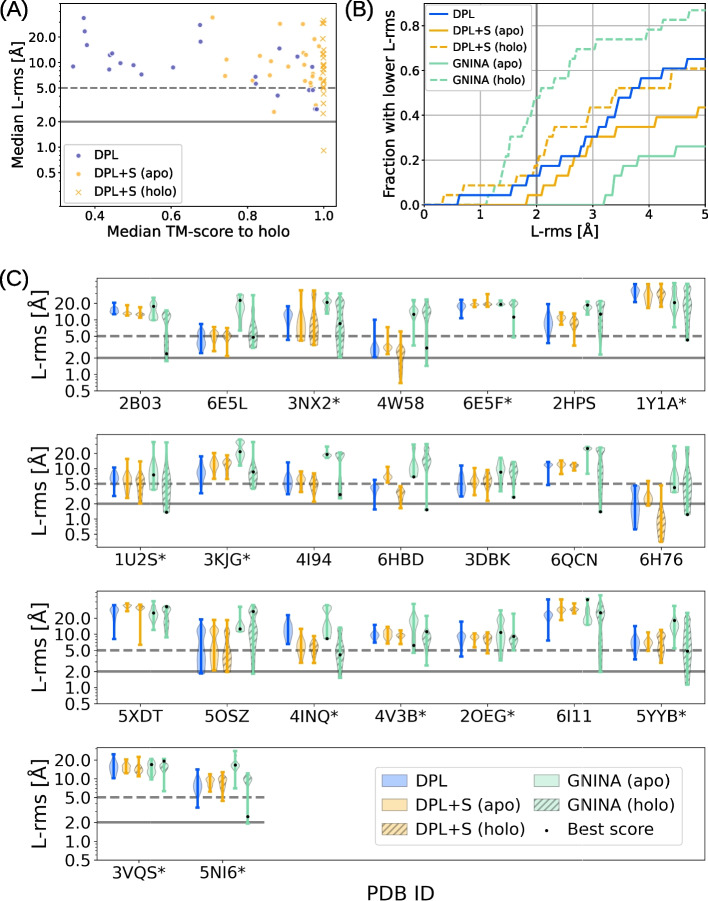
我们介绍了一种基于等变扩散的生成模型,该模型学习配体和蛋白质构象的联合分布,条件是配体的分子图和从预训练的蛋白质语言模型中提取的蛋白质序列表示。基准结果表明,这种无蛋白质结构的模型能够生成蛋白质-配体复合物的多种结构,包括具有正确结合构象的结构。进一步的分析表明,当配体结合的蛋白质结构不可用时,所提出的端到端方法特别有效。

结论

目前的结果表明,基于扩散的生成模型的端到端复合物结构建模框架具有有效性和生成能力。我们假设该框架将导致更好的蛋白质-配体复合物建模,我们期望进一步的改进和广泛的应用。
https://cdn.ncbi.nlm.nih.gov/pmc/blobs/b914/10240776/79e22bd7ec8b/12859_2023_5354_Fig7_HTML.jpg
https://cdn.ncbi.nlm.nih.gov/pmc/blobs/b914/10240776/1ef33c437269/12859_2023_5354_Fig1_HTML.jpg
https://cdn.ncbi.nlm.nih.gov/pmc/blobs/b914/10240776/df47ca404a24/12859_2023_5354_Fig2_HTML.jpg
https://cdn.ncbi.nlm.nih.gov/pmc/blobs/b914/10240776/5accc5144193/12859_2023_5354_Fig3_HTML.jpg
https://cdn.ncbi.nlm.nih.gov/pmc/blobs/b914/10240776/087687ed19fe/12859_2023_5354_Fig4_HTML.jpg
https://cdn.ncbi.nlm.nih.gov/pmc/blobs/b914/10240776/accea94ba143/12859_2023_5354_Fig5_HTML.jpg
https://cdn.ncbi.nlm.nih.gov/pmc/blobs/b914/10240776/33ef132823d6/12859_2023_5354_Fig6_HTML.jpg
https://cdn.ncbi.nlm.nih.gov/pmc/blobs/b914/10240776/79e22bd7ec8b/12859_2023_5354_Fig7_HTML.jpg
https://cdn.ncbi.nlm.nih.gov/pmc/blobs/b914/10240776/1ef33c437269/12859_2023_5354_Fig1_HTML.jpg
https://cdn.ncbi.nlm.nih.gov/pmc/blobs/b914/10240776/df47ca404a24/12859_2023_5354_Fig2_HTML.jpg
https://cdn.ncbi.nlm.nih.gov/pmc/blobs/b914/10240776/5accc5144193/12859_2023_5354_Fig3_HTML.jpg
https://cdn.ncbi.nlm.nih.gov/pmc/blobs/b914/10240776/087687ed19fe/12859_2023_5354_Fig4_HTML.jpg
https://cdn.ncbi.nlm.nih.gov/pmc/blobs/b914/10240776/accea94ba143/12859_2023_5354_Fig5_HTML.jpg
https://cdn.ncbi.nlm.nih.gov/pmc/blobs/b914/10240776/33ef132823d6/12859_2023_5354_Fig6_HTML.jpg
https://cdn.ncbi.nlm.nih.gov/pmc/blobs/b914/10240776/79e22bd7ec8b/12859_2023_5354_Fig7_HTML.jpg

相似文献

1
End-to-end protein-ligand complex structure generation with diffusion-based generative models.基于扩散模型的端到端蛋白质-配体复合物结构生成。
BMC Bioinformatics. 2023 Jun 5;24(1):233. doi: 10.1186/s12859-023-05354-5.
2
Molecule Design Using Molecular Generative Models Constrained by Ligand-Protein Interactions.基于配体-蛋白相互作用约束的分子生成模型的分子设计。
J Chem Inf Model. 2022 Jul 25;62(14):3291-3306. doi: 10.1021/acs.jcim.2c00177. Epub 2022 Jul 6.
3
PIDiff: Physics informed diffusion model for protein pocket-specific 3D molecular generation.PIDiff:用于蛋白质口袋特定 3D 分子生成的物理信息扩散模型。
Comput Biol Med. 2024 Sep;180:108865. doi: 10.1016/j.compbiomed.2024.108865. Epub 2024 Jul 26.
4
DynamicBind: predicting ligand-specific protein-ligand complex structure with a deep equivariant generative model.动态绑定:使用深度等变生成模型预测配体特异性蛋白质-配体复合物结构。
Nat Commun. 2024 Feb 5;15(1):1071. doi: 10.1038/s41467-024-45461-2.
5
Equivariant score-based generative diffusion framework for 3D molecules.基于等变得分的 3D 分子生成扩散框架。
BMC Bioinformatics. 2024 May 30;25(1):203. doi: 10.1186/s12859-024-05810-w.
6
Identification of ligand templates using local structure alignment for structure-based drug design.基于结构的药物设计中使用局部结构比对来鉴定配体模板。
J Chem Inf Model. 2012 Oct 22;52(10):2784-95. doi: 10.1021/ci300178e. Epub 2012 Sep 28.
7
Employing Molecular Conformations for Ligand-Based Virtual Screening with Equivariant Graph Neural Network and Deep Multiple Instance Learning.利用基于分子构象的等价图神经网络和深度多重实例学习进行配体虚拟筛选。
Molecules. 2023 Aug 9;28(16):5982. doi: 10.3390/molecules28165982.
8
From Target to Drug: Generative Modeling for the Multimodal Structure-Based Ligand Design.从靶点到药物:基于多模态结构的配体生成式设计。
Mol Pharm. 2019 Oct 7;16(10):4282-4291. doi: 10.1021/acs.molpharmaceut.9b00634. Epub 2019 Sep 10.
9
Incorporating backbone flexibility in MedusaDock improves ligand-binding pose prediction in the CSAR2011 docking benchmark.在 MedusaDock 中加入骨架柔性可以提高 CSAR2011 对接基准中的配体结合构象预测。
J Chem Inf Model. 2013 Aug 26;53(8):1871-9. doi: 10.1021/ci300478y. Epub 2012 Dec 24.
10
Generalized modeling of enzyme-ligand interactions using proteochemometrics and local protein substructures.使用蛋白质化学计量学和局部蛋白质亚结构对酶-配体相互作用进行广义建模。
Proteins. 2006 Nov 15;65(3):568-79. doi: 10.1002/prot.21163.

引用本文的文献

1
Alternative therapeutic approaches for combating multi-drug-resistant bacteria: Reverse vaccinology against Enterobacter cloacae.对抗多重耐药菌的替代治疗方法:针对阴沟肠杆菌的反向疫苗学
J Genet Eng Biotechnol. 2025 Sep;23(3):100519. doi: 10.1016/j.jgeb.2025.100519. Epub 2025 Jun 17.
2
AI meets physics in computational structure-based drug discovery for GPCRs.在基于计算结构的G蛋白偶联受体药物发现中,人工智能与物理学相遇。
NPJ Drug Discov. 2025;2(1):16. doi: 10.1038/s44386-025-00019-0. Epub 2025 Jul 3.
3
Protein structure prediction via deep learning: an in-depth review.

本文引用的文献

1
OpenFold: retraining AlphaFold2 yields new insights into its learning mechanisms and capacity for generalization.OpenFold:重新训练 AlphaFold2 可深入了解其学习机制和泛化能力。
Nat Methods. 2024 Aug;21(8):1514-1524. doi: 10.1038/s41592-024-02272-z. Epub 2024 May 14.
2
Evolutionary-scale prediction of atomic-level protein structure with a language model.用语言模型进行原子级蛋白质结构的进化尺度预测。
Science. 2023 Mar 17;379(6637):1123-1130. doi: 10.1126/science.ade2574. Epub 2023 Mar 16.
3
Predicting locations of cryptic pockets from single protein structures using the PocketMiner graph neural network.
基于深度学习的蛋白质结构预测:深入综述
Front Pharmacol. 2025 Apr 3;16:1498662. doi: 10.3389/fphar.2025.1498662. eCollection 2025.
4
CoDNet: controlled diffusion network for structure-based drug design.CoDNet:用于基于结构的药物设计的可控扩散网络。
Bioinform Adv. 2025 Feb 19;5(1):vbaf031. doi: 10.1093/bioadv/vbaf031. eCollection 2025.
5
ProteinReDiff: Complex-based ligand-binding proteins redesign by equivariant diffusion-based generative models.ProteinReDiff:基于等变扩散生成模型的基于复合物的配体结合蛋白重新设计
Struct Dyn. 2024 Nov 25;11(6):064102. doi: 10.1063/4.0000271. eCollection 2024 Nov.
6
Identification of Laccase Family of and Structural Prediction Using Alphafold.利用 AlphaFold 鉴定 漆酶家族并进行结构预测。
Int J Mol Sci. 2024 Nov 2;25(21):11784. doi: 10.3390/ijms252111784.
7
QuickBind: A Light-Weight And Interpretable Molecular Docking Model.快速绑定:一种轻量级且可解释的分子对接模型。
ArXiv. 2024 Oct 21:arXiv:2410.16474v1.
8
Sifting through the noise: A survey of diffusion probabilistic models and their applications to biomolecules.筛选噪音:扩散概率模型及其在生物分子中的应用综述
J Mol Biol. 2025 Mar 15;437(6):168818. doi: 10.1016/j.jmb.2024.168818. Epub 2024 Oct 9.
9
Diffusion Models in De Novo Drug Design.从头药物设计中的扩散模型。
J Chem Inf Model. 2024 Oct 14;64(19):7238-7256. doi: 10.1021/acs.jcim.4c01107. Epub 2024 Sep 25.
10
Sequence-Based Protein Design: A Review of Using Statistical Models to Characterize Coevolutionary Traits for Developing Hybrid Proteins as Genetic Sensors.基于序列的蛋白质设计:综述使用统计模型来描述共进化特征,以开发作为遗传传感器的杂交蛋白。
Int J Mol Sci. 2024 Jul 30;25(15):8320. doi: 10.3390/ijms25158320.
利用 PocketMiner 图神经网络从单个蛋白质结构预测隐匿口袋的位置。
Nat Commun. 2023 Mar 1;14(1):1177. doi: 10.1038/s41467-023-36699-3.
4
Critical assessment of methods of protein structure prediction (CASP)-Round XIV.蛋白质结构预测方法的关键性评估(CASP)-第十四轮。
Proteins. 2021 Dec;89(12):1607-1617. doi: 10.1002/prot.26237. Epub 2021 Oct 7.
5
Accurate prediction of protein structures and interactions using a three-track neural network.使用三轨神经网络准确预测蛋白质结构和相互作用。
Science. 2021 Aug 20;373(6557):871-876. doi: 10.1126/science.abj8754. Epub 2021 Jul 15.
6
AutoDock Vina 1.2.0: New Docking Methods, Expanded Force Field, and Python Bindings.AutoDock Vina 1.2.0:新的对接方法、扩展的力场及Python绑定
J Chem Inf Model. 2021 Aug 23;61(8):3891-3898. doi: 10.1021/acs.jcim.1c00203. Epub 2021 Jul 19.
7
Highly accurate protein structure prediction with AlphaFold.利用 AlphaFold 进行高精度蛋白质结构预测。
Nature. 2021 Aug;596(7873):583-589. doi: 10.1038/s41586-021-03819-2. Epub 2021 Jul 15.
8
GNINA 1.0: molecular docking with deep learning.GNINA 1.0:基于深度学习的分子对接
J Cheminform. 2021 Jun 9;13(1):43. doi: 10.1186/s13321-021-00522-2.
9
Improved protein structure prediction using predicted interresidue orientations.利用预测的残基间取向改进蛋白质结构预测。
Proc Natl Acad Sci U S A. 2020 Jan 21;117(3):1496-1503. doi: 10.1073/pnas.1914677117. Epub 2020 Jan 2.
10
Software for molecular docking: a review.分子对接软件综述
Biophys Rev. 2017 Apr;9(2):91-102. doi: 10.1007/s12551-016-0247-1. Epub 2017 Jan 16.