School of Health Sciences, Division of Nursing, Midwifery and Social Work, Manchester Academic Health Science Centre, University of Manchester, Manchester, M13 9PL, UK.
Department of Psychology, University of Sheffield, Sheffield, UK.
BMC Psychiatry. 2023 Jun 6;23(1):405. doi: 10.1186/s12888-023-04829-2.
The implementation of new and complex interventions in mental health settings can be challenging. This paper explores the use of a Theory of Change (ToC) for intervention design and evaluation to increase the likelihood of complex interventions being effective, sustainable, and scalable. Our intervention was developed to enhance the quality of psychological interventions delivered by telephone in primary care mental health services.
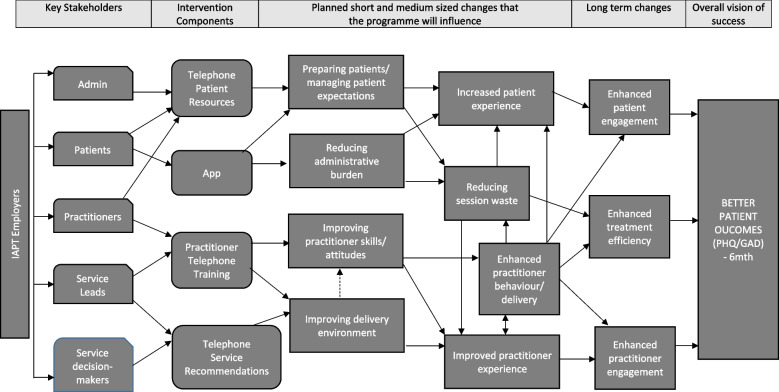
A ToC represents how our designed quality improvement intervention targeting changes at service, practitioner, and patient levels was expected to improve engagement in, and the quality of, telephone-delivered psychological therapies. The intervention was evaluated following implementation in a feasibility study within three NHS Talking Therapies services through a qualitative research design incorporating semi-structured interviews and a focus group with key stakeholders (patients, practitioners, and service leads) (N = 15). Data were analysed using the Consolidated Framework for Implementation Research (CFIR) and the ToC was examined and modified accordingly following the findings.
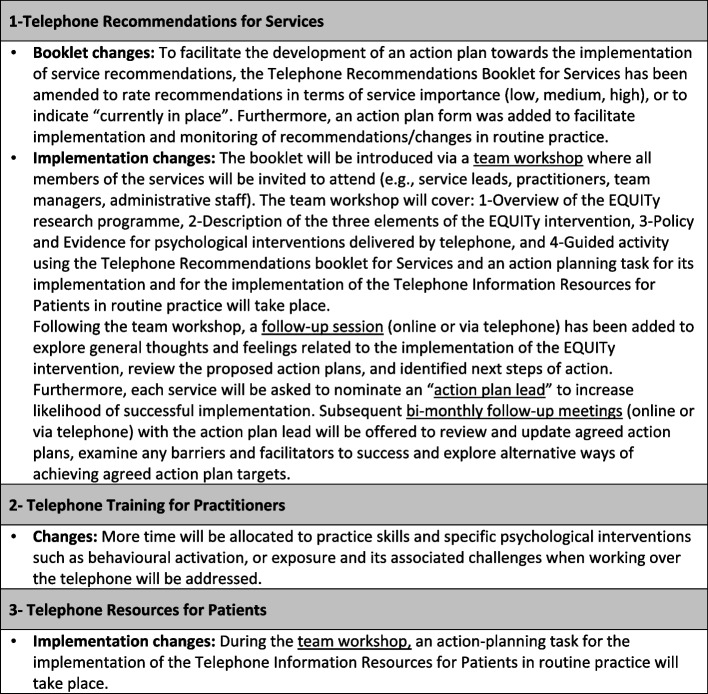
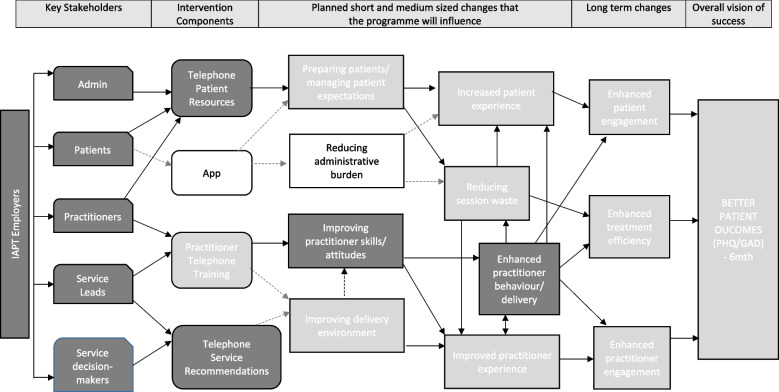
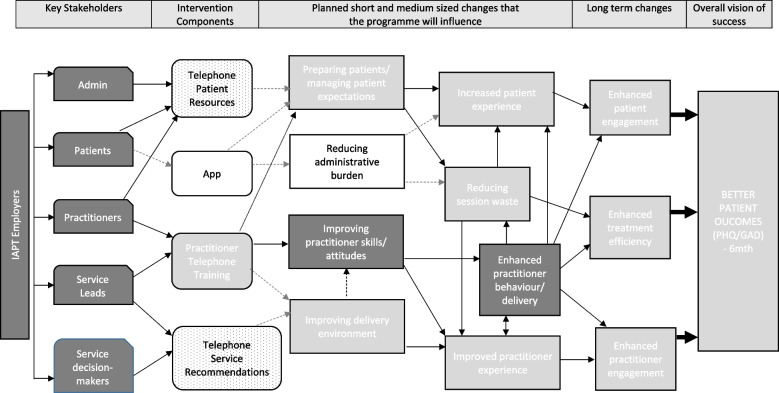
CFIR analysis highlighted a set of challenges encountered during the implementation of our service quality improvement telephone intervention that appeared to have weakened the contribution to the change mechanisms set out by the initial ToC. Findings informed changes to the intervention and refinement of the ToC and are expected to increase the likelihood of successful future implementation in a randomised controlled trial.
Four key recommendations that could help to optimise implementation of a complex intervention involving different key stakeholder groups in any setting were identified. These include: 1-developing a good understanding of the intervention and its value among those receiving the intervention; 2-maximising engagement from key stakeholders; 3-ensuring clear planning and communication of implementation goals; and 4-encouraging the use of strategies to monitor implementation progress.
在心理健康环境中实施新的和复杂的干预措施可能具有挑战性。本文探讨了使用变革理论(ToC)进行干预设计和评估,以提高复杂干预措施有效性、可持续性和可扩展性的方法。我们的干预措施旨在提高初级保健心理健康服务中通过电话提供的心理干预的质量。
变革理论代表了我们针对服务、从业者和患者层面的变化设计的质量改进干预措施,预计将如何改善电话提供的心理疗法的参与度和质量。该干预措施在 NHS 三种谈话疗法服务中的一项可行性研究中实施后,通过包含关键利益相关者(患者、从业者和服务负责人)的半结构化访谈和焦点小组的定性研究设计进行了评估(N=15)。使用实施研究综合框架(CFIR)对数据进行分析,并根据研究结果相应地检查和修改变革理论。
CFIR 分析突出了在实施我们的服务质量改进电话干预措施过程中遇到的一系列挑战,这些挑战似乎削弱了初始变革理论中设定的变革机制的贡献。研究结果为干预措施的改变和变革理论的改进提供了信息,并有望增加在随机对照试验中未来成功实施的可能性。
确定了四项可以帮助优化涉及任何环境中不同关键利益相关者群体的复杂干预措施实施的关键建议。这些建议包括:1. 让接受干预措施的人对干预措施及其价值有很好的理解;2. 最大限度地提高关键利益相关者的参与度;3. 确保明确规划和沟通实施目标;4. 鼓励使用策略来监测实施进展。