Nara Prefectural Health Research Center, Nara Medical University.
Chuwa Public Health Center of Nara Prefectural Government.
Environ Health Prev Med. 2023;28:35. doi: 10.1265/ehpm.23-00061.
Many previous studies have reported that COVID-19 vaccine effectiveness decreased over time and declined with newly emerging variants. However, there are few such studies in Japan. Using data from a community-based retrospective study, we aimed to assess the association between vaccination status and severe COVID-19 outcomes caused by the Omicron variant, considering the length of time since the last vaccination dose.
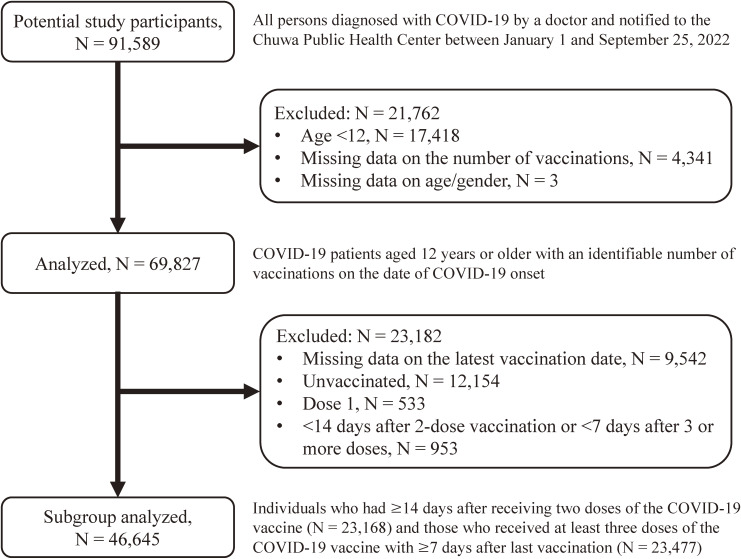
We included all persons aged ≥12 diagnosed with COVID-19 by a doctor and notified to the Chuwa Public Health Center of Nara Prefectural Government during the Omicron BA.1/BA.2 and BA.5-predominant periods in Japan (January 1 to September 25, 2022). The outcome variable was severe health consequences (SHC) (i.e., COVID-19-related hospitalization or death). The explanatory variable was vaccination status of the individuals (i.e., the number of vaccinations and length of time since last dose). Covariates included gender, age, risk factors for aggravation, and the number of hospital beds per population. Using the generalized estimating equations of the multivariable Poisson regression models, we estimated the cumulative incidence ratio (CIR) and 95% confidence interval (CI) for SHC, with stratified analyses by period (BA.1/BA.2 or BA.5) and age (65 and older or 12-64 years).
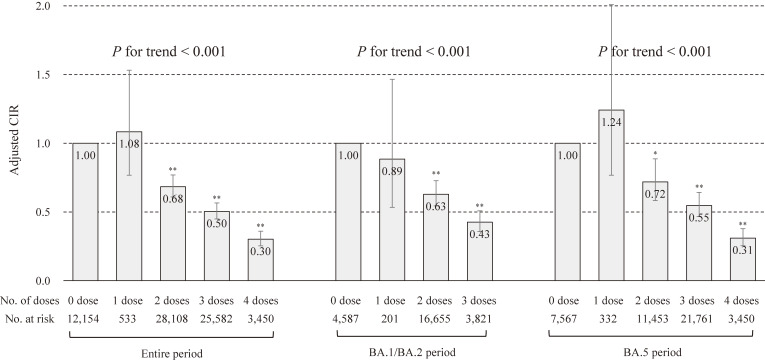
Of the 69,827 participants, 2,224 (3.2%) had SHC, 12,154 (17.4%) were unvaccinated, and 29,032 (41.6%) received ≥3 vaccine doses. Regardless of period or age, there was a significant dose-response relationship in which adjusted CIR for SHC decreased with an increased number of vaccinations and a longer time since the last vaccination. On the one hand, in the BA.5 period, those with ≥175 days after the third dose had no significant difference in people aged 65 and older (CIR 0.77; 95% CI, 0.53-1.12), but significantly lower CIR for SHC in people aged 12-64 (CIR 0.47; 95% CI, 0.26-0.84), compared with those with ≥14 days after the second dose.
A higher number of vaccinations were associated with lower risk of SHC against both BA.1/BA.2 and BA.5 sublineages. Our findings suggest that increasing the number of doses of COVID-19 vaccine can prevent severe COVID-19 outcomes, and that a biannual vaccination is recommended for older people.
许多先前的研究报告称,COVID-19 疫苗的有效性随时间推移而降低,并随着新出现的变异而下降。然而,在日本这样的研究很少。本研究使用基于社区的回顾性研究的数据,旨在考虑最后一次接种疫苗剂量的时间,评估接种状态与由奥密克戎变异株引起的严重 COVID-19 结局之间的关联。
我们纳入了在日本奥密克戎 BA.1/BA.2 和 BA.5 流行期间(2022 年 1 月 1 日至 9 月 25 日),由医生诊断并通知奈良县政府中央保健中心的所有 12 岁及以上的 COVID-19 患者。结局变量为严重健康后果(SHC)(即与 COVID-19 相关的住院或死亡)。个体的解释变量为接种状态(即接种次数和最后一次接种剂量后的时间)。协变量包括性别、年龄、加重风险因素和每人口的病床数。使用多变量泊松回归模型的广义估计方程,我们根据时期(BA.1/BA.2 或 BA.5)和年龄(65 岁及以上或 12-64 岁)进行分层分析,估计了 SHC 的累积发病率比(CIR)和 95%置信区间(CI)。
在 69827 名参与者中,2224 名(3.2%)发生 SHC,12154 名(17.4%)未接种疫苗,29032 名(41.6%)接种≥3 剂疫苗。无论时期或年龄如何,调整后的 CIR 与接种次数的增加和最后一次接种剂量后的时间延长呈显著剂量反应关系,即 SHC 的调整 CIR 随着接种次数的增加和最后一次接种剂量后的时间延长而降低。一方面,在 BA.5 流行期间,与第二剂接种后≥175 天相比,第三剂接种后≥175 天的 65 岁及以上人群中,SHC 的 CIR 无显著差异(CIR 0.77;95%CI,0.53-1.12),但 12-64 岁人群中 SHC 的 CIR 显著降低(CIR 0.47;95%CI,0.26-0.84)。
接种次数越多,发生 BA.1/BA.2 和 BA.5 亚系的 SHC 的风险越低。我们的研究结果表明,增加 COVID-19 疫苗的接种次数可以预防严重的 COVID-19 结局,建议老年人每半年接种一次疫苗。