Division of Infectious Diseases, Mayo Clinic, 200 First Street SW, Rochester, MN, 55905, USA.
Division of Nephrology and Hypertension, Mayo Clinic, MN, Rochester, USA.
BMC Nephrol. 2023 Jun 7;24(1):161. doi: 10.1186/s12882-023-03225-y.
Continuous kidney replacement therapy (CKRT) is an increasingly common intervention for critically ill patients with kidney failure. Because CKRT affects body temperature, detecting infections in patients on CKRT is challenging. Understanding the relation between CKRT and body temperature may facilitate earlier detection of infection.
We retrospectively reviewed adult patients (≥ 18 years) admitted to the intensive care unit at Mayo Clinic in Rochester, Minnesota, from December 1, 2006, through November 31, 2015, who required CKRT. We summarized central body temperatures for these patients according to the presence or absence of infection.
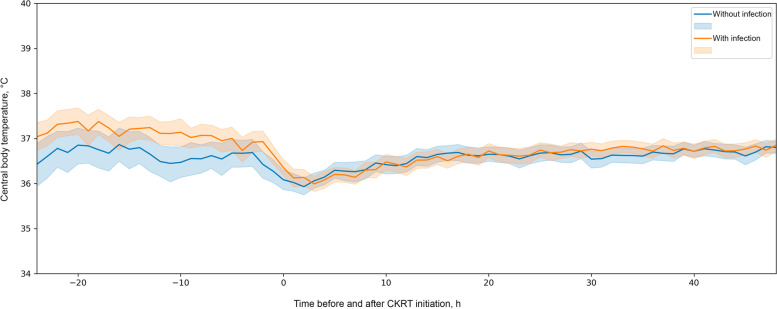
We identified 587 patients who underwent CKRT during the study period, of whom 365 had infections, and 222 did not have infections. We observed no statistically significant differences in minimum (P = .70), maximum (P = .22), or mean (P = .55) central body temperature for patients on CKRT with infection vs. those without infection. While not on CKRT (before CKRT initiation and after cessation), all three body temperature measurements were significantly higher in patients with infection than in those without infection (all P < .02).
Body temperature is insufficient to indicate an infection in critically ill patients on CKRT. Clinicians should remain watchful for other signs, symptoms, and indications of infection in patients on CKRT because of expected high infection rates.
连续性肾脏替代治疗(CKRT)是一种越来越常见的治疗肾衰竭重症患者的方法。由于 CKRT 会影响体温,因此在接受 CKRT 的患者中检测感染具有挑战性。了解 CKRT 与体温之间的关系可能有助于更早地发现感染。
我们回顾性分析了 2006 年 12 月 1 日至 2015 年 11 月 31 日期间在明尼苏达州罗切斯特市梅奥诊所重症监护病房接受 CKRT 的成年患者(≥18 岁)。我们根据患者是否存在感染,总结了这些患者的中心体温。
我们确定了在研究期间接受 CKRT 的 587 名患者,其中 365 名患者发生了感染,222 名患者没有感染。我们观察到,感染患者与无感染患者的 CKRT 期间的中心体温最低值(P=0.70)、最高值(P=0.22)和平均值(P=0.55)均无统计学差异。而在未接受 CKRT 时(在开始 CKRT 之前和停止 CKRT 之后),所有三种体温测量值在感染患者中均显著高于无感染患者(所有 P<0.02)。
在接受 CKRT 的重症患者中,体温不足以指示感染。由于预期感染率较高,临床医生应密切关注接受 CKRT 的患者的其他感染迹象、症状和指征。