Yuan Hang, Yuan Wenwen, Duan Sixuan, Jiao Keran, Zhang Quan, Lim Eng Gee, Chen Min, Zhao Chun, Pan Peng, Liu Xinyu, Song Pengfei
School of Advanced Technology, Xi'an Jiaotong - Liverpool University, Suzhou, China.
Department of Electrical and Electronic Engineering, University of Liverpool, Liverpool, UK.
Cyborg Bionic Syst. 2023 Apr 14;4:0011. doi: 10.34133/cbsystems.0011. eCollection 2023.
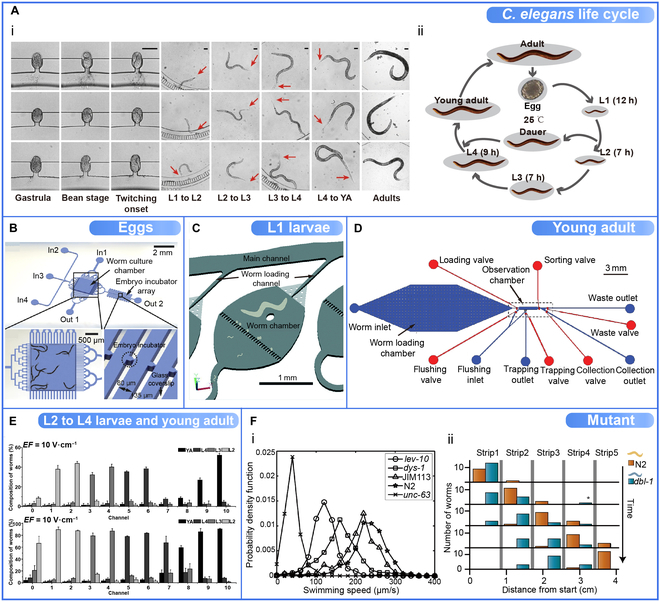
() has been a popular model organism for several decades since its first discovery of the huge research potential for modeling human diseases and genetics. Sorting is an important means of providing stage- or age-synchronized worm populations for many worm-based bioassays. However, conventional manual techniques for sorting are tedious and inefficient, and commercial complex object parametric analyzer and sorter is too expensive and bulky for most laboratories. Recently, the development of lab-on-a-chip (microfluidics) technology has greatly facilitated studies where large numbers of synchronized worm populations are required and advances of new designs, mechanisms, and automation algorithms. Most previous reviews have focused on the development of microfluidic devices but lacked the summaries and discussion of the biological research demands of , and are hard to read for worm researchers. We aim to comprehensively review the up-to-date microfluidic-assisted sorting developments from several angles to suit different background researchers, i.e., biologists and engineers. First, we highlighted the microfluidic sorting devices' advantages and limitations compared to the conventional commercialized worm sorting tools. Second, to benefit the engineers, we reviewed the current devices from the perspectives of active or passive sorting, sorting strategies, target populations, and sorting criteria. Third, to benefit the biologists, we reviewed the contributions of sorting to biological research. We expect, by providing this comprehensive review, that each researcher from this multidisciplinary community can effectively find the needed information and, in turn, facilitate future research.
自首次发现其在模拟人类疾病和遗传学方面具有巨大研究潜力以来的几十年里,(某生物)一直是一种广受欢迎的模式生物。分选是为许多基于该生物的生物测定提供阶段或年龄同步的虫群的重要手段。然而,传统的手动分选技术繁琐且效率低下,而商业用复杂物体参数分析仪和分选仪对大多数实验室来说过于昂贵且体积庞大。最近,芯片实验室(微流控)技术的发展极大地促进了需要大量同步虫群的研究,以及新设计、机制和自动化算法的进步。以前的大多数综述都集中在微流控装置的开发上,但缺乏对该生物的生物学研究需求的总结和讨论,对于研究该生物的研究人员来说也难以读懂。我们旨在从几个角度全面综述最新的微流控辅助分选进展,以适应不同背景的研究人员,即生物学家和工程师。首先,我们强调了与传统商业化虫分选工具相比,微流控分选装置的优点和局限性。其次,为了让工程师受益,我们从主动或被动分选、分选策略、目标群体和分选标准的角度综述了当前的装置。第三,为了让生物学家受益,我们综述了分选对生物学研究的贡献。我们期望,通过提供这一全面综述,这个多学科领域的每位研究人员都能有效地找到所需信息,进而促进未来的研究。