Shamanaev Aleksandr, Dickeson S Kent, Ivanov Ivan, Litvak Maxim, Sun Mao-Fu, Kumar Sunil, Cheng Quifang, Srivastava Priyanka, He Tracey Z, Gailani David
Department of Pathology, Microbiology and Immunology, Vanderbilt University Medical Center, Nashville, TN, United States.
Front Physiol. 2023 May 23;14:1146834. doi: 10.3389/fphys.2023.1146834. eCollection 2023.
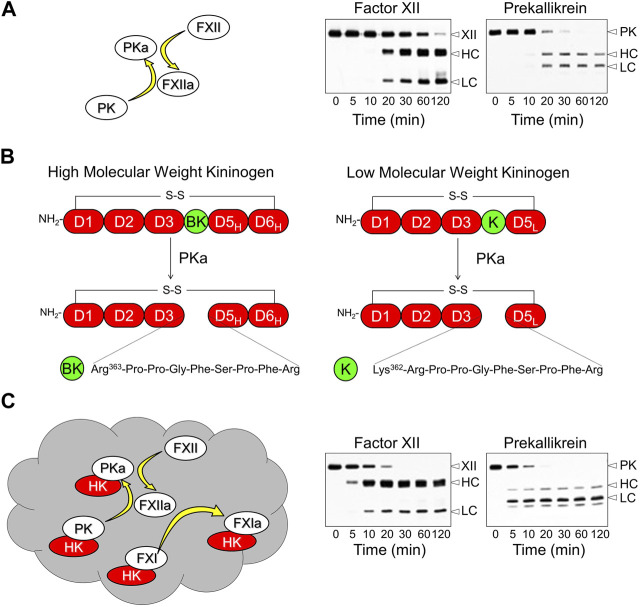
Patients with the inherited disorder hereditary angioedema (HAE) suffer from episodes of soft tissue swelling due to excessive bradykinin production. In most cases, dysregulation of the plasma kallikrein-kinin system due to deficiency of plasma C1 inhibitor is the underlying cause. However, at least 10% of HAE patients have normal plasma C1 inhibitor activity levels, indicating their syndrome is the result of other causes. Two mutations in plasma protease zymogens that appear causative for HAE with normal C1 inhibitor activity have been identified in multiple families. Both appear to alter protease activity in a gain-of-function manner. Lysine or arginine substitutions for threonine 309 in factor XII introduces a new protease cleavage site that results in formation of a truncated factor XII protein (Δ-factor XII) that accelerates kallikrein-kinin system activity. A glutamic acid substitution for lysine 311 in the fibrinolytic protein plasminogen creates a consensus binding site for lysine/arginine side chains. The plasmin form of the variant plasminogen cleaves plasma kininogens to release bradykinin directly, bypassing the kallikrein-kinin system. Here we review work on the mechanisms of action of the FXII-Lys/Arg and Plasminogen-Glu variants, and discuss the clinical implications of these mechanisms.
患有遗传性疾病遗传性血管性水肿(HAE)的患者,由于缓激肽产生过多,会出现软组织肿胀发作。在大多数情况下,血浆C1抑制剂缺乏导致血浆激肽释放酶-激肽系统失调是根本原因。然而,至少10%的HAE患者血浆C1抑制剂活性水平正常,这表明他们的综合征是由其他原因引起的。在多个家族中已鉴定出两种血浆蛋白酶原突变,这些突变似乎是导致C1抑制剂活性正常的HAE的原因。两者似乎都以功能获得的方式改变蛋白酶活性。因子XII中苏氨酸309被赖氨酸或精氨酸取代,会引入一个新的蛋白酶切割位点,导致形成截短的因子XII蛋白(Δ-因子XII),从而加速激肽释放酶-激肽系统的活性。纤溶蛋白纤溶酶原中赖氨酸311被谷氨酸取代,会形成一个赖氨酸/精氨酸侧链的共有结合位点。变体纤溶酶原的纤溶酶形式直接切割血浆激肽原以释放缓激肽,从而绕过激肽释放酶-激肽系统。在此,我们综述了FXII-Lys/Arg和纤溶酶原-Glu变体作用机制的研究工作,并讨论了这些机制的临床意义。