Department of Psychology, Education and Child Studies, Erasmus University Rotterdam, Burg. Oudlaan 50, 3062, Rotterdam, PA, the Netherlands.
Department of Child and Adolescent Psychiatry/Psychology, Erasmus MC, Rotterdam, the Netherlands.
Res Child Adolesc Psychopathol. 2023 Oct;51(10):1465-1480. doi: 10.1007/s10802-023-01091-8. Epub 2023 Jun 8.
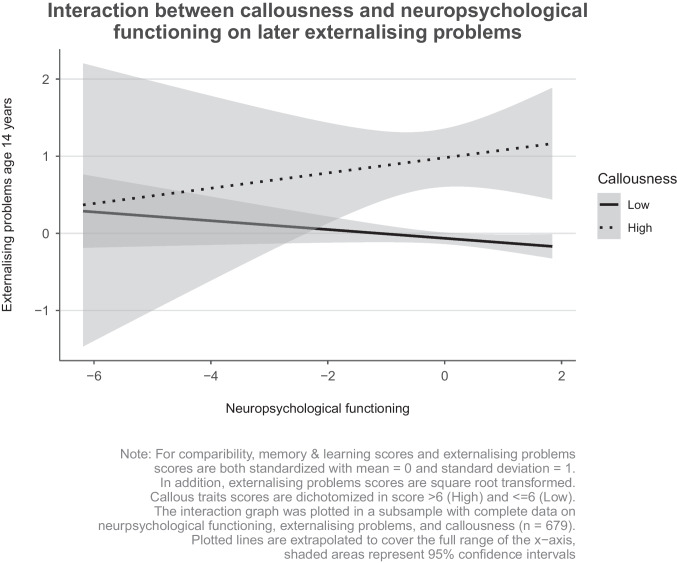
Externalizing problems are a key predictor of individual functioning in adulthood. Therefore, identifying possible risk factors for externalising problems is valuable for optimising prevention and treatment programmes. Previous research has shown that (domains of) neuropsychological functioning predict externalising problems later in life. However, the influence of callous traits, and sex as potential moderators in this relation remains unclear. The aim of this study was to examine associations between neuropsychological functioning in children (at age 8 years) and later externalising behaviour in adolescence (at age 14 years), as well as to test the role of callous traits (at age 10 years) and sex as moderating factors. The analyses were conducted using data from 661 Dutch children from the population-based Generation R Study (47.2% female). We found no association between neuropsychological functioning and later externalising behaviour. However, callous traits predicted externalising problems at age 14 years. Further, callous traits moderated the association between neuropsychological functioning and externalising behaviour, though this association dropped below the statistical significance level when adjusted for confounders. Specifically, while higher neuropsychological functioning was associated with more externalising behaviour in children with high callous traits, lower neuropsychological functioning was not associated with externalising behaviour in children with low callous traits. Although boys showed significantly higher externalising behaviours compared to girls, no moderating effect of sex was found on the association between neuropsychological functioning and externalising behaviour. These results add to a growing body of evidence supporting a distinct neurocognitive profile in children with high vs low callousness.
外化问题是个体成年后功能的一个关键预测指标。因此,确定外化问题的可能风险因素对于优化预防和治疗方案是有价值的。先前的研究表明,(神经认知功能的)领域预测了以后生活中外化问题的发生。然而,冷酷特质的影响以及性别作为这种关系的潜在调节因素仍不清楚。本研究旨在检验儿童(8 岁时)神经认知功能与青少年期(14 岁时)外化行为之间的关联,并测试冷酷特质(10 岁时)和性别作为调节因素的作用。分析使用了来自基于人群的 Generation R 研究的 661 名荷兰儿童的数据(47.2%为女性)。我们没有发现神经认知功能与以后的外化行为之间存在关联。然而,冷酷特质预测了 14 岁时的外化问题。此外,冷酷特质调节了神经认知功能与外化行为之间的关联,但在调整混杂因素后,这种关联降至统计学显著性水平以下。具体来说,虽然较高的神经认知功能与高冷酷特质儿童的更多外化行为相关,但在低冷酷特质儿童中,较低的神经认知功能与外化行为无关。尽管男孩的外化行为明显高于女孩,但没有发现性别对神经认知功能与外化行为之间关联的调节作用。这些结果增加了越来越多的证据,支持高冷酷特质与低冷酷特质儿童之间存在不同的神经认知特征。