Faculty of Medicine, Centre for Health Services Research, The University of Queensland, Brisbane, QLD, Australia.
Faculty of Medicine, The University of Queensland, Brisbane, QLD, Australia.
Qual Life Res. 2023 Oct;32(10):2911-2924. doi: 10.1007/s11136-023-03449-3. Epub 2023 Jun 8.
Australia's population is steadily growing older, with older persons expected to make up over 20% of the population by 2066. Ageing is strongly associated with a significant drop in cognitive ability, ranging from mild cognitive impairment to severe cognitive impairment (dementia). This study examined the association between cognitive impairment and health-related quality of life (HRQoL) in older Australians.
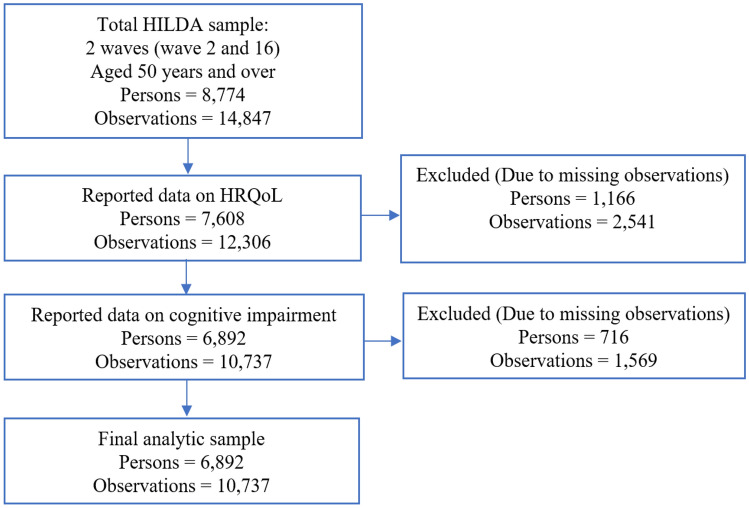
Two waves of longitudinal data from the nationally representative Household, Income and Labour Dynamics in Australia (HILDA) survey were utilised, with the age cut-off for older Australians defined as above 50. The final analysis included 10,737 person-year observations from 6892 unique individuals between 2012 and 2016. This study utilised the Backwards Digit Span (BDS) test and Symbol Digit Modalities test (SDMT) to assess cognitive function. HRQoL was measured using the physical and mental component summary scores of the SF-36 Health Survey (PCS and MCS). Additionally, HRQoL was measured using health state utility values (SF-6D score). A longitudinal random-effects GLS regression model was used to analyse the association between cognitive impairment and HRQoL.
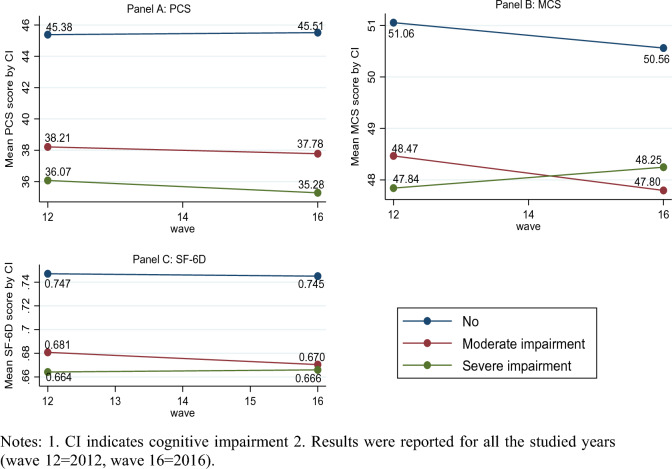
This study found that approximately 89% of Australian adults aged 50 or older had no cognitive impairment, 10.16% had moderate cognitive impairment, and 0.72% had severe cognitive impairment. This study also found that moderate and severe cognitive impairment were both negatively associated with HRQoL. Older Australians with moderate cognitive impairment scored worse on the PCS (β = - 1.765, SE = 0.317), MCS (β = - 1.612, SE = 0.326), and SF-6D (β = - 0.024, SE = 0.004) than peers without cognitive impairment given other covariates reference categories remain constant. Older adults experiencing severe cognitive had lower PCS (β = - 3.560, SE = 1.103), and SF-6D (β = - 0.034, SE = 0.012) scores compared to their counterparts with no cognitive impairment given other covariates reference categories remain constant.
We found evidence that HRQoL is negatively associated with cognitive impairment. Our findings will be beneficial for the future cost-effectiveness intervention targeted at reducing cognitive impairment since it provides information on the disutility associated with moderate and severe cognitive impairment.
澳大利亚的人口正稳步老龄化,预计到 2066 年,老年人将占总人口的 20%以上。随着年龄的增长,认知能力会显著下降,从轻度认知障碍到严重认知障碍(痴呆症)不等。本研究调查了澳大利亚老年人认知障碍与健康相关生活质量(HRQoL)之间的关系。
本研究使用了来自全国代表性的家庭、收入和劳动力动态调查(HILDA)的两波纵向数据,将澳大利亚老年人的年龄界定为 50 岁以上。最终分析包括了 2012 年至 2016 年期间,6892 名个体的 10737 人年观察结果。本研究使用了回溯数字跨度(BDS)测试和符号数字模态测试(SDMT)来评估认知功能。HRQoL 采用 SF-36 健康调查的身体和精神成分综合评分(PCS 和 MCS)进行衡量。此外,HRQoL 还采用健康状态效用值(SF-6D 评分)进行衡量。采用纵向随机效应 GLS 回归模型分析认知障碍与 HRQoL 之间的关系。
本研究发现,约 89%的澳大利亚 50 岁或以上的成年人没有认知障碍,10.16%有中度认知障碍,0.72%有严重认知障碍。本研究还发现,中度和重度认知障碍都与 HRQoL 呈负相关。与没有认知障碍的同龄人相比,有中度认知障碍的澳大利亚老年人在 PCS(β=-1.765,SE=0.317)、MCS(β=-1.612,SE=0.326)和 SF-6D(β=-0.024,SE=0.004)上的得分更差,前提是其他协变量参考类别保持不变。与没有认知障碍的同龄人相比,患有严重认知障碍的老年人的 PCS(β=-3.560,SE=1.103)和 SF-6D(β=-0.034,SE=0.012)得分更低,前提是其他协变量参考类别保持不变。
我们发现 HRQoL 与认知障碍呈负相关。我们的研究结果将对未来针对减少认知障碍的成本效益干预措施具有重要意义,因为它提供了与中度和重度认知障碍相关的不良效用的信息。