Division of Pulmonary and Critical Care Medicine and.
Program to Support People and Enhance Recovery and.
Ann Am Thorac Soc. 2023 Oct;20(10):1475-1482. doi: 10.1513/AnnalsATS.202301-025OC.
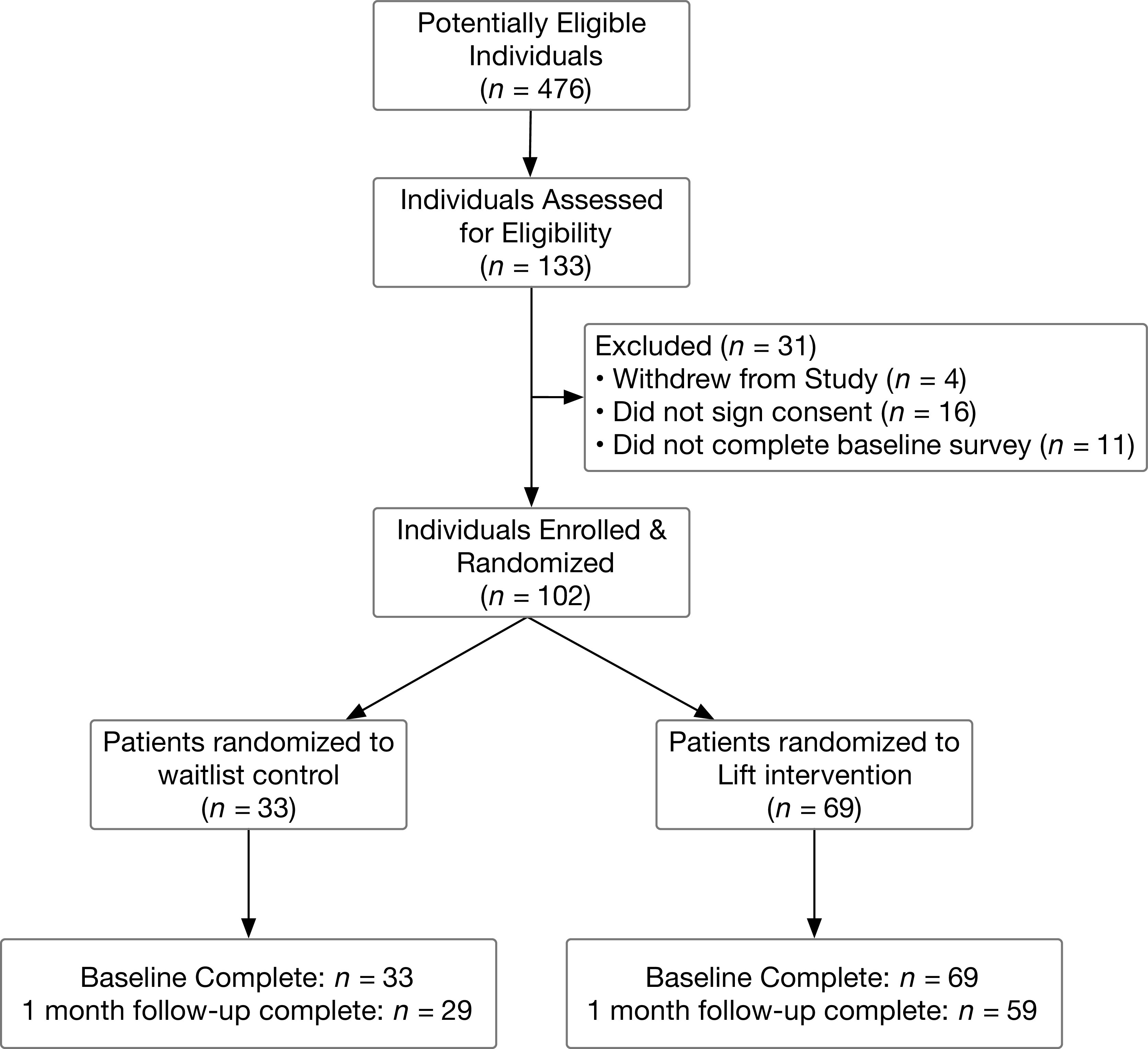
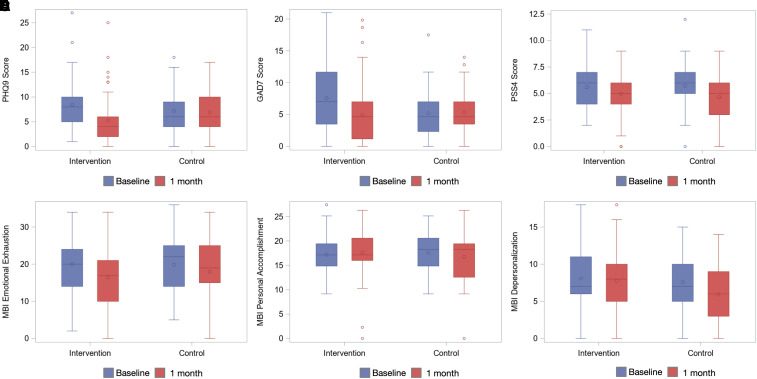
The coronavirus disease (COVID-19) pandemic exacerbated psychological distress and burnout in frontline healthcare workers. Interventions addressing psychological distress and burnout among these workers are lacking. To determine the feasibility and explore the impact of mobile mindfulness to treat psychological distress and burnout among nurses in frontline COVID-19 units. We conducted a pilot randomized trial of 102 nurses working in COVID-19 units at a single hospital between May 2021 and January 2022. Participants were randomized to mobile mindfulness (intervention) or waiting list (control). The primary outcome was feasibility, assessed by comparing rates of randomization, retention, and intervention completion to predefined targets. Secondary outcomes were changes in psychological distress (Patient Health Questionnaire-9, General Anxiety Disorder-7, Perceived Stress Scale-4) and burnout symptoms (Maslach Burnout Inventory) after 1 month. We randomized 102 of 113 consented individuals (90%, target 80%), and 88 completed follow-up (86%, target 80%). Among 69 intervention participants, 19 completed ⩾1 mindfulness session per week (28%, target 60%), and 13 completed ⩾75% of mindfulness sessions (19%, target 50%). Intervention participants had greater decreases in Patient Health Questionnaire-9 scores than control subjects (difference in differences, -2.21; 95% confidence interval, -3.99, -0.42; = 0.016), but the Maslach Burnout Inventory depersonalization scores decreased more in the control arm than in the intervention arm (difference in differences, 1.60; 95% confidence interval, 0.18, 3.02; = 0.027). There were no other changes in emotional distress or burnout symptoms. This trial of mobile mindfulness in frontline nurses met feasibility targets for randomization and retention, but participants had modest intervention use. Intervention participants had a reduction in depression symptoms, but not in burnout. Clinical trial registered with www.clinicaltrials.gov (NCT04816708).
新型冠状病毒病(COVID-19)大流行加剧了一线医护人员的心理困扰和倦怠。针对这些工作人员的心理困扰和倦怠问题,目前还缺乏干预措施。本研究旨在确定移动正念治疗一线 COVID-19 病房护士心理困扰和倦怠的可行性,并探讨其效果。
我们在 2021 年 5 月至 2022 年 1 月期间,在一家医院的 COVID-19 病房对 102 名护士进行了一项试点随机试验。参与者被随机分配到移动正念(干预)或候补名单(对照组)。主要结局是可行性,通过比较随机分组、保留和干预完成率与预定目标来评估。次要结局是在 1 个月后心理困扰(患者健康问卷-9 项、广泛性焦虑症-7 项、感知压力量表-4 项)和倦怠症状(马氏倦怠量表)的变化。
我们对 113 名同意参与的个体中的 102 名进行了随机分组(90%,目标 80%),其中 88 名完成了随访(86%,目标 80%)。在 69 名干预参与者中,有 19 名每周完成了 ⩾1 次正念课程(28%,目标 60%),有 13 名完成了 ⩾75%的正念课程(19%,目标 50%)。与对照组相比,干预组患者健康问卷-9 评分下降更大(差值,-2.21;95%置信区间,-3.99,-0.42; = 0.016),但对照组的马氏倦怠量表去人格化评分下降大于干预组(差值,1.60;95%置信区间,0.18,3.02; = 0.027)。其他情绪困扰或倦怠症状没有变化。
本研究中,一线护士的移动正念试验达到了随机分组和保留的可行性目标,但参与者的干预使用程度较低。干预组的抑郁症状有所减轻,但倦怠感没有减轻。该研究已在 www.clinicaltrials.gov(NCT04816708)注册。