Department of Urology, College of Medicine, University of Illinois at Chicago, Chicago, Illinois, United States of America.
Department of Epidemiology and Biostatistics, School of Public Health, University of Illinois at Chicago, Chicago, Illinois, United States of America.
PLoS One. 2020 Sep 3;15(9):e0238217. doi: 10.1371/journal.pone.0238217. eCollection 2020.
Healthcare professionals (HCPs) on the front lines against COVID-19 may face increased workload and stress. Understanding HCPs' risk for burnout is critical to supporting HCPs and maintaining the quality of healthcare during the pandemic.
To assess exposure, perceptions, workload, and possible burnout of HCPs during the COVID-19 pandemic we conducted a cross-sectional survey. The main outcomes and measures were HCPs' self-assessment of burnout, indicated by a single item measure of emotional exhaustion, and other experiences and attitudes associated with working during the COVID-19 pandemic.
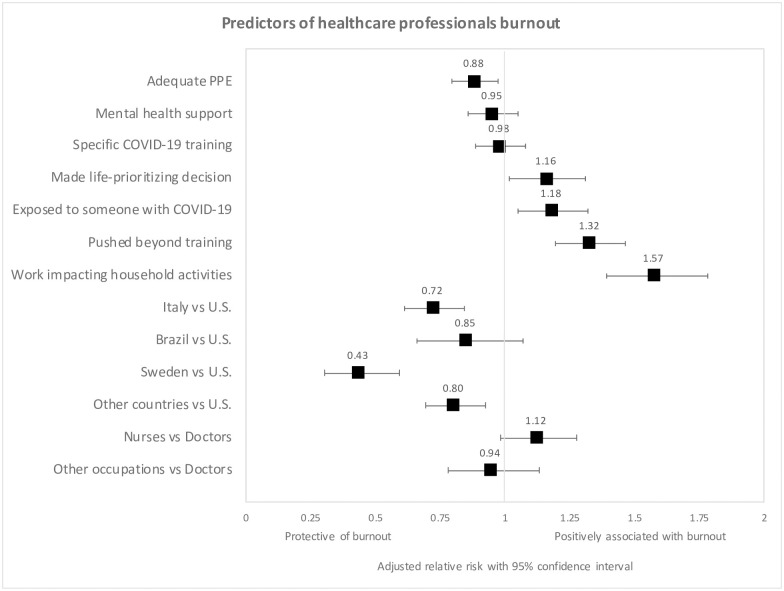
A total of 2,707 HCPs from 60 countries participated in this study. Fifty-one percent of HCPs reported burnout. Burnout was associated with work impacting household activities (RR = 1·57, 95% CI = 1·39-1·78, P<0·001), feeling pushed beyond training (RR = 1·32, 95% CI = 1·20-1·47, P<0·001), exposure to COVID-19 patients (RR = 1·18, 95% CI = 1·05-1·32, P = 0·005), and making life prioritizing decisions (RR = 1·16, 95% CI = 1·02-1·31, P = 0·03). Adequate personal protective equipment (PPE) was protective against burnout (RR = 0·88, 95% CI = 0·79-0·97, P = 0·01). Burnout was higher in high-income countries (HICs) compared to low- and middle-income countries (LMICs) (RR = 1·18; 95% CI = 1·02-1·36, P = 0·018).
Burnout is present at higher than previously reported rates among HCPs working during the COVID-19 pandemic and is related to high workload, job stress, and time pressure, and limited organizational support. Current and future burnout among HCPs could be mitigated by actions from healthcare institutions and other governmental and non-governmental stakeholders aimed at potentially modifiable factors, including providing additional training, organizational support, and support for family, PPE, and mental health resources.
抗击 COVID-19 的一线医护人员(HCPs)可能面临工作量增加和压力增大的问题。了解 HCPs 的倦怠风险对于支持 HCPs 并在大流行期间维持医疗保健质量至关重要。
为了评估 COVID-19 大流行期间 HCPs 的暴露、认知、工作量和可能的倦怠情况,我们进行了一项横断面调查。主要结局和测量指标是 HCPs 自我评估的倦怠程度,通过一项情绪耗竭的单一项目测量来表示,以及与 COVID-19 大流行期间工作相关的其他经历和态度。
共有来自 60 个国家的 2707 名 HCPs 参与了这项研究。51%的 HCPs 报告存在倦怠。倦怠与工作影响家庭活动(RR = 1.57,95%CI = 1.39-1.78,P<0.001)、感觉超出培训范围(RR = 1.32,95%CI = 1.20-1.47,P<0.001)、接触 COVID-19 患者(RR = 1.18,95%CI = 1.05-1.32,P = 0.005)和优先做出生活决策(RR = 1.16,95%CI = 1.02-1.31,P = 0.03)相关。充足的个人防护设备(PPE)可预防倦怠(RR = 0.88,95%CI = 0.79-0.97,P = 0.01)。与中低收入国家(LMICs)相比,高收入国家(HICs)的倦怠发生率更高(RR = 1.18;95%CI = 1.02-1.36,P = 0.018)。
在 COVID-19 大流行期间工作的 HCPs 中,倦怠的发生率高于先前报告的水平,与高工作量、工作压力和时间压力以及有限的组织支持有关。医疗机构和其他政府和非政府利益相关者可以采取行动,针对潜在可改变的因素,例如提供额外的培训、组织支持和家庭支持、PPE 和心理健康资源,从而减轻 HCPs 当前和未来的倦怠。