Collett George, Korszun Ania, Gupta Ajay K
William Harvey Research Institute, Queen Mary University of London, London, United Kingdom.
Wolfson Institute of Population Health, Queen Mary University of London, London, United Kingdom.
EClinicalMedicine. 2024 Apr 6;71:102562. doi: 10.1016/j.eclinm.2024.102562. eCollection 2024 May.
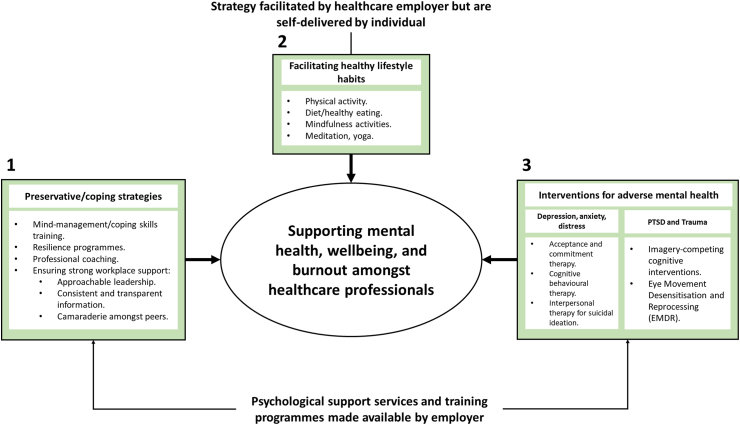
Healthcare professionals (HCPs) experienced prolonged stressful conditions during the coronavirus disease 2019 pandemic, and the global situation (particularly in the United Kingdom) meant that they continue to sustain mental stress related to the subsequent cost-of-living and healthcare budgeting crises. The psychological toll on HCPs may lead to increased staff attrition, adversely impacting the quality of patient care and work security. To help mitigate this psychological impact, the current evidence is strongly supportive of healthcare providers consistently adopting programmes fostering improvement in coping and resilience, facilitating healthy lifestyle, and allocating some resources for therapeutic strategies (e.g. cognitive behavioural therapy-based strategies and other strategies specified to trauma-related issues) which can be delivered by trained professionals. We stress that some approaches are not a one-size-fits-all strategy, and we also highlight the need to encourage treatment-seeking among those who need it. These strategies are highly relevant to healthcare employers and policymakers to support all HCPs in settings marked by prolonged periods of stress. The investment in these strategies are expected not only to reduce staff attrition in the long-term, but are likely to add to the cost-effectiveness of overall healthcare budgetary allocation.
在2019冠状病毒病大流行期间,医疗保健专业人员(HCPs)经历了长期的压力状况,而且全球形势(尤其是在英国)意味着他们继续承受与随后的生活成本和医疗预算危机相关的精神压力。对医疗保健专业人员的心理影响可能会导致员工流失增加,对患者护理质量和工作保障产生不利影响。为了帮助减轻这种心理影响,目前的证据有力地支持医疗保健提供者持续采用各种方案,促进应对能力和恢复力的提升,推动健康的生活方式,并为治疗策略(如基于认知行为疗法的策略和其他针对创伤相关问题的特定策略)分配一些资源,这些策略可由训练有素的专业人员提供。我们强调,有些方法并非适用于所有人的策略,我们还强调需要鼓励有需要的人寻求治疗。这些策略与医疗保健雇主和政策制定者高度相关,以支持长期处于压力环境中的所有医疗保健专业人员。对这些策略的投资预计不仅能长期减少员工流失,而且可能会提高整体医疗预算分配的成本效益。