Unidad de Infección Viral e Inmunidad, Centro Nacional de Microbiología, Instituto de Salud Carlos III, Majadahonda, Spain.
Unidad de Infección Viral e Inmunidad, Centro Nacional de Microbiología, Instituto de Salud Carlos III, Majadahonda, Spain; Centro de Investigación Biomédica en Red en Enfermedades Infecciosas (CIBERINFEC), Instituto de Salud Carlos III, Madrid, Spain; Servicio de Microbiología Clínica, Hospital Universitario Príncipe de Asturias, Madrid, Spain; Universidad de Alcalá, Facultad de Medicina, Departamento de Biomedicina y Biotecnología, Madrid, Spain.
Int J Infect Dis. 2023 Sep;134:126-132. doi: 10.1016/j.ijid.2023.06.001. Epub 2023 Jun 7.
We analyzed the expression of inflammatory and antiviral genes in the nasopharynx of SARS-CoV-2 infected patients and their association with the severity of COVID-19 pneumonia.
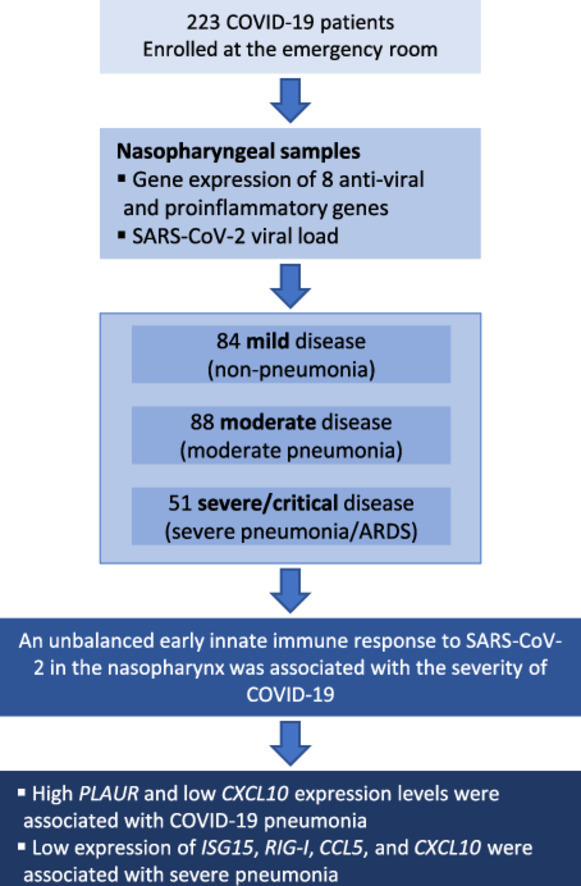
We conducted a cross-sectional study on 223 SARS-CoV-2 infected patients. Clinical data were collected from medical records, and nasopharyngeal samples were collected in the first 24 hours after admission to the emergency room. The gene expression of eight proinflammatory/antiviral genes (plasminogen activator urokinase receptor [PLAUR], interleukin [IL]-6, IL-8, interferon [IFN]-β, IFN-stimulated gene 15 [ISG15], retinoic acid-inducible gene I [RIG-I], C-C motif ligand 5 [CCL5], and chemokine C-X-C motif ligand 10 [CXCL10]) were quantified by real-time polymerase chain reaction. Outcome variables were: (i) pneumonia; (ii) severe pneumonia or acute respiratory distress syndrome. Statistical analysis was performed using multivariate logistic regression analyses.
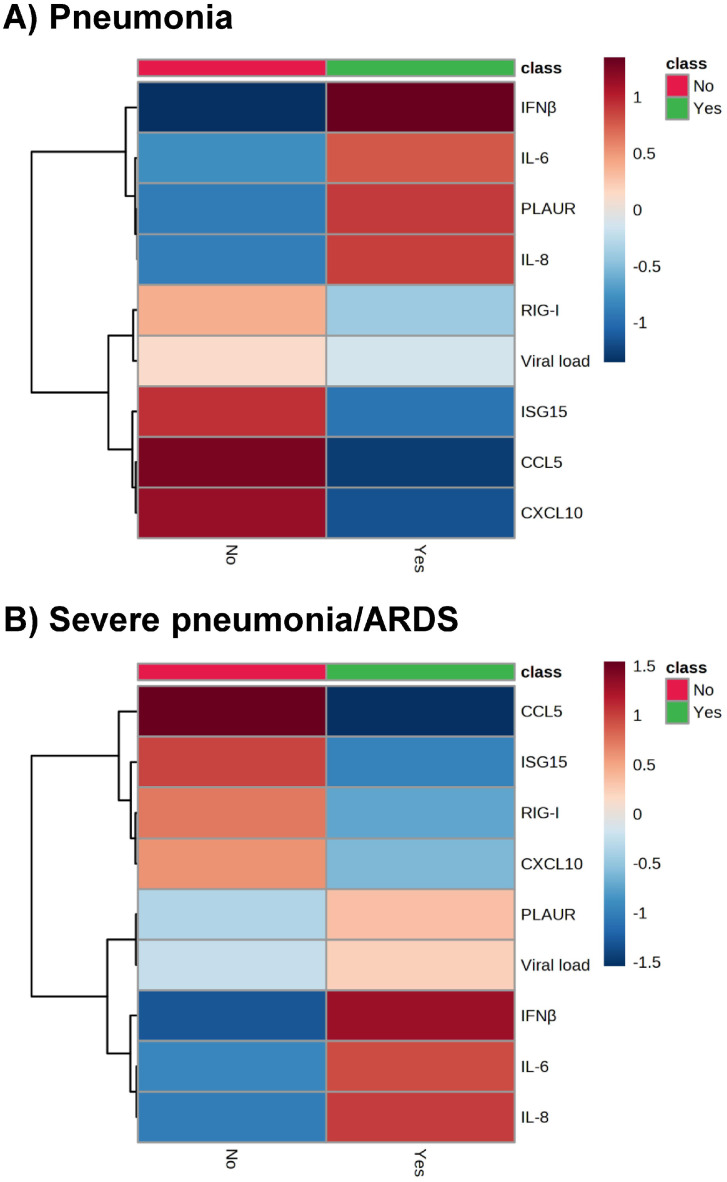
We enrolled 84 mild, 88 moderate, and 51 severe/critical cases. High expression of PLAUR (adjusted odds ratio [aOR] = 1.25; P = 0.032, risk factor) and low expression of CXCL10 (aOR = 0.89; P = 0.048, protective factor) were associated with pneumonia. Furthermore, lower values of ISG15 (aOR = 0.88, P = 0.021), RIG-I (aOR = 0.87, P = 0.034), CCL5 (aOR = 0.73, P <0.001), and CXCL10 (aOR = 0.84, P = 0.002) were risk factors for severe pneumonia/acute respiratory distress syndrome.
An unbalanced early innate immune response to SARS-CoV-2 in the nasopharynx, characterized by high expression of PLAUR and low expression of antiviral genes (ISG15 and RIG-I), and chemokines (CCL5 and CXCL10), was associated with COVID-19 severity.
我们分析了 SARS-CoV-2 感染患者鼻咽喉组织中炎症和抗病毒基因的表达情况,并探讨其与 COVID-19 肺炎严重程度的关系。
我们进行了一项横断面研究,共纳入 223 例 SARS-CoV-2 感染患者。临床资料来自病历,于急诊入院后 24 小时内采集鼻咽拭子。采用实时聚合酶链反应定量检测 8 种促炎/抗病毒基因(尿激酶型纤溶酶原激活物受体 [PLAUR]、白细胞介素 [IL]-6、IL-8、干扰素 [IFN]-β、IFN 刺激基因 15 [ISG15]、视黄酸诱导基因 I [RIG-I]、C-C 基序趋化因子配体 5 [CCL5]和趋化因子 C-X-C 基序配体 10 [CXCL10])的表达情况。主要结局指标为:(i)肺炎;(ii)重症肺炎或急性呼吸窘迫综合征。采用多变量逻辑回归分析进行统计学分析。
我们纳入了 84 例轻症、88 例中度和 51 例重症/危重症患者。PLAUR 高表达(调整后比值比 [aOR] 为 1.25,P=0.032,危险因素)和 CXCL10 低表达(aOR 为 0.89,P=0.048,保护因素)与肺炎相关。此外,ISG15(aOR 为 0.88,P=0.021)、RIG-I(aOR 为 0.87,P=0.034)、CCL5(aOR 为 0.73,P<0.001)和 CXCL10(aOR 为 0.84,P=0.002)低表达是重症肺炎/急性呼吸窘迫综合征的危险因素。
SARS-CoV-2 感染患者鼻咽喉组织中固有免疫应答失衡,表现为 PLAUR 高表达和抗病毒基因(ISG15 和 RIG-I)及趋化因子(CCL5 和 CXCL10)低表达,与 COVID-19 严重程度相关。