Graduate School of Health Management, Keio University, Fujisawa, Kanagawa, Japan.
Department of Community and Global Health, Graduate School of Medicine, The University of Tokyo, Bunkyo-ku, Tokyo, Japan.
BMJ Open. 2023 Jun 8;13(6):e072787. doi: 10.1136/bmjopen-2023-072787.
For adolescents and young adults, most health literacy research has been conducted in Western countries, but few studies have been conducted in the Eastern Mediterranean region (EMR). This review aimed to explore the existing health literacy research in the EMR in addition to the levels of health literacy and its associated factors among adolescents and young adults.
The search, conducted using the PubMed/MEDLINE, EBSCOhost/CINAHL plus, Web of Science and J-STAGE databases, was initially performed on 16 June 2022 and later updated on 1 October 2022. Studies that targeted 10-25 years old persons, conducted in any of the EMR countries and that used the health literacy concept and/or described its levels or predictors were included in the review. Content analysis was used for data extraction and analysis. Data related to the study methods, participants, outcome variables and health literacy were extracted.
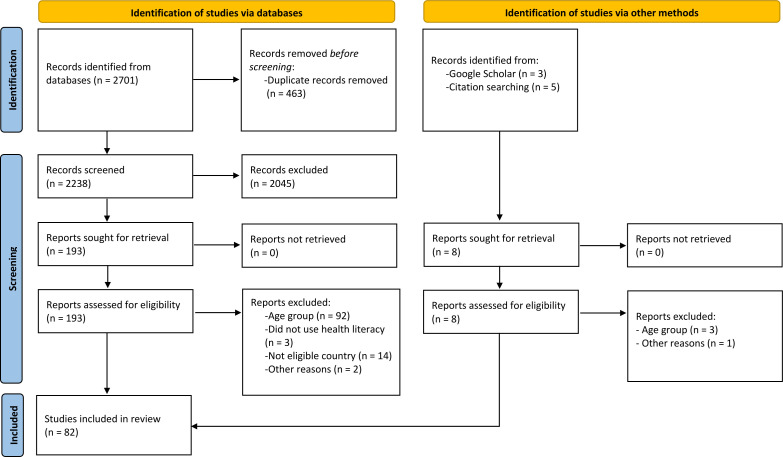
The review included 82 studies, most of which were conducted in Iran and Turkey and adopted a cross-sectional design. Half of the studies showed that more than half of adolescents and young adults had low or moderate health literacy. Nine studies applied university-based or school-based health education interventions to improve health literacy, which was also predicted by demographic and socioeconomic factors and internet usage. Little attention was paid to assessing the health literacy of vulnerable people, such as refugees and those with a disability and exposed to violence. Finally, various health literacy topics were investigated, including nutrition, non-communicable diseases, media and depression.
Health literacy levels were low-to-moderate in adolescents and young adults in the EMR. To promote health literacy, it is recommended to use school-based health education and attempt to reach adolescents and young adults through social media platforms. More attention should be paid to refugees, people with disabilities and those exposed to violence.
对于青少年和年轻人来说,大多数健康素养研究都是在西方国家进行的,但在东地中海地区(EMR)进行的研究很少。本综述旨在探讨 EMR 中现有的健康素养研究,以及青少年和年轻人的健康素养水平及其相关因素。
使用 PubMed/MEDLINE、EBSCOhost/CINAHL plus、Web of Science 和 J-STAGE 数据库进行初步搜索,时间为 2022 年 6 月 16 日,后于 2022 年 10 月 1 日更新。纳入针对 10-25 岁人群、在 EMR 国家进行、使用健康素养概念和/或描述其水平或预测因素的研究。采用内容分析法进行数据提取和分析。提取与研究方法、参与者、结果变量和健康素养相关的数据。
综述纳入 82 项研究,其中大多数研究在伊朗和土耳其进行,采用横断面设计。半数研究表明,超过一半的青少年和年轻人健康素养水平较低或中等。有 9 项研究采用基于大学或学校的健康教育干预措施来提高健康素养,这也受到人口统计学和社会经济因素以及互联网使用的预测。很少有研究关注评估弱势群体(如难民、残疾人和遭受暴力的人)的健康素养。最后,研究了各种健康素养主题,包括营养、非传染性疾病、媒体和抑郁。
EMR 地区青少年和年轻人的健康素养水平较低至中等。为了提高健康素养,建议采用基于学校的健康教育,并尝试通过社交媒体平台接触青少年和年轻人。应更多关注难民、残疾人和遭受暴力的人。