Faculty of Philosophy and Social Sciences, Nicolaus Copernicus University, Toruń, Poland.
Centre for Modern Interdisciplinary Technologies, Nicolaus Copernicus University, Toruń, Poland.
Psychopharmacology (Berl). 2023 Jul;240(7):1601-1614. doi: 10.1007/s00213-023-06394-8. Epub 2023 Jun 9.
Psychedelics are getting closer to being widely used in clinical treatment. Music is known as a key element of psychedelic-assisted therapy due to its psychological effects, specifically on the emotion, meaning-making, and sensory processing. However, there is still a lack of understanding in how psychedelics influence brain activity in experimental settings involving music listening.
The main goal of our research was to investigate the effect of music, as a part of "setting," on the brain states dynamics after lysergic acid diethylamide (LSD) intake.
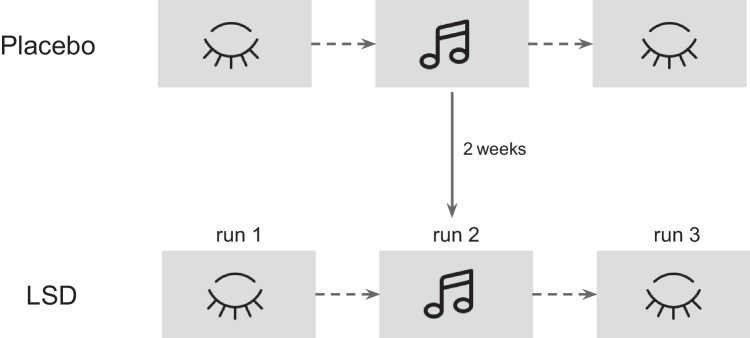
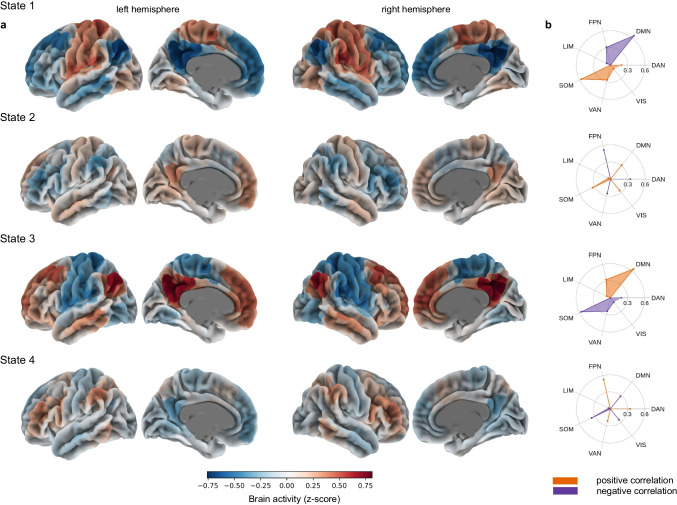
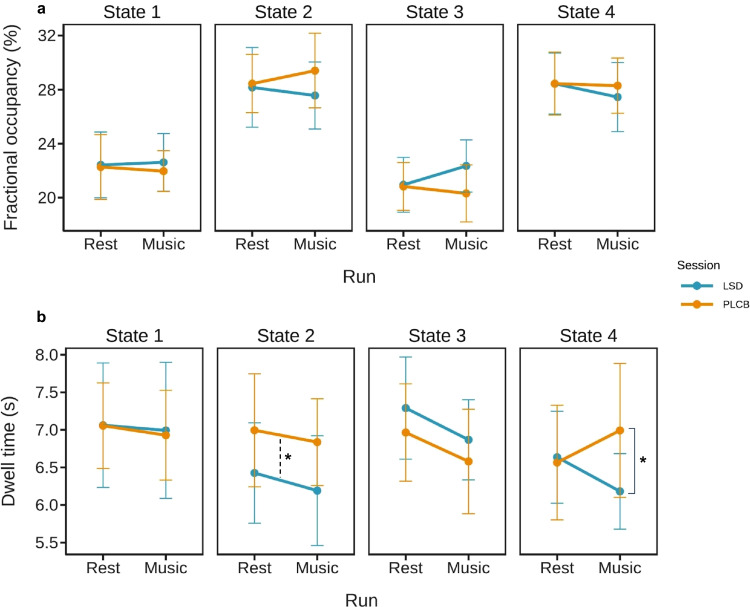
We used an open dataset, where a group of 15 participants underwent two functional MRI scanning sessions under LSD and placebo influence. Every scanning session contained three runs: two resting-state runs separated by one run with music listening. We applied K-Means clustering to identify the repetitive patterns of brain activity, so-called brain states. For further analysis, we calculated states' dwell time, fractional occupancy and transition probability.
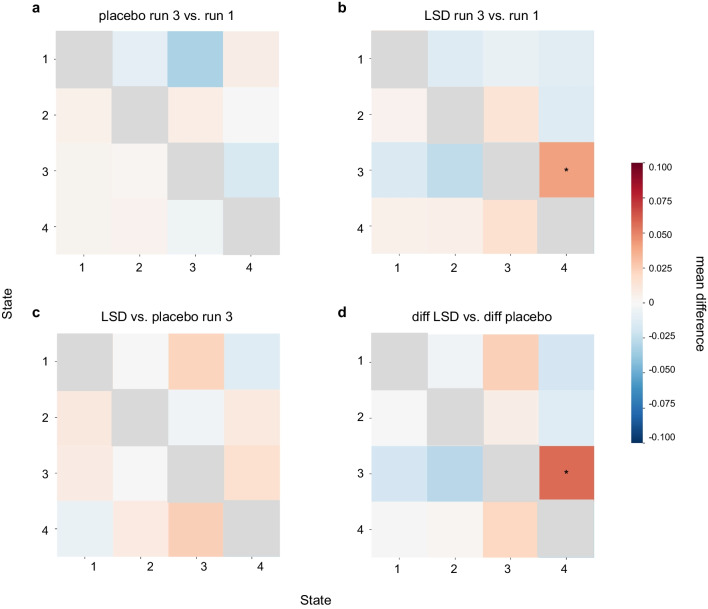
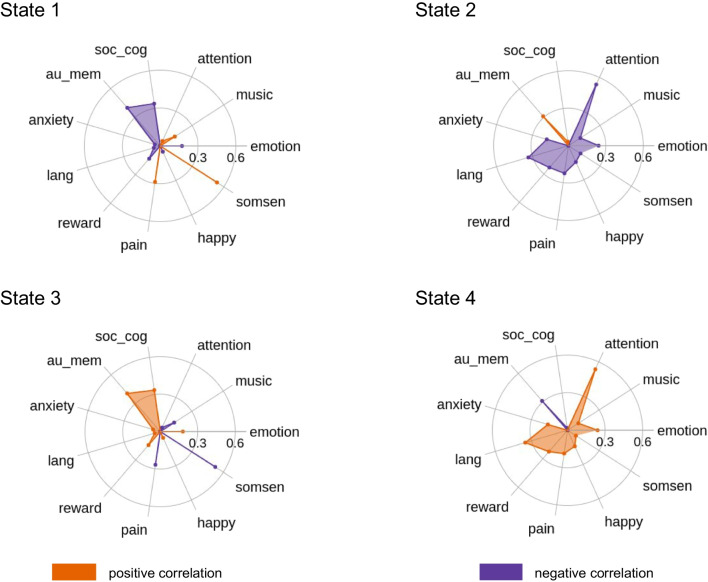
The interaction effect of music and psychedelics led to change in the time-varying brain activity of the task-positive state. LSD, regardless of the music, affected the dynamics of the state of combined activity of DMN, SOM, and VIS networks. Crucially, we observed that the music itself could potentially have a long-term influence on the resting-state, in particular on states involving task-positive networks.
This study indicates that music, as a crucial element of "setting," can potentially have an influence on the subject's resting-state during psychedelic experience. Further studies should replicate these results on a larger sample size.
迷幻剂在临床治疗中的应用越来越广泛。音乐因其对情绪、意义构建和感官处理的心理影响,被认为是迷幻辅助治疗的关键元素之一。然而,在涉及音乐聆听的实验设置中,迷幻剂如何影响大脑活动,人们对此仍缺乏了解。
我们研究的主要目的是调查音乐(作为“设置”的一部分)对 LSD 摄入后大脑状态动力学的影响。
我们使用了一个公开数据集,其中 15 名参与者在 LSD 和安慰剂的影响下进行了两次功能磁共振扫描。每个扫描会话包含三个运行:两个静息态运行,由一个音乐聆听运行隔开。我们应用 K-Means 聚类来识别大脑活动的重复模式,即所谓的大脑状态。为了进一步分析,我们计算了状态的停留时间、分数占用率和转换概率。
音乐和迷幻剂的相互作用导致了任务正性状态的时变大脑活动的变化。无论是否有音乐,LSD 都影响了 DMN、SOM 和 VIS 网络的综合活动状态的动力学。重要的是,我们观察到音乐本身可能对静息状态产生潜在的长期影响,特别是在涉及任务正性网络的状态中。
这项研究表明,音乐作为“设置”的关键元素,可能对迷幻体验期间个体的静息状态产生影响。需要进一步的研究在更大的样本量上复制这些结果。