Department of Neuroscience, Perelman School of Medicine, Philadelphia, PA, 19104, USA.
Department of Bioengineering, School of Engineering & Applied Science, Philadelphia, PA, 19104, USA.
Commun Biol. 2020 May 22;3(1):261. doi: 10.1038/s42003-020-0961-x.
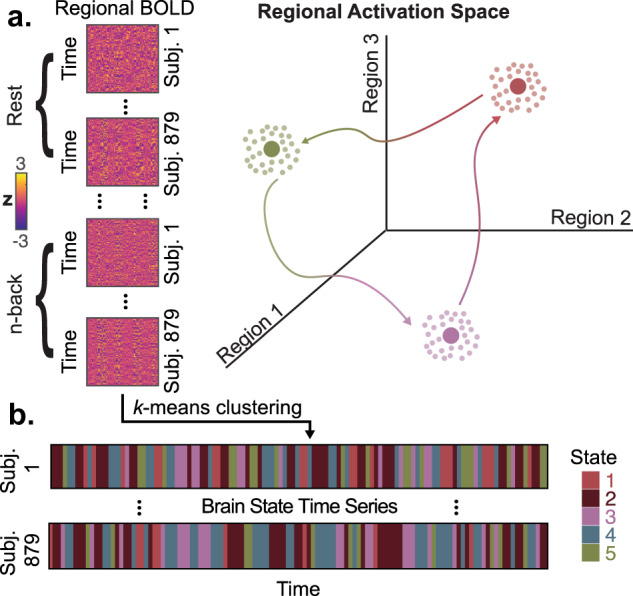
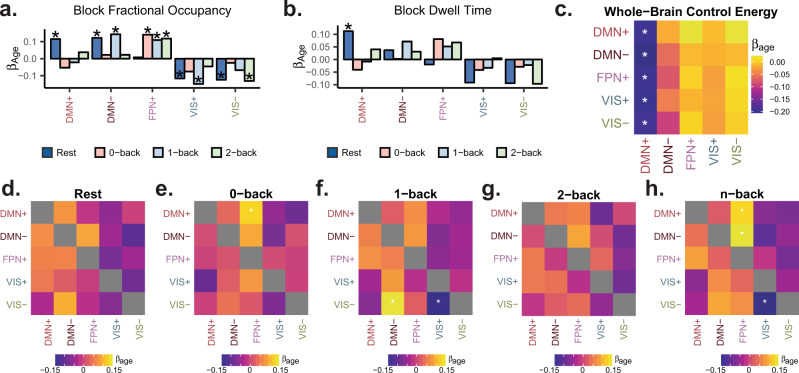
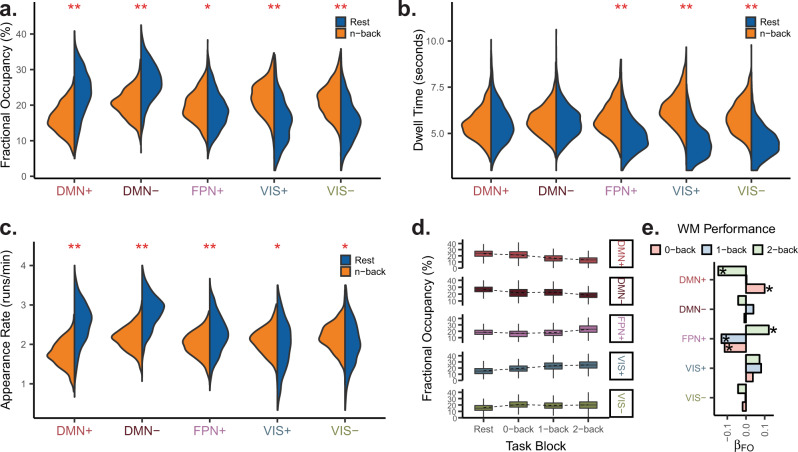
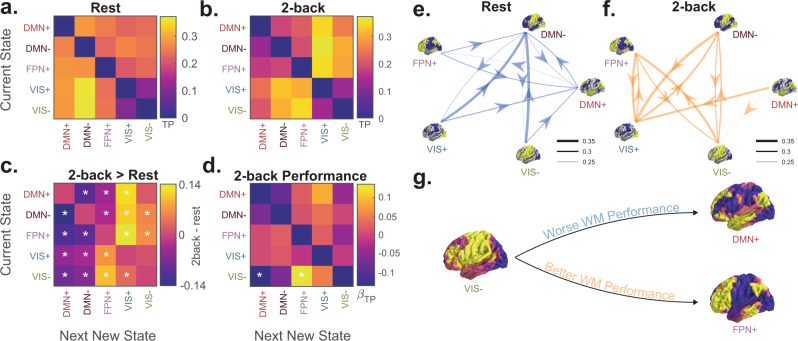
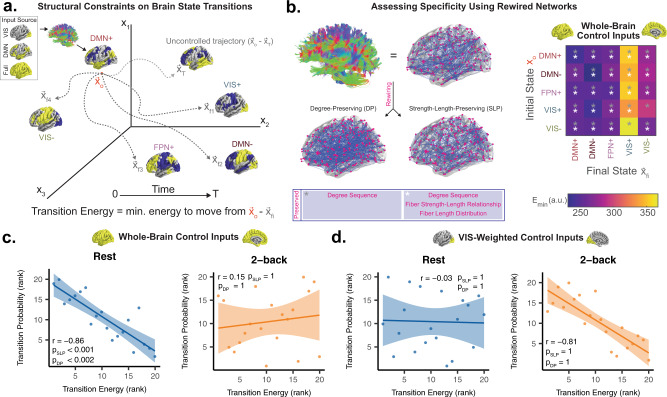
A diverse set of white matter connections supports seamless transitions between cognitive states. However, it remains unclear how these connections guide the temporal progression of large-scale brain activity patterns in different cognitive states. Here, we analyze the brain's trajectories across a set of single time point activity patterns from functional magnetic resonance imaging data acquired during the resting state and an n-back working memory task. We find that specific temporal sequences of brain activity are modulated by cognitive load, associated with age, and related to task performance. Using diffusion-weighted imaging acquired from the same subjects, we apply tools from network control theory to show that linear spread of activity along white matter connections constrains the probabilities of these sequences at rest, while stimulus-driven visual inputs explain the sequences observed during the n-back task. Overall, these results elucidate the structural underpinnings of cognitively and developmentally relevant spatiotemporal brain dynamics.
一组多样化的白质连接支持认知状态之间的无缝转换。然而,目前尚不清楚这些连接如何引导不同认知状态下大规模脑活动模式的时间进程。在这里,我们分析了从静息状态和 n 回工作记忆任务获得的功能磁共振成像数据中单个时间点活动模式集合的大脑轨迹。我们发现,脑活动的特定时间序列受认知负荷调节,与年龄相关,并与任务表现相关。使用从同一受试者获得的扩散加权成像,我们应用网络控制理论的工具来表明,活动沿着白质连接的线性传播限制了这些序列在静息状态下的概率,而刺激驱动的视觉输入解释了在 n 回任务中观察到的序列。总的来说,这些结果阐明了与认知和发育相关的时空大脑动力学的结构基础。