Borba Luis A B, Passos Gustavo, Oliveira Irlon
Department of Neurosurgery, Hospital Universitário Evangelico de Curitiba, Curitiba, Parana, Brazil.
Surg Neurol Int. 2023 May 26;14:183. doi: 10.25259/SNI_52_2023. eCollection 2023.
Gliomas are the most common primary malignant neoplasms of the central nervous system and their characteristic genetic heterogeneity implies in a prominent complexity in their management. The definition of the genetic/molecular profile of gliomas is currently essential for the classification of the disease, prognosis, choice of treatment, and it is still dependent on surgical biopsies, which in many cases become unfeasible. Liquid biopsy with detection and analysis of biomarkers such as deoxyribonucleic acid (DNA) and ribonucleic acid (RNA) from the tumor and circulating in the bloodstream or cerebrospinal fluid (CSF) has emerged as a minimally invasive alternative to aid in diagnosis, follow-up, and response to treatment of gliomas.
Through a systematic search in the PubMed MEDLINE, Cochrane Library, and Embase databases, we reviewed the evidence on the use of liquid biopsy to detect tumor DNA/RNA in the CSF of patients diagnosed with central nervous system gliomas.
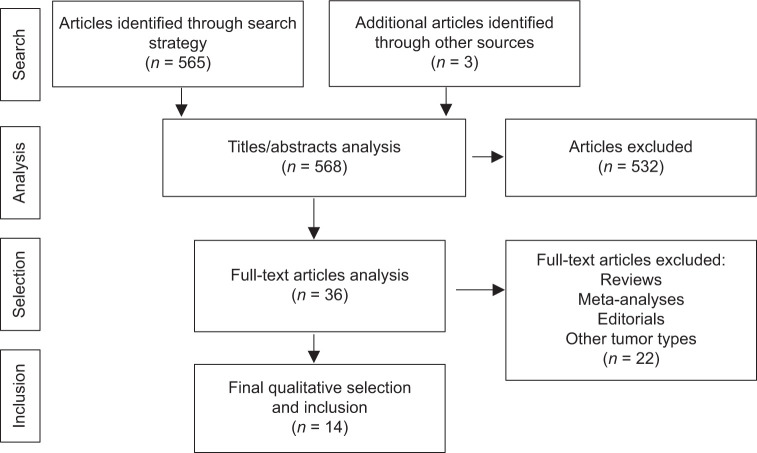
After a systematic review applying all inclusion and exclusion criteria, as well as a double review by independent authors, 14 studies specifically addressing the detection of tumor DNA/RNA in the CSF of patients diagnosed with central nervous system glioma were selected in the final analysis.
Sensitivity and specificity of liquid biopsy in CSF are still very variable depending on factors such as the diagnostic method, collection timing, biomarker (DNA and RNA), tumor type, extension and volume of the tumor, collection method, and contiguity from neoplasm to CSF. Despite the technical limitations that still exist and prevent the routine and validated use of liquid biopsy in CSF, the growing number of studies around the world is increasingly improving this technic, resulting in promising prospects for its use in diagnosis, evolutionary follow-up, and response to the treatment of complex diseases such as central nervous system gliomas.
胶质瘤是中枢神经系统最常见的原发性恶性肿瘤,其特征性的基因异质性意味着其治疗极具复杂性。目前,胶质瘤的基因/分子特征定义对于疾病分类、预后评估、治疗选择至关重要,且仍依赖手术活检,但在许多情况下这并不可行。液体活检通过检测和分析来自肿瘤并在血液或脑脊液(CSF)中循环的生物标志物,如脱氧核糖核酸(DNA)和核糖核酸(RNA),已成为一种微创替代方法,有助于胶质瘤的诊断、随访及治疗反应评估。
通过在PubMed MEDLINE、Cochrane图书馆和Embase数据库中进行系统检索,我们回顾了关于使用液体活检检测中枢神经系统胶质瘤患者脑脊液中肿瘤DNA/RNA的证据。
在应用所有纳入和排除标准进行系统综述以及由独立作者进行双重审查后,最终分析中选择了14项专门针对检测中枢神经系统胶质瘤患者脑脊液中肿瘤DNA/RNA的研究。
脑脊液液体活检的敏感性和特异性仍因多种因素而差异很大,这些因素包括诊断方法、采集时间、生物标志物(DNA和RNA)、肿瘤类型、肿瘤范围和体积、采集方法以及肿瘤与脑脊液的接近程度。尽管仍然存在技术限制,阻碍了脑脊液液体活检的常规和有效应用,但全球越来越多的研究正在不断改进这项技术,使其在中枢神经系统胶质瘤等复杂疾病的诊断、病情进展随访及治疗反应评估方面具有广阔的应用前景。