Ganmaa Davaasambuu, Khudyakov Polyna, Buyanjargal Uyanga, Tserenkhuu Enkhtsetseg, Erdenenbaatar Sumiya, Achtai Chuluun-Erdene, Yansan Narankhuu, Delgererekh Baigal, Ankhbat Munkhzaya, Tsendjav Enkhjargal, Ochirbat Batbayar, Jargalsaikhan Badamtsetseg, Davaasambuu Enkhmaa, Martineau Adrian R
Channing Division of Network Medicine, Brigham and Women's Hospital, Harvard Medical School, Boston, MA 02115, USA.
Harvard T.H. Chan School of Public Health, Boston, MA 02115, USA.
medRxiv. 2023 May 19:2023.05.18.23290181. doi: 10.1101/2023.05.18.23290181.
Randomized controlled trials (RCT) of vitamin D supplementation to reduce fracture risk in children are lacking.
We conducted a Phase 3 RCT of weekly oral supplementation with 14,000 IU vitamin D for 3 years in Mongolian schoolchildren aged 6-13 years. Serum 25-hydroxyvitamin D (25[OH]D) concentrations and the proportion of participants reporting ≥1 fracture were secondary outcomes for the main trial. Radial bone mineral density (BMD) was assessed in a nested sub-study, with serum concentrations of parathyroid hormone (PTH) and bone-specific alkaline phosphatase (BALP) determined in a subset of participants.
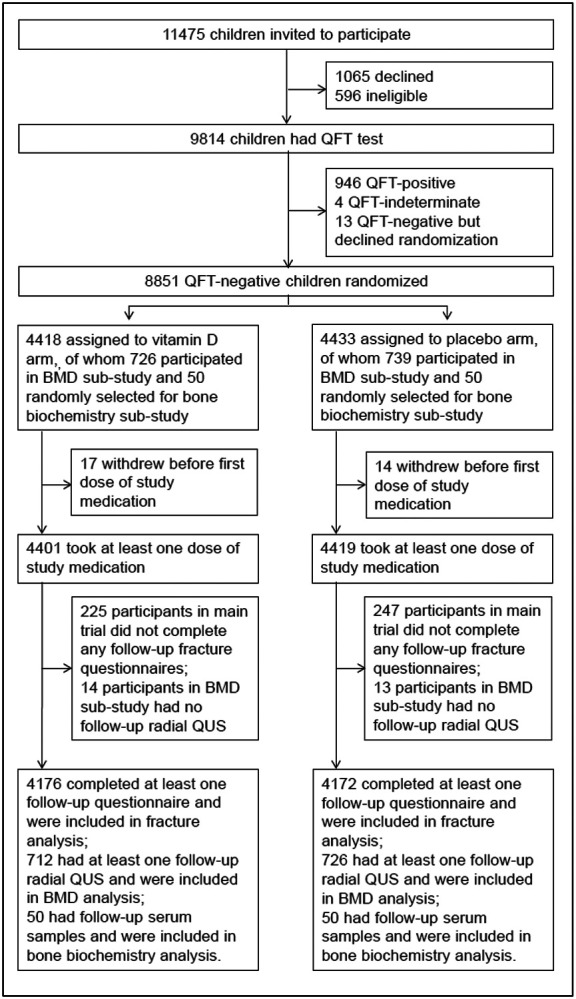
8851 children were enrolled in the main trial, of whom 1465 also participated in the sub-study. Vitamin D deficiency was prevalent at baseline (25[OH]D <20 ng/mL in 90.1%). The intervention elevated 25(OH)D concentrations (adjusted inter-arm mean difference [aMD] 20.3 ng/mL, 95% CI 19.9 to 20.6) and suppressed PTH concentrations (aMD -13.6 pmol/L, 95% CI -23.5 to -3.7), but it did not influence fracture risk (adjusted risk ratio 1.10, 95% CI 0.93 to 1.29, P=0.27) or radial BMD z-score (aMD -0.06, 95% CI -0.18 to 0.07, P=0.36). Vitamin D suppressed serum BALP concentrations more among participants with baseline 25(OH)D concentrations <10 vs. ≥10 ng/mL (P=0.04). However, effects of the intervention on fracture risk and radial BMD were not modified by baseline vitamin D status (P≥0.67).
Weekly oral vitamin D supplementation elevated serum 25(OH)D concentrations and suppressed PTH concentrations in vitamin D-deficient schoolchildren in Mongolia. However, this was not associated with reduced fracture risk or increased radial BMD.
National Institutes of Health.
缺乏关于补充维生素D以降低儿童骨折风险的随机对照试验(RCT)。
我们对6至13岁的蒙古族学龄儿童进行了一项为期3年的3期随机对照试验,每周口服14000国际单位维生素D。血清25-羟基维生素D(25[OH]D)浓度以及报告有≥1次骨折的参与者比例是主要试验的次要结局。在一项嵌套子研究中评估了桡骨骨密度(BMD),并在一部分参与者中测定了甲状旁腺激素(PTH)和骨特异性碱性磷酸酶(BALP)的血清浓度。
885名儿童参与了主要试验,其中1465名也参与了子研究。维生素D缺乏在基线时很普遍(90.1%的儿童25[OH]D<20纳克/毫升)。干预提高了25(OH)D浓度(调整后的组间平均差异[aMD]为20.3纳克/毫升,95%置信区间为19.9至20.6)并抑制了PTH浓度(aMD为-13.6皮摩尔/升,95%置信区间为-23.5至-3.7),但它并未影响骨折风险(调整后的风险比为1.10,95%置信区间为0.93至1.29,P=0.27)或桡骨BMD z评分(aMD为-0.06,95%置信区间为-0.18至0.07,P=0.36)。与基线25(OH)D浓度≥10纳克/毫升的参与者相比,维生素D在基线25(OH)D浓度<10纳克/毫升的参与者中对血清BALP浓度的抑制作用更强(P=0.04)。然而,干预对骨折风险和桡骨BMD的影响并未因基线维生素D状态而改变(P≥0.67)。
每周口服维生素D补充剂可提高蒙古维生素D缺乏学龄儿童的血清25(OH)D浓度并抑制PTH浓度。然而,这与降低骨折风险或增加桡骨BMD无关。
美国国立卫生研究院。