Ganmaa Davaasambuu, Hemmings Stephanie, Jolliffe David A, Buyanjargal Uyanga, Garmaa Gantsetseg, Adiya Unaganshagai, Tumurbaatar Tumenulzii, Dorjnamjil Khulan, Tserenkhuu Enkhtsetseg, Erdenenbaatar Sumiya, Tsendjav Enkhjargal, Enkhamgalan Nomin, Achtai Chuluun-Erdene, Talhaasuren Yagaantsetseg, Byambasuren Tuya, Ganbaatar Erdenetuya, Purevdorj Erkhembulgan, Martineau Adrian R
Harvard Medical School, Boston, Massachusetts, USA.
Harvard TH Chan School of Public Health, Boston, Massachusetts, USA.
BMJ Open Sport Exerc Med. 2024 Sep 26;10(3):e002018. doi: 10.1136/bmjsem-2024-002018. eCollection 2024.
To determine whether weekly oral vitamin D supplementation influences grip strength, explosive leg power, cardiorespiratory fitness or spirometric lung volumes in Mongolian schoolchildren.
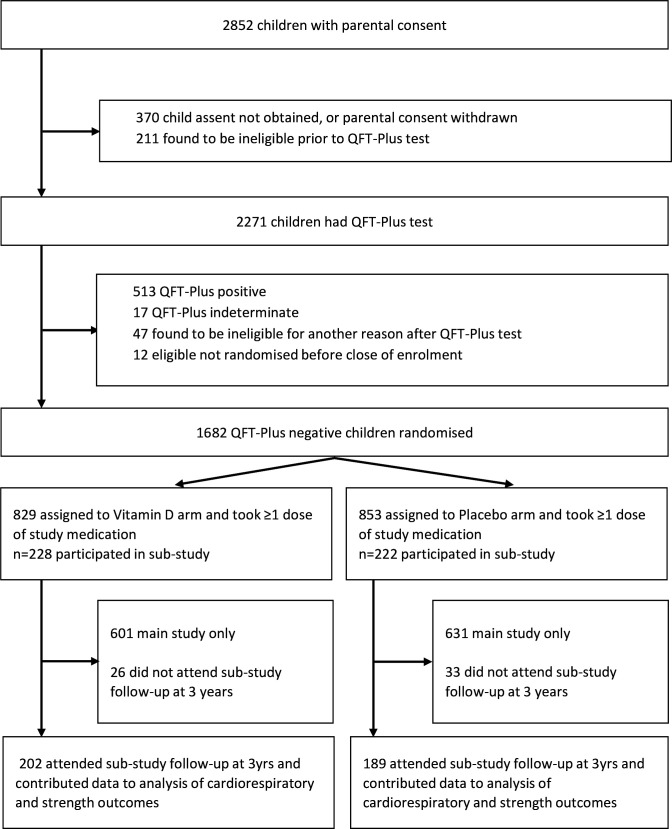
Multicentre, randomised, placebo-controlled clinical trial conducted in children aged 6-13 years at baseline attending 18 schools in Ulaanbaatar. The intervention was weekly oral doses of 14 000 IU vitamin D (n=4418) or placebo (n=4433) for 3 years. Outcome measures were grip strength, standing long jump distance and serum 25-hydroxyvitamin D (25(OH)D) concentrations (determined in all participants), peak oxygen uptake (VO, determined in a subset of 632 participants using 20 m multistage shuttle run tests) and spirometric outcomes (determined in a subset of 1343 participants).
99.8% of participants had serum 25(OH)D concentrations <75 nmol/L at baseline, and mean end-study 25(OH)D concentrations in children randomised to vitamin D versus placebo were 77.4 vs 26.7 nmol/L (mean difference 50.7 nmol/L, 95% CI 49.7 to 51.4). However, vitamin D supplementation did not influence mean grip strength, standing long jump distance, VO, spirometric lung volumes or peak expiratory flow rate, either overall or within subgroups defined by sex, baseline 25(OH)D concentration <25 vs ≥25 nmol/L or calcium intake <500 vs ≥500 mg/day.
A 3-year course of weekly oral supplementation with 14 000 IU vitamin D elevated serum 25(OH)D concentrations in Mongolian schoolchildren with a high baseline prevalence of vitamin D deficiency. However, this intervention did not influence grip strength, explosive leg power, peak oxygen uptake or spirometric lung volumes, either overall or in subgroup analyses.
NCT02276755.
确定每周口服维生素D补充剂是否会影响蒙古学龄儿童的握力、腿部爆发力、心肺适能或肺量计测量的肺容积。
在乌兰巴托18所学校对6至13岁儿童进行多中心、随机、安慰剂对照临床试验。干预措施为每周口服14000国际单位维生素D(n = 4418)或安慰剂(n = 4433),持续3年。观察指标包括握力、立定跳远距离和血清25-羟维生素D(25(OH)D)浓度(所有参与者均测定)、峰值摄氧量(VO,在632名参与者的子集中使用20米多级往返跑测试测定)和肺量计测量结果(在1343名参与者的子集中测定)。
99.8%的参与者在基线时血清25(OH)D浓度<75 nmol/L,随机分配到维生素D组与安慰剂组的儿童在研究结束时的平均25(OH)D浓度分别为77.4和26.7 nmol/L(平均差异50.7 nmol/L,95%CI 49.7至51.4)。然而,补充维生素D对平均握力、立定跳远距离、VO、肺量计测量的肺容积或呼气峰值流速均无影响,无论是总体上还是在按性别、基线25(OH)D浓度<25与≥25 nmol/L或钙摄入量<500与≥500 mg/天定义的亚组中。
在维生素D缺乏基线患病率较高的蒙古学龄儿童中,为期3年的每周口服14000国际单位维生素D补充疗程可提高血清25(OH)D浓度。然而,该干预措施对握力、腿部爆发力、峰值摄氧量或肺量计测量的肺容积均无影响,无论是总体分析还是亚组分析。
NCT02276755。