Schmidt Kira, Barac-Dammeyer Drazena, Kowalski Axel, Teigelack Per, Pfeiffer Corinna, Robitzsch Anita, Dörrie Nora, Skoda Eva-Maria, Bäuerle Alexander, Fink Madeleine, Teufel Martin
Department for Psychosomatic Medicine and Psychotherapy, LVR-University Hospital Essen, University of Duisburg-Essen, Essen, Germany.
Center for Translational Neuro-and Behavioral Sciences (C-TNBS), University of Duisburg-Essen, Essen, Germany.
Front Psychiatry. 2023 May 24;14:1140880. doi: 10.3389/fpsyt.2023.1140880. eCollection 2023.
Feedback-based therapies such as biofeedback have a benefit in patients with mental health disorders. While biofeedback is heavily researched in outpatient settings, it has been rarely investigated in psychosomatic inpatient settings. The implementation of an additional treatment option in inpatient settings holds special requirements. The aim of this pilot study is the evaluation of additional biofeedback treatment in an inpatient psychosomatic-psychotherapeutic unit to derive clinical implications and recommendations for the future implementation of biofeedback offers.
The evaluation of the implementation process was investigated using a convergent parallel mixed methods approach (following MMARS guidelines). Quantitative questionnaires measured patients' acceptance and satisfaction with biofeedback treatment after receiving 10 sessions in addition to treatment as usual. After 6 months during implementation, qualitative interviews were conducted with biofeedback practitioners, i.e., staff nurses, examining acceptance and feasibility. Data analysis was conducted using either descriptive statistics or Mayring's qualitative content analysis.
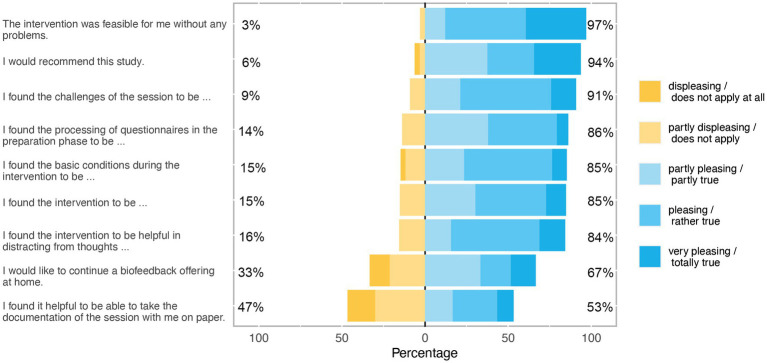
In total, 40 patients and 10 biofeedback practitioners were included. Quantitative questionnaires revealed high satisfaction and acceptance in patients regarding biofeedback treatment. Qualitative interviews showed high acceptance in biofeedback practitioners but revealed several challenges that were encountered during the implementation process, e.g., increased workload due to additional tasks, organizational and structural difficulties. However, biofeedback practitioners were enabled to expand their own competencies and take over a therapeutic part of the inpatient treatment.
Even though patient satisfaction and staff motivation are high, the implementation of biofeedback in an inpatient unit requires special actions to be taken. Not only should personnel resources be planned and available in advance of implementation but also be the workflow for biofeedback practitioners as easy and quality of biofeedback treatment as high as possible. Consequently, the implementation of a manualized biofeedback treatment should be considered. Nevertheless, more research needs to be done about suitable biofeedback protocols for this patient clientele.
基于反馈的疗法,如生物反馈疗法,对心理健康障碍患者有益。虽然生物反馈疗法在门诊环境中得到了大量研究,但在身心疾病住院环境中的研究却很少。在住院环境中实施额外的治疗方案有特殊要求。本试点研究的目的是评估在身心疾病住院治疗单元中增加生物反馈治疗,以得出临床启示,并为未来生物反馈治疗的实施提供建议。
采用收敛平行混合方法(遵循MMARS指南)对实施过程进行评估。定量问卷测量了患者在接受除常规治疗外的10次生物反馈治疗后的接受度和满意度。在实施6个月后,对生物反馈治疗从业者,即护士进行了定性访谈,以检查接受度和可行性。数据分析采用描述性统计或梅林的定性内容分析法。
共纳入40名患者和10名生物反馈治疗从业者。定量问卷显示患者对生物反馈治疗的满意度和接受度较高。定性访谈显示生物反馈治疗从业者的接受度较高,但也揭示了实施过程中遇到的一些挑战,例如由于额外任务导致工作量增加、组织和结构方面的困难。然而,生物反馈治疗从业者能够扩展自己的能力,并承担住院治疗的一部分治疗工作。
尽管患者满意度和工作人员积极性很高,但在住院单元中实施生物反馈疗法仍需要采取特殊行动。不仅应在实施前规划并提供人力资源,而且生物反馈治疗从业者的工作流程应尽可能简便,生物反馈治疗的质量应尽可能高。因此,应考虑实施标准化的生物反馈治疗。尽管如此,对于这类患者群体,仍需要更多关于合适生物反馈方案的研究。