University of Duisburg-Essen, Essen, Germany.
Partner Site University Hospital Essen, and German Cancer Research Center (DKFZ), Essen, Germany.
Integr Cancer Ther. 2023 Jan-Dec;22:15347354221149950. doi: 10.1177/15347354221149950.
EEG biofeedback (NF) is an established therapy to enable individuals to influence their own cognitive-emotional state by addressing changes in brainwaves. Psycho-oncological approaches of NF in cancer patients are rare and effects are hardly studied.
The aim of this explorative, randomized controlled trial was to test the effectiveness of an alpha and theta NF training protocol, compared to mindfulness based therapy as an established psycho-oncological treatment.
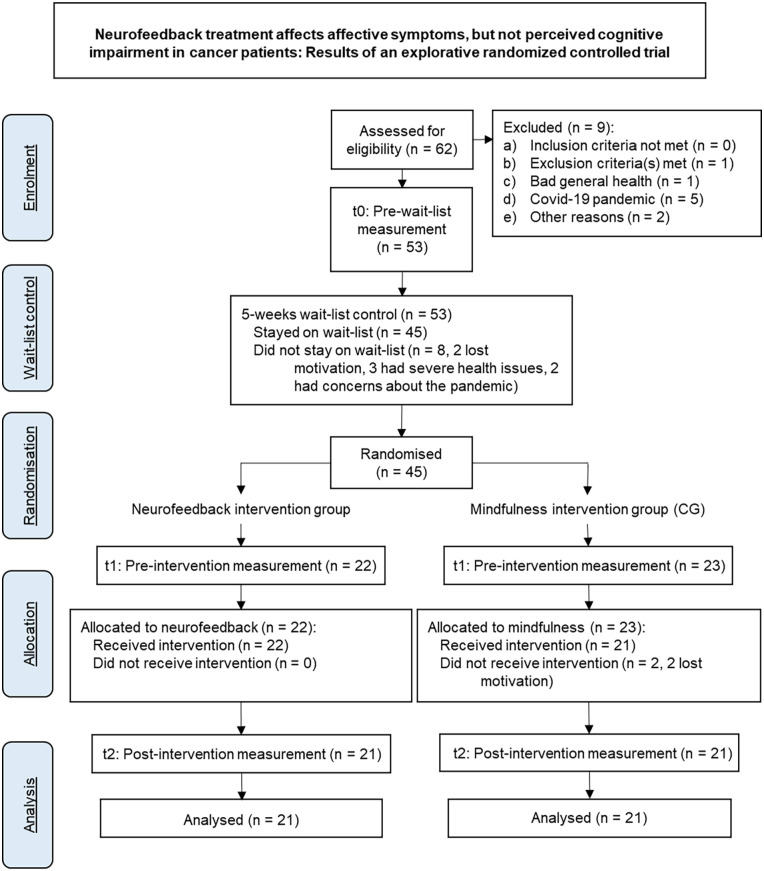
Of initially 62 screened patients, 56 were included (inclusion criteria were cancer independent of tumor stage, age >18 years, German speaking; exclusion criteria suicidal ideation, brain tumor). Randomization and stratification (tumor stage) was conducted by a computer system. Participants got 10 sessions over 5 weeks, in (a) an NF intervention (n = 21; 13 female, 8 male; MAge = 52.95(10 519); range = 31 to 73 years)) or (b) a mindfulness group therapy as control condition (CG; n = 21; ie, 15 female, 6 male; MAge = 50.33(8708); range = 32 to 67 years)). Outcome parameters included self-reported cognitive impairment (PCI) as primary outcome, and secondary outcomes of emotional distress (DT, PHQ-8, GAD-7), fatigue (MFI-20), rumination (RSQ), quality of life (QoL, EORTC-30 QoL), self-efficacy (GSE), and changes in EEG alpha, and theta-beta band performance in the NF condition.
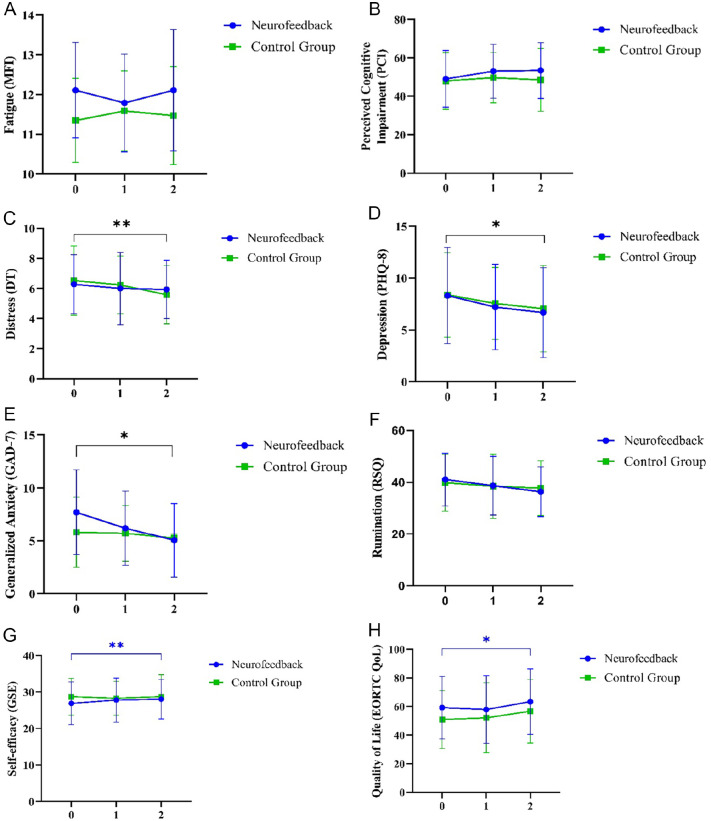
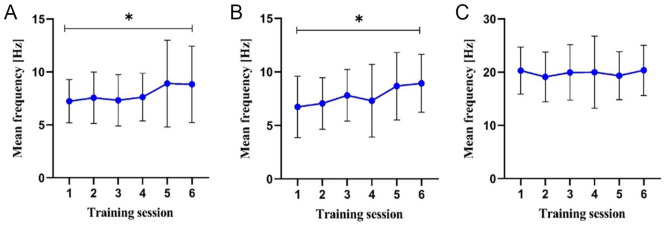
No changes in cognitive impairment were found ( = .079), neither in NF nor CG. High affective distress was evident, with 70.7% showing elevated distress and 34.1% showing severe depressive symptoms. Affective symptoms of distress ( ≤ .01), depression ( ≤ .05) and generalized anxiety ( ≤ .05) decreased significantly over time. No differences between NF and CG were found. There was a significant increase of the alpha band ( ≤ .05; N = 15) over the NF sessions. Self-efficacy predicted QoL increase in NF with ≤ .001 and an explained variance of 48.2%.
This is the first study to investigate NF technique with regard to basic mechanisms of effectiveness in a sample of cancer patients, compared to an established psycho-oncological intervention in this field. Though there were no changes in cognitive impairment, present data show that NF improves affective symptoms comparably to mindfulness-based therapy and even more pronounced in QoL and self-efficacy.Trial registration: ID: DRKS00015773.
脑电图生物反馈(NF)是一种成熟的治疗方法,通过改变脑电波,使个体能够影响自己的认知-情绪状态。癌症患者的 NF 心理肿瘤学方法很少见,效果也很难研究。
本探索性、随机对照试验的目的是测试阿尔法和 theta NF 训练方案的有效性,与作为成熟心理肿瘤学治疗的正念疗法进行比较。
最初筛选了 62 名患者,其中 56 名患者入组(纳入标准为癌症与肿瘤分期无关,年龄>18 岁,会说德语;排除标准为自杀意念,脑肿瘤)。通过计算机系统进行随机分组和分层(肿瘤分期)。参与者在 5 周内进行 10 次治疗,在(a)NF 干预组(n=21;13 名女性,8 名男性;MAge=52.95(10519);范围=31 至 73 岁)或(b)正念组对照条件下进行治疗(CG;n=21;15 名女性,6 名男性;MAge=50.33(8708);范围=32 至 67 岁)。主要结局参数包括自我报告的认知障碍(PCI),次要结局参数包括情绪困扰(DT、PHQ-8、GAD-7)、疲劳(MFI-20)、反刍(RSQ)、生活质量(EORTC-30 QoL)、自我效能感(GSE),以及 NF 条件下脑电图阿尔法和 theta-beta 波段表现的变化。
认知障碍没有变化( = .079),无论是在 NF 组还是 CG 组。情绪困扰明显较高,70.7%的人情绪困扰严重,34.1%的人有严重的抑郁症状。情绪困扰( ≤ .01)、抑郁( ≤ .05)和广泛性焦虑( ≤ .05)症状随时间显著下降。NF 组与 CG 组之间无差异。NF 治疗过程中 alpha 波段显著增加( ≤ .05;N=15)。NF 组自我效能感预测生活质量增加, ≤ .001,解释方差为 48.2%。
这是第一项研究,比较了 NF 技术在癌症患者样本中的基本有效性机制,与该领域中成熟的心理肿瘤学干预措施进行了比较。虽然认知障碍没有变化,但目前的数据表明,NF 改善了情绪症状,与基于正念的疗法相当,甚至在生活质量和自我效能感方面更为显著。
DRKS00015773。