Kirby Jordona D, Chipman Richard B, Nelson Kathleen M, Rupprecht Charles E, Blanton Jesse D, Algeo Timothy P, Slate Dennis
United States Department of Agriculture, Animal and Plant Health Inspection Service, Wildlife Services, National Rabies Management Program, Concord, NH 03301, USA.
LYSSA, LLC, Atlanta, GA 30333, USA.
Trop Med Infect Dis. 2017 Jul 28;2(3):34. doi: 10.3390/tropicalmed2030034.
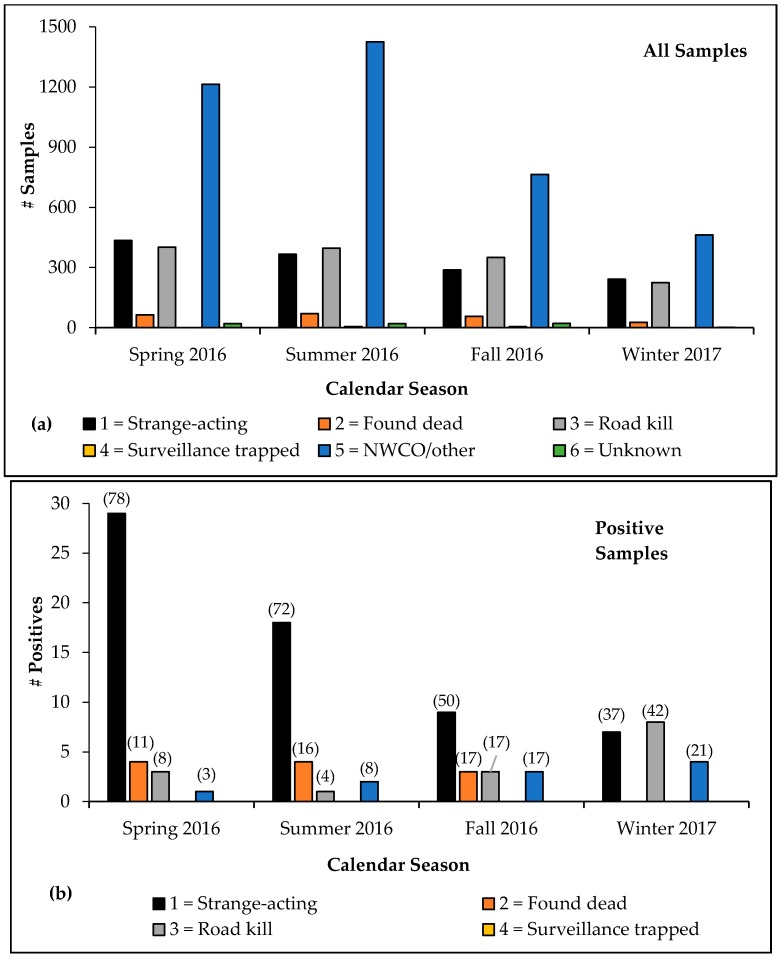
Enhanced rabies surveillance (ERS) is essential for sound oral rabies vaccination (ORV) decisions to prevent the spread of specific rabies virus variants in meso-carnivores and to achieve disease elimination. Use of a direct rapid immunohistochemistry test (dRIT) in North America for timely, accurate rabies diagnosis in the field has facilitated greater ERS emphasis since 2005. ERS used in tandem with exposure-based public health surveillance provides a comprehensive understanding of the geographic distribution of rabies as an aid to formulate effective management strategies for raccoons and other meso-carnivores. In 2015, best management practices were implemented for improving, reinvigorating, and standardizing ERS. A point system for weighing ERS sample categories was evaluated, to determine whether sampling emphasis should be focused upon ill or strange-acting animals, the highest quality category. During 2016, 70.7% of rabid animals detected through ERS in raccoon rabies management states were obtained from strange-acting animals, followed by animals found dead (14.1%), road kills (9.1%), and nuisance-collected specimens (6.1%). Sample category weights may be adjusted based on additional evaluation to ensure continued emphasis on the highest value samples. High quality ERS, in conjunction with serologic evidence of population-based immunity, form the backbone for ORV decisions in the elimination of raccoon rabies.
强化狂犬病监测(ERS)对于做出合理的口服狂犬病疫苗接种(ORV)决策至关重要,有助于预防特定狂犬病病毒变种在中食肉动物中的传播并实现疾病消除。自2005年以来,北美使用直接快速免疫组织化学检测(dRIT)在现场进行及时、准确的狂犬病诊断,这促使人们更加重视ERS。ERS与基于暴露的公共卫生监测协同使用,可全面了解狂犬病的地理分布,有助于制定针对浣熊和其他中食肉动物的有效管理策略。2015年,实施了最佳管理实践,以改进、振兴和规范ERS。评估了一种用于权衡ERS样本类别的评分系统,以确定采样重点是否应集中在生病或行为异常的动物上,这是最高质量的类别。在2016年,通过ERS在浣熊狂犬病管理州检测到的狂犬病动物中,70.7%来自行为异常的动物,其次是发现死亡的动物(14.1%)、路毙动物(9.1%)和扰民收集的标本(6.1%)。可根据进一步评估调整样本类别权重,以确保继续重视最高价值的样本。高质量的ERS与基于人群免疫的血清学证据相结合,构成了在消除浣熊狂犬病过程中进行ORV决策的基础。