Department of Neurology, Dale and Deborah Smith Center for Alzheimer's Research and Treatment, Neuroscience Institute, Southern Illinois University School of Medicine, Springfield, IL, 62702, USA.
Department of Internal Medicine, Southern Illinois University School of Medicine, Springfield, IL, 62702, USA.
Geroscience. 2023 Oct;45(5):2835-2850. doi: 10.1007/s11357-023-00843-0. Epub 2023 Jun 9.
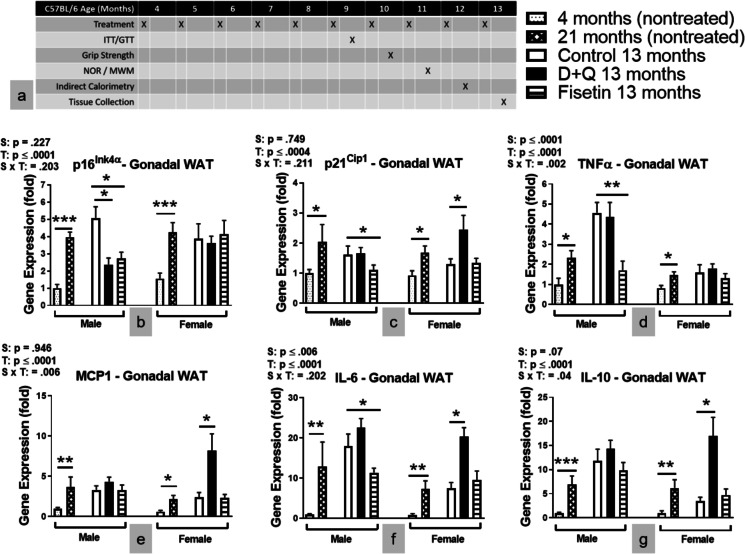
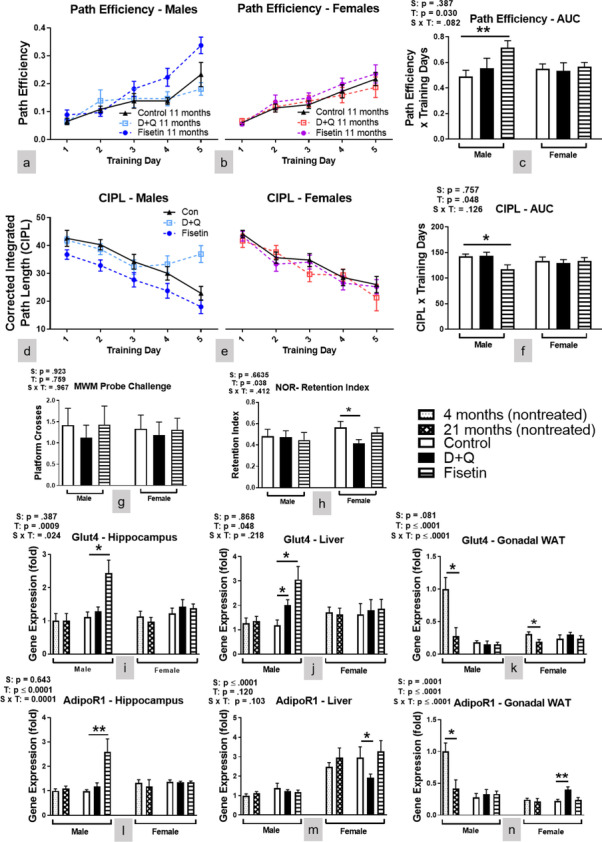
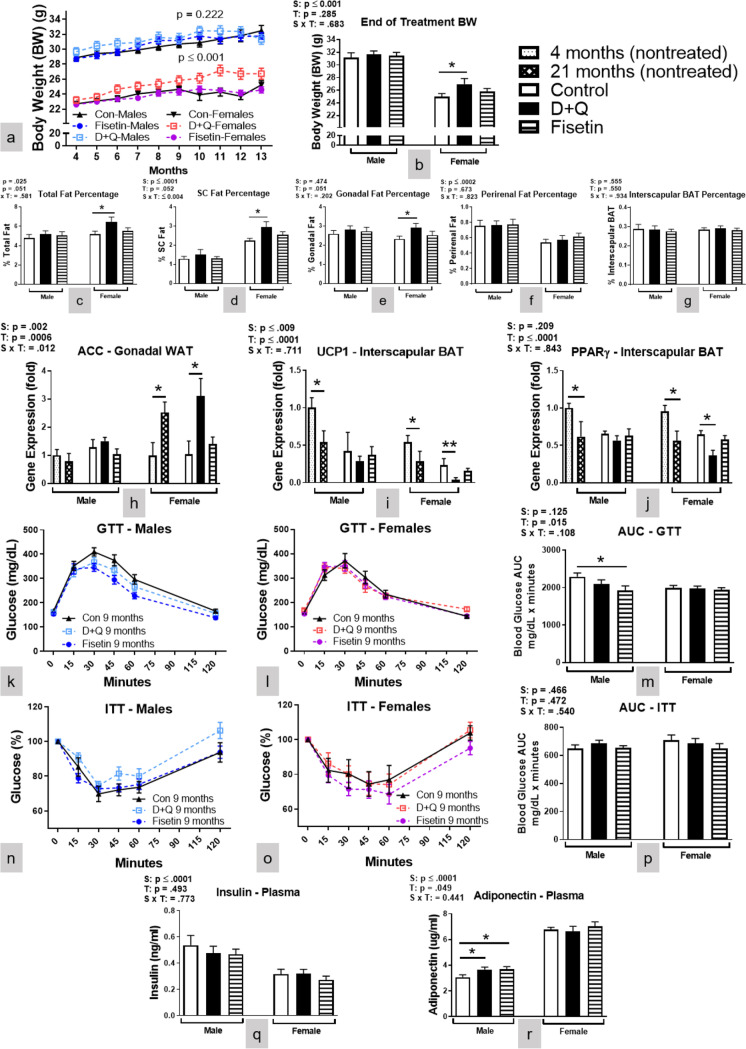
Senolytic treatment in aged mice clears senescent cell burden leading to functional improvements. However, less is known regarding the effects of these compounds when administered prior to significant senescent cell accumulation. From 4-13 months of age, C57BL/6 male and female mice received monthly oral dosing of either 100 mg/kg Fisetin or a 5 mg/kg Dasatinib (D) plus 50 mg/kg Quercetin (Q) cocktail. During treatment, several aspects of healthy aging were assayed including glucose metabolism using an insulin and glucose tolerance test, cognitive performance using Morris water maze and novel object recognition, and energy metabolism using indirect calorimetry. Afterwards, mice were euthanized for plasma, tissue specific markers of senescence-associated secretory phenotype (SASP), and white adipose tissue accumulation (WAT). Sexually dimorphic treatment effects were observed. Fisetin treated male mice had reduced SASP, enhanced glucose and energy metabolism, improved cognitive performance, and increased mRNA expression of adiponectin receptor 1 and glucose transporter 4. D + Q treatment had minimal effects in male C57BL/6 mice, but was detrimental to females causing increased SASP expression along with accumulation of WAT depots. Reduced energy metabolism and cognitive performance were also noted. Fisetin treatment had no effect in female C57BL/6 mice potentially due to a slower rate of biological aging. In summary, the senolytic treatment in young adulthood, has beneficial, negligible, or detrimental effects in C57BL/6 mice dependent upon sex and treatment. These observations should serve as a note of caution in this rapidly evolving and expanding field of investigation. Male and female C57BL/6 mice were treated with once monthly oral doses of either Dasatinib (D) + Quercetin (Q) or Fisetin from 4-13 months of age. Males treated with Fisetin had reduced SASP markers (blue spheres) as well as improved metabolism (red flame) and cognition. Females treated with D + Q had increased adiposity and SASP markers (red spheres) along with decreased metabolism (blue flame) and cognitive performance. No effects were observed in females treated with Fisetin or males treated with D + Q.
衰老小鼠的衰老细胞清除治疗可清除衰老细胞负担,从而改善功能。然而,当这些化合物在显著的衰老细胞积累之前被给予时,其效果知之甚少。从 4-13 个月大时,C57BL/6 雄性和雌性小鼠每月接受一次口服 100mg/kg 非瑟酮或 5mg/kg 达沙替尼(D)加 50mg/kg 槲皮素(Q)鸡尾酒的治疗。在治疗过程中,检测了几种健康衰老的方面,包括使用胰岛素和葡萄糖耐量试验进行葡萄糖代谢、使用 Morris 水迷宫和新物体识别进行认知表现、以及使用间接测热法进行能量代谢。之后,对小鼠进行安乐死,以获得血浆、组织衰老相关分泌表型(SASP)的特异性标志物和白色脂肪组织堆积(WAT)。观察到性别二态性的治疗效果。非瑟酮治疗的雄性小鼠的 SASP 减少,葡萄糖和能量代谢增强,认知表现改善,以及脂肪细胞因子受体 1 和葡萄糖转运蛋白 4 的 mRNA 表达增加。D+Q 治疗对雄性 C57BL/6 小鼠几乎没有影响,但对雌性小鼠有害,导致 SASP 表达增加和 WAT 堆积。能量代谢和认知表现也降低。非瑟酮治疗对雌性 C57BL/6 小鼠没有影响,可能是由于生物学衰老的速度较慢。总之,在 C57BL/6 小鼠中,年轻成年时的衰老细胞清除治疗具有有益、可忽略或有害的影响,这取决于性别和治疗方法。这些观察结果应该在这个快速发展和不断扩大的研究领域中引起注意。雄性和雌性 C57BL/6 小鼠从 4-13 个月大时每月接受一次口服 Dasatinib(D)+Quercetin(Q)或非瑟酮的治疗。用非瑟酮治疗的雄性小鼠的 SASP 标志物(蓝色球体)减少,代谢(红色火焰)和认知能力提高。用 D+Q 治疗的雌性小鼠的肥胖和 SASP 标志物(红色球体)增加,代谢(蓝色火焰)和认知表现降低。用非瑟酮治疗的雌性小鼠或用 D+Q 治疗的雄性小鼠均未观察到效果。