Department of Infectious Disease and Global Health, Cummings School of Veterinary Medicine, Tufts University, North Grafton, MA 01536, USA.
Department of Public Health and Community Medicine, Tufts University School of Medicine, Boston, MA 02111, USA.
Int J Environ Res Public Health. 2023 Jun 1;20(11):6030. doi: 10.3390/ijerph20116030.
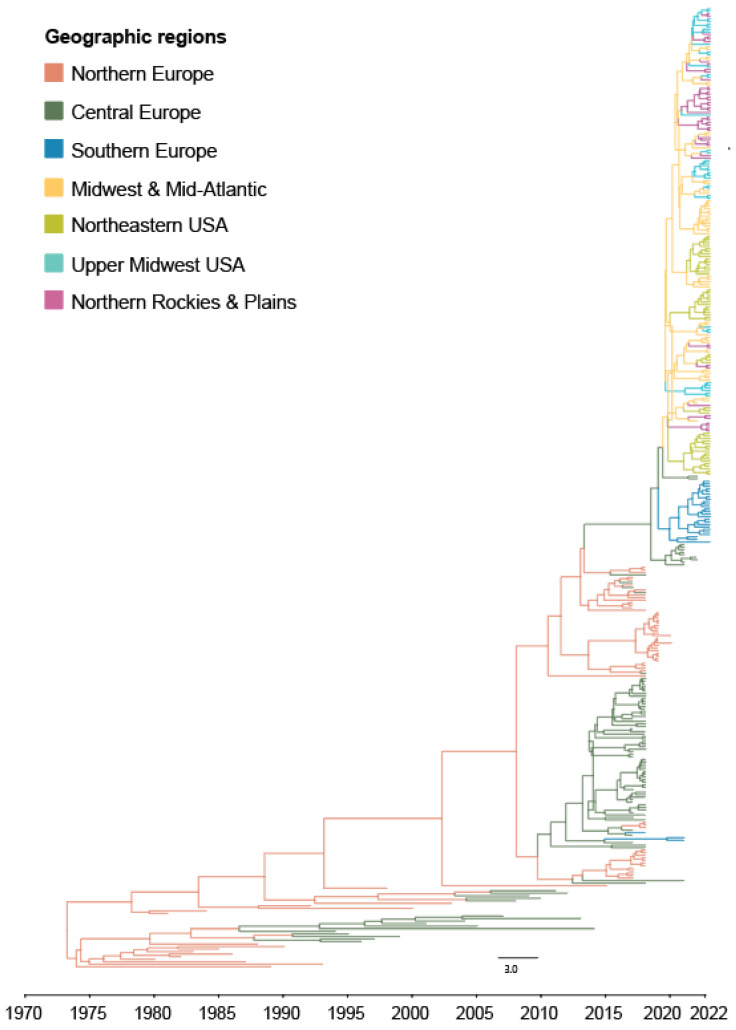
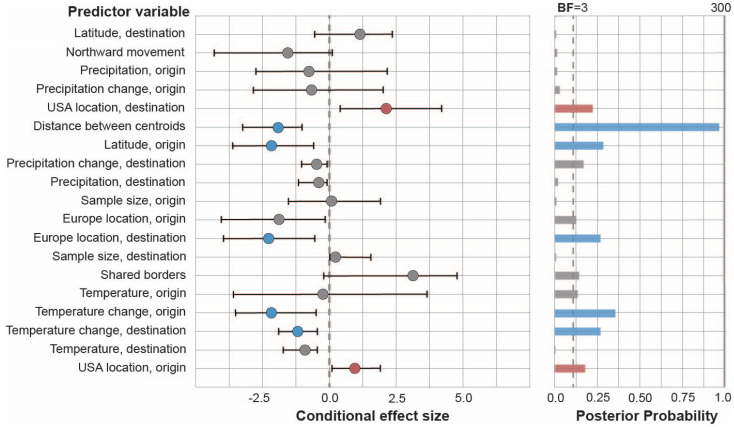
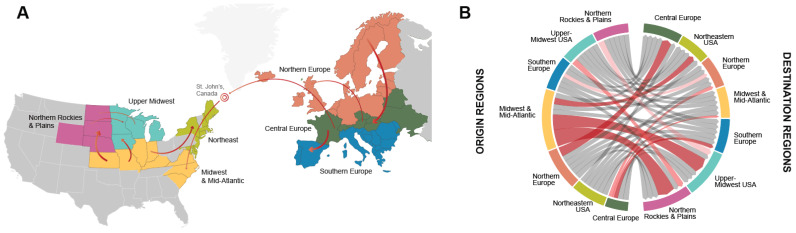
H5Nx highly pathogenic avian influenza (HPAI) viruses of clade 2.3.4.4 have caused outbreaks in Europe among wild and domestic birds since 2016 and were introduced to North America via wild migratory birds in December 2021. We examined the spatiotemporal extent of HPAI viruses across continents and characterized ecological and environmental predictors of virus spread between geographic regions by constructing a Bayesian phylodynamic generalized linear model (phylodynamic-GLM). The findings demonstrate localized epidemics of H5Nx throughout Europe in the first several years of the epizootic, followed by a singular branching point where H5N1 viruses were introduced to North America, likely via stopover locations throughout the North Atlantic. Once in the United States (US), H5Nx viruses spread at a greater rate between US-based regions as compared to prior spread in Europe. We established that geographic proximity is a predictor of virus spread between regions, implying that intercontinental transport across the Atlantic Ocean is relatively rare. An increase in mean ambient temperature over time was predictive of reduced H5Nx virus spread, which may reflect the effect of climate change on declines in host species abundance, decreased persistence of the virus in the environment, or changes in migratory patterns due to ecological alterations. Our data provide new knowledge about the spread and directionality of H5Nx virus dispersal in Europe and the US during an actively evolving intercontinental outbreak, including predictors of virus movement between regions, which will contribute to surveillance and mitigation strategies as the outbreak unfolds, and in future instances of uncontained avian spread of HPAI viruses.
H5Nx 高致病性禽流感(HPAI)病毒 2.3.4.4 分支自 2016 年以来在欧洲的野生和家养鸟类中引发了疫情,并于 2021 年 12 月通过野生候鸟传入北美。我们通过构建贝叶斯系统发育广义线性模型(phylodynamic-GLM),检查了跨大陆的 HPAI 病毒的时空范围,并对地理区域之间病毒传播的生态和环境预测因子进行了特征描述。研究结果表明,在疫情的头几年,H5Nx 在整个欧洲都出现了局部流行,随后出现了一个分支点,H5N1 病毒被引入北美,可能是通过北大西洋的中途停留地。一旦进入美国(US),与之前在欧洲的传播相比,H5Nx 病毒在美国境内各地区的传播速度更快。我们确定了地理位置的接近度是区域间病毒传播的预测因子,这意味着跨越大西洋的洲际运输相对较少。随着时间的推移,环境温度均值的增加与 H5Nx 病毒传播的减少相关,这可能反映了气候变化对宿主物种数量减少、病毒在环境中持续时间缩短或因生态变化导致迁徙模式改变的影响。我们的数据提供了关于 H5Nx 病毒在欧洲和美国的传播和方向的新知识,包括区域间病毒运动的预测因子,这将有助于随着疫情的发展以及未来未受控制的 HPAI 病毒在禽类中的传播,制定监测和缓解策略。