Peukert Konrad, Sauer Andrea, Seeliger Benjamin, Feuerborn Caroline, Fox Mario, Schulz Susanne, Wild Lennart, Borger Valeri, Schuss Patrick, Schneider Matthias, Güresir Erdem, Coburn Mark, Putensen Christian, Wilhelm Christoph, Bode Christian
Department of Anesthesiology and Intensive Care Medicine, University Hospital Bonn, Venusberg-Campus 1, 53127 Bonn, Germany.
Department of Respiratory Medicine and German Centre of Lung Research (DZL), Hannover Medical School, Carl-Neuberg-Str. 1, 30635 Hannover, Germany.
J Clin Med. 2023 May 24;12(11):3649. doi: 10.3390/jcm12113649.
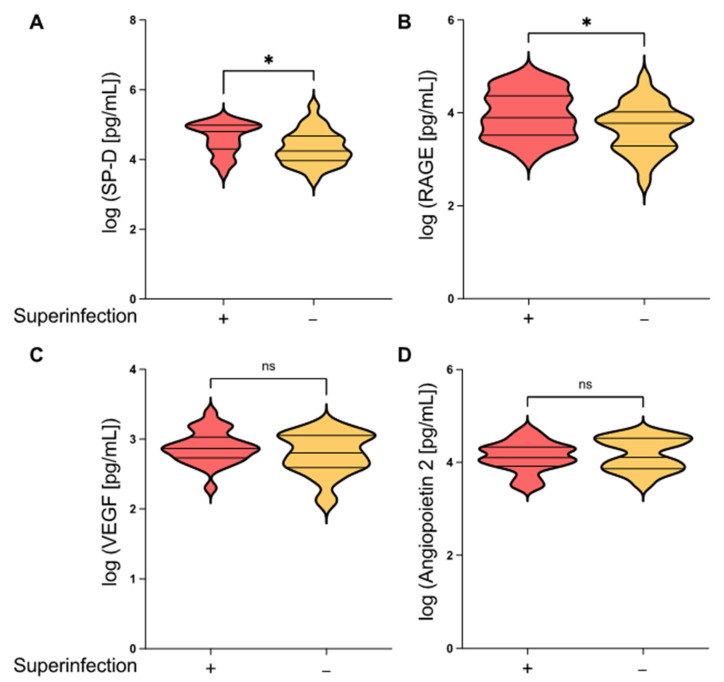
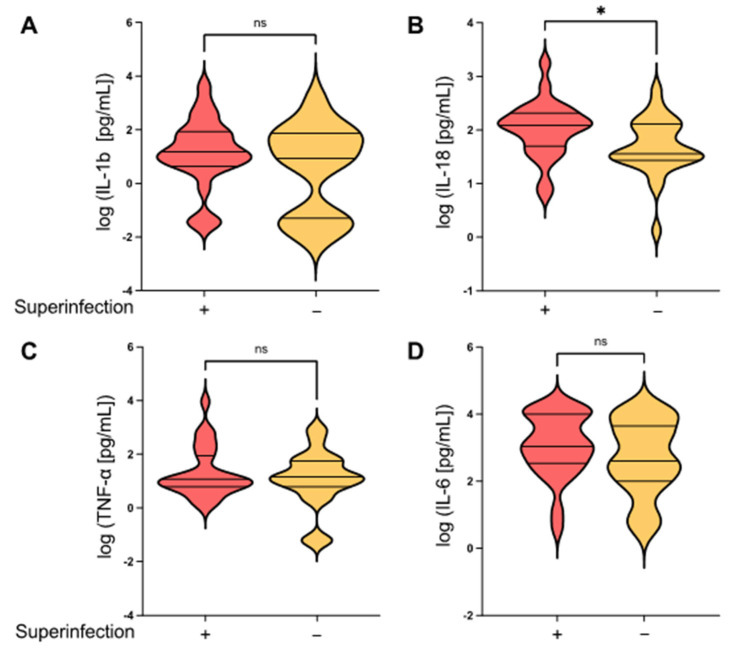
Acute respiratory distress syndrome (ARDS) is a life-threatening form of respiratory failure defined by dysregulated immune homeostasis and alveolar epithelial and endothelial damage. Up to 40% of ARDS patients develop pulmonary superinfections, contributing to poor prognosis and increasing mortality. Understanding what renders ARDS patients highly susceptible to pulmonary superinfections is therefore essential. We hypothesized that ARDS patients who develop pulmonary superinfections display a distinct pulmonary injury and pro-inflammatory response pattern. Serum and BALF samples from 52 patients were collected simultaneously within 24 h of ARDS onset. The incidence of pulmonary superinfections was determined retrospectively, and the patients were classified accordingly. Serum concentrations of the epithelial markers soluble receptor for advanced glycation end-products (sRAGE) and surfactant protein D (SP-D) and the endothelial markers vascular endothelial growth factor (VEGF) and angiopoetin-2 (Ang-2) as well as bronchoalveolar lavage fluid concentrations of the pro-inflammatory cytokines interleukin 1ß (IL-1ß), interleukin 18 (IL-18), interleukin 6 (IL-6), and tumor necrosis factor-alpha (TNF-a) were analyzed via multiplex immunoassay. Inflammasome-regulated cytokine IL-18 and the epithelial damage markers SP-D and sRAGE were significantly increased in ARDS patients who developed pulmonary superinfections. In contrast, endothelial markers and inflammasome-independent cytokines did not differ between the groups. The current findings reveal a distinct biomarker pattern that indicates inflammasome activation and alveolar epithelial injury. This pattern may potentially be used in future studies to identify high-risk patients, enabling targeted preventive strategies and personalized treatment approaches.
急性呼吸窘迫综合征(ARDS)是一种危及生命的呼吸衰竭形式,其定义为免疫稳态失调以及肺泡上皮和内皮损伤。高达40%的ARDS患者会发生肺部重复感染,导致预后不良并增加死亡率。因此,了解导致ARDS患者极易发生肺部重复感染的因素至关重要。我们假设发生肺部重复感染的ARDS患者表现出独特的肺损伤和促炎反应模式。在ARDS发病后24小时内同时采集52例患者的血清和支气管肺泡灌洗液(BALF)样本。回顾性确定肺部重复感染的发生率,并据此对患者进行分类。通过多重免疫测定分析上皮标志物晚期糖基化终产物可溶性受体(sRAGE)和表面活性蛋白D(SP-D)以及内皮标志物血管内皮生长因子(VEGF)和血管生成素-2(Ang-2)的血清浓度,以及促炎细胞因子白细胞介素1β(IL-1β)、白细胞介素18(IL-18)、白细胞介素6(IL-6)和肿瘤坏死因子-α(TNF-α)的支气管肺泡灌洗液浓度。发生肺部重复感染的ARDS患者中,炎性小体调节的细胞因子IL-18以及上皮损伤标志物SP-D和sRAGE显著增加。相比之下,两组之间的内皮标志物和非炎性小体依赖性细胞因子没有差异。目前的研究结果揭示了一种独特的生物标志物模式,表明炎性小体激活和肺泡上皮损伤。这种模式可能在未来的研究中用于识别高危患者,从而制定有针对性的预防策略和个性化的治疗方法。