Centre for the Development of Renewable Energies-Centre for Energy, Environmental and Technological Research (CEDER-CIEMAT), Autovía de Navarra A-15, Salida 56, 42290 Lubia, Spain.
Centro de Investigação de Montanha (CIMO), Instituto Politécnico de Bragança, Campus de Santa Apolónia, 5300-253 Bragança, Portugal.
Molecules. 2023 May 30;28(11):4448. doi: 10.3390/molecules28114448.
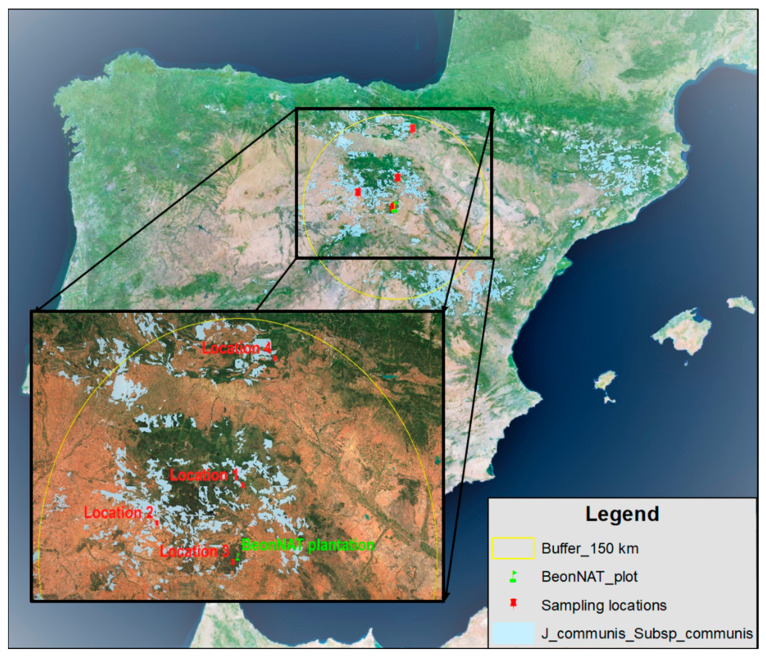
Essential oils (EOs) obtained from L. are frequently used in the production of bioproducts. However, there are no studies regarding industrial crops' production, allowing for better control of the quality and production of juniper EOs. To select the plant material for developing future crops of this species in northern Spain, four locations where this shrub species grows in the wild were selected and samples of both genera were collected. The EOs were obtained by steam distillation, and their chemical composition and bioactivity were evaluated. The results showed that the yield of EOs from male and female samples were within the usual reported ranges, varying between 0.24 and 0.58% (dry basis, d.b.). However, limonene content in three locations varied between 15 and 25%, which is between 100% and 200% higher than the values usually reported for other European countries. The antibacterial activity was determined by broth microdilution and showed that gram-positive bacteria were more susceptible to the tested EOs since, in general, lower MIC values were obtained compared to gram-negatives. The EOs from location 1 (L1F) and 2 (L2M) inhibited the growth of six out of the eight clinical strains tested. Samples from location 1 were particularly effective, exhibiting MBC against two gram-negative ( and ) and one gram-positive bacteria (). Moreover, the majority of the EOs tested showed anti-inflammatory activity. Cytotoxic effect has been demonstrated in tumor cell lines, with the best results observed against gastric carcinoma (AGS) cells (GI between 7 to 77 µg/mL). Although generally presenting higher GI, most samples also inhibited the growth of non-tumoral cells, particularly hepatocytes (PLP2 cells). Therefore, its use for their anti-proliferative activity should consider specific conditions to avoid damaging normal cells. Finally, the results and conclusions obtained led to the selection of the female shrubs from location 1 (L1F) as the plant material to be propagated in order to produce plants for a future juniper crop.
从 L.获得的精油(EOs)常用于生物制品的生产。然而,目前还没有关于工业作物生产的研究,无法更好地控制油质量和生产。为了选择在西班牙北部开发该物种未来作物的植物材料,选择了四个该灌木物种在野外生长的地点,并采集了两个属的样本。通过蒸汽蒸馏获得精油,并评估其化学成分和生物活性。结果表明,来自雄性和雌性样本的精油产量在通常报道的范围内,变化范围在 0.24%和 0.58%(干基,d.b.)之间。然而,在三个地点,柠檬烯的含量在 15%到 25%之间,比其他欧洲国家通常报道的值高 100%到 200%。通过肉汤微量稀释法测定抗菌活性,结果表明革兰氏阳性菌对测试的精油更敏感,因为与革兰氏阴性菌相比,通常获得的 MIC 值更低。来自地点 1(L1F)和 2(L2M)的精油抑制了所测试的 8 株临床菌株中的 6 株的生长。来自地点 1 的样本特别有效,对两种革兰氏阴性菌(和)和一种革兰氏阳性菌()表现出 MBC。此外,大多数测试的精油表现出抗炎活性。在肿瘤细胞系中已经证明了细胞毒性作用,对胃癌(AGS)细胞(GI 在 7 至 77μg/mL 之间)的效果最佳。尽管通常具有更高的 GI,但大多数样本也抑制了非肿瘤细胞的生长,特别是肝细胞(PLP2 细胞)。因此,考虑到避免损害正常细胞,其用于抗增殖活性的用途应考虑特定条件。最后,获得的结果和结论导致选择来自地点 1(L1F)的雌性灌木作为要繁殖的植物材料,以便生产未来的杜松作物的植物。