Carolina Population Center, University of North Carolina at Chapel Hill, Chapel Hill, NC, USA.
Carolina Population Center, University of North Carolina at Chapel Hill, Chapel Hill, NC, USA; Department of Geography, University of North Carolina at Chapel Hill, Chapel Hill, NC, USA.
Spat Spatiotemporal Epidemiol. 2023 Jun;45:100566. doi: 10.1016/j.sste.2023.100566. Epub 2023 Jan 13.
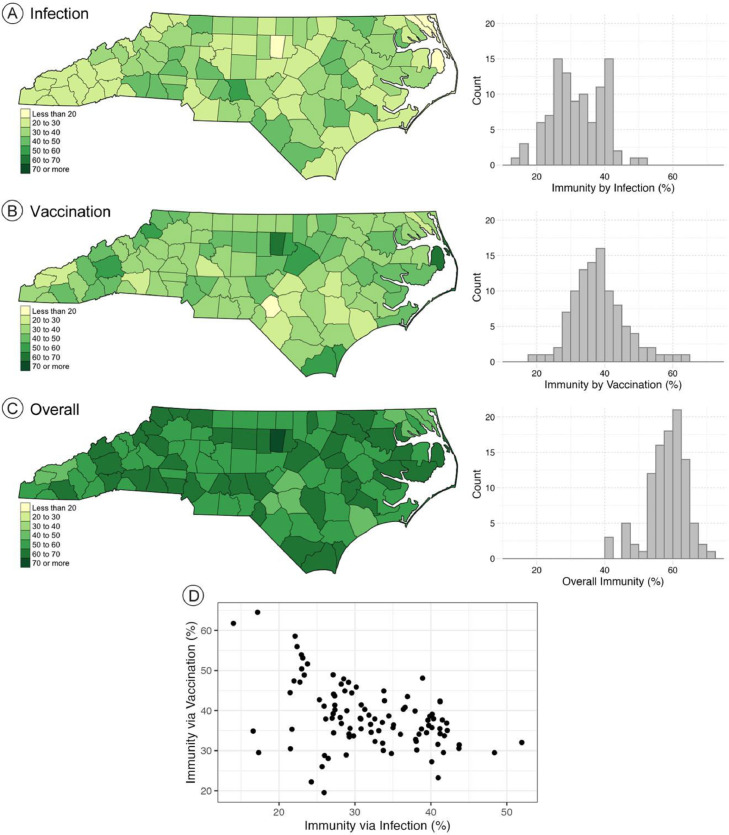
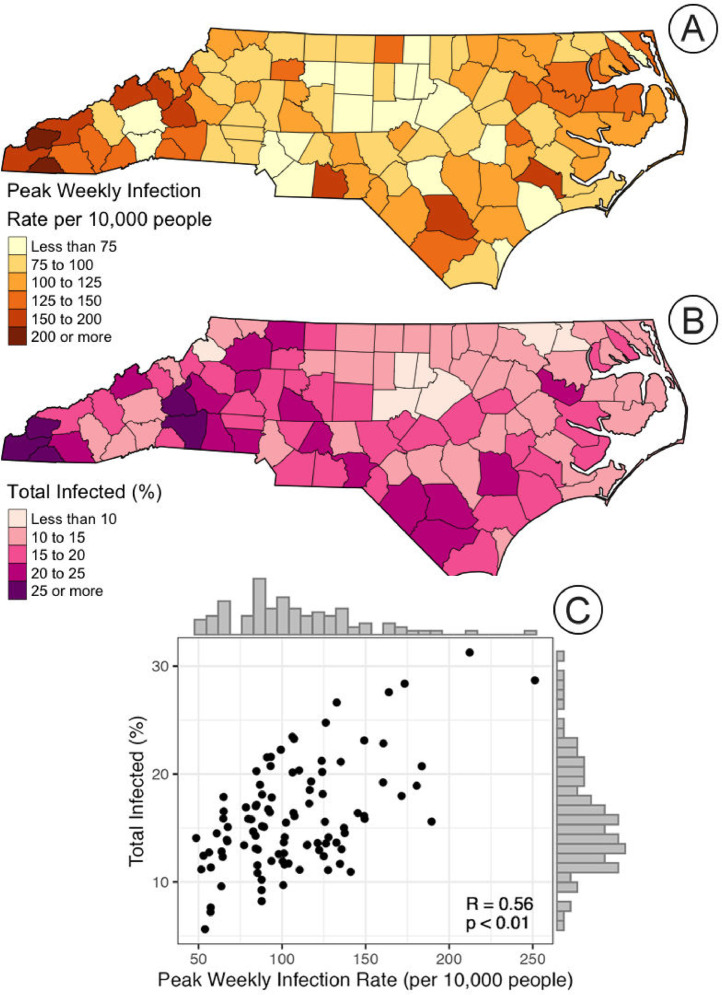
We constructed county-level models to examine properties of the SARS-CoV-2 B.1.617.2 (Delta) variant wave of infections in North Carolina and assessed immunity levels (via prior infection, via vaccination, and overall) prior to the Delta wave. To understand how prior immunity shaped Delta wave outcomes, we assessed relationships among these characteristics. Peak weekly infection rate and total percent of the population infected during the Delta wave were negatively correlated with the proportion of people with vaccine-derived immunity prior to the Delta Wave, signaling that places with higher vaccine uptake had better outcomes. We observed a positive correlation between immunity via infection prior to Delta and percent of the population infected during the Delta wave, meaning that counties with poor pre-Delta outcomes also had poor Delta wave outcomes. Our findings illustrate geographic variation in outcomes during the Delta wave in North Carolina, highlighting regional differences in population characteristics and infection dynamics.
我们构建了县级模型,以研究北卡罗来纳州 SARS-CoV-2 B.1.617.2(Delta)变异株感染波的特征,并评估了 Delta 波之前的免疫水平(通过既往感染、通过疫苗接种和总体水平)。为了了解既往免疫如何影响 Delta 波的结果,我们评估了这些特征之间的关系。Delta 波期间每周感染率峰值和感染总人数百分比与 Delta 波之前具有疫苗衍生免疫力的人群比例呈负相关,表明疫苗接种率较高的地区结果较好。我们观察到 Delta 波之前感染获得的免疫力与 Delta 波期间感染人数百分比之间呈正相关,这意味着 Delta 波之前结果较差的县,Delta 波的结果也较差。我们的研究结果说明了北卡罗来纳州 Delta 波期间结果的地理差异,突出了人口特征和感染动态的地区差异。