Longitudinal Study of Adult Health - ELSA Brasil, Federal University of Minas Gerais, Prof. Alfredo Balena, 110 - Santa Efigênia, Belo Horizonte, MG, 30130-100, Brazil.
Center for Clinical and Epidemiological Research, Hospital Universitário, Universidade de São Paulo, São Paulo, Brazil.
Sci Rep. 2023 Jun 10;13(1):9456. doi: 10.1038/s41598-023-35298-y.
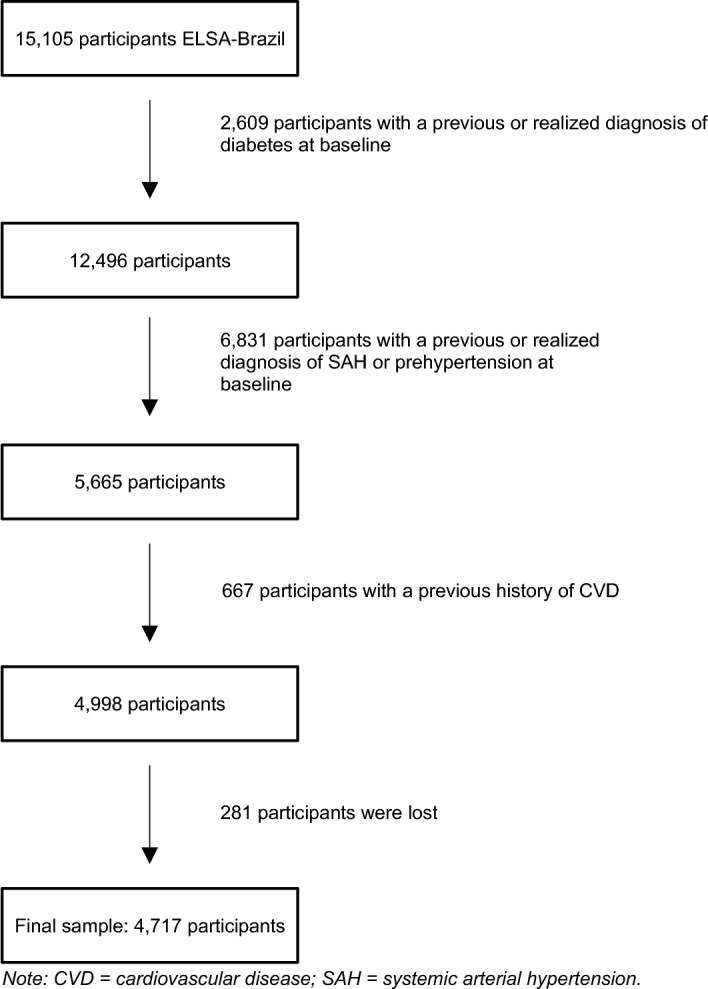
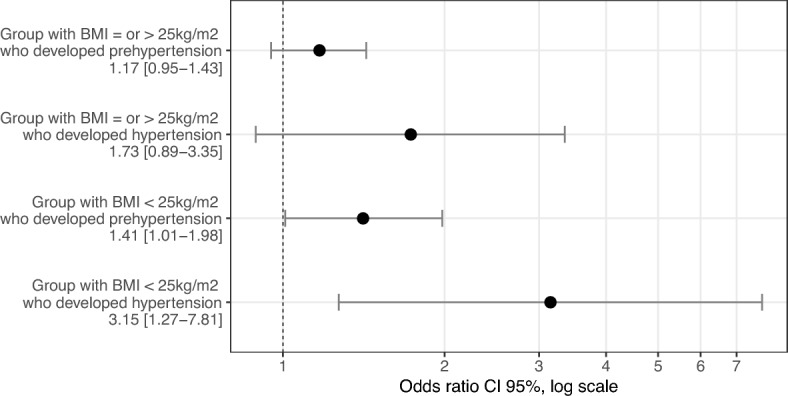
Insulin resistance (IR) is defined as the subnormal response to insulin action on its target tissues. Studies suggest that IR may increase the risk of hypertension, but the results are inconsistent and it is not known whether such an effect is independent of overweight/obesity. We aimed to evaluate the association between IR and the incidence of prehypertension and hypertension in the Brazilian population and whether this association is independent of overweight/obesity. In 4717 participants of the Brazilian Longitudinal Study of Adult's Health (ELSA-Brasil), free of diabetes and cardiovascular disease at baseline (2008-2010), we investigated the incidence of prehypertension and hypertension after a mean follow-up of 3.8 ± 0.5 years. Insulin resistance at baseline was assessed by the Homeostasis Model Assessment of Insulin Resistance (HOMA-IR) index, defined if above the 75th percentile. The risk of IR-associated prehypertension/hypertension was estimated by multinomial logistic regression after adjustment for confounding factors. Secondary analysis were stratified by body mass index. The mean (SD) age of participants was 48 (8) years, 67% were women. The 75th percentile of HOMA-IR at baseline was 2.85. The presence of IR increased the chance of developing prehypertension by 51% (95% CI 1.28-1.79) and hypertension by 150% (95% CI 1.48-4.23). In individuals with BMI < 25 kg/m, the presence of IR remained associated with the incidence of prehypertension (OR 1.41; 95% CI 1.01-1.98) and hypertension (OR 3.15; 95% CI 1.27-7.81). In conclusion, our results suggest that IR is a risk factor for hypertension, regardless of the presence of overweight or obesity.
胰岛素抵抗(IR)被定义为胰岛素对其靶组织作用的异常反应。研究表明,IR 可能会增加高血压的风险,但结果不一致,并且尚不清楚这种影响是否独立于超重/肥胖。我们旨在评估巴西人群中 IR 与前期高血压和高血压的发病率之间的关系,以及这种关系是否独立于超重/肥胖。在基线时(2008-2010 年)无糖尿病和心血管疾病的巴西纵向成人健康研究(ELSA-Brasil)的 4717 名参与者中,我们在平均随访 3.8±0.5 年后调查了前期高血压和高血压的发病率。IR 是通过稳态模型评估的胰岛素抵抗(HOMA-IR)指数来评估的,如果该指数高于第 75 百分位数,则定义为存在 IR。在调整混杂因素后,采用多项逻辑回归估计与 IR 相关的前期高血压/高血压的风险。分层分析按体重指数进行。参与者的平均(SD)年龄为 48(8)岁,67%为女性。基线时 HOMA-IR 的第 75 百分位数为 2.85。IR 的存在使发生前期高血压的机会增加了 51%(95%CI 1.28-1.79),高血压的机会增加了 150%(95%CI 1.48-4.23)。在 BMI<25kg/m 的个体中,IR 的存在仍然与前期高血压(OR 1.41;95%CI 1.01-1.98)和高血压(OR 3.15;95%CI 1.27-7.81)的发病有关。总之,我们的结果表明,IR 是高血压的一个危险因素,无论是否存在超重或肥胖。