Fortune Alice E, Sims Jonathan M G, Ampat George
School of Medicine, University of Liverpool, Liverpool L69 3GE, United Kingdom.
Research Unit, Talita Cumi Ltd., Southport, PR8 3NS, United Kingdom.
World J Orthop. 2023 May 18;14(5):348-361. doi: 10.5312/wjo.v14.i5.348.
Running is a hugely popular sport. Unfortunately, running-related injury (RRI) rates are high, particularly amongst amateur and recreational runners. Finding ways to reduce RRI rates and maximise comfort and performance for runners is important. Evidence regarding whether orthotics can successfully improve these parameters is limited and contradicting. Further research is required to provide runners with clearer guidance on the usefulness of orthotics.
To investigate the effect of Aetrex Orthotics on comfort, speed and RRI rates during recreational running.
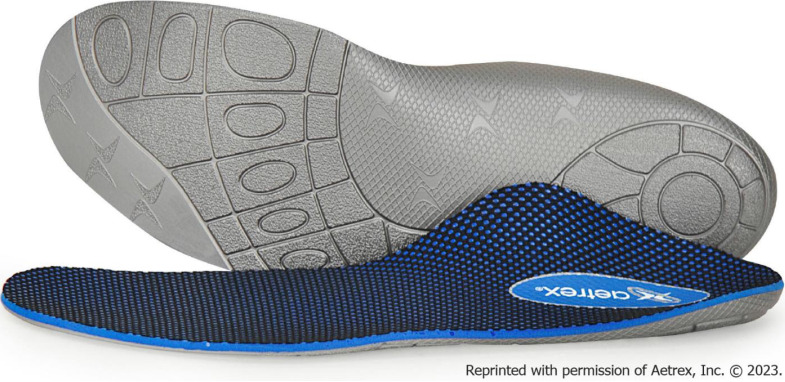
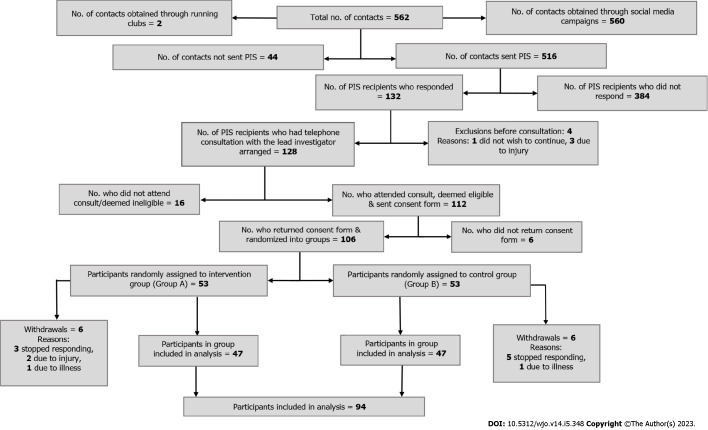
One hundred and six recreational runners were recruited on a voluntary basis running clubs and social media pages and randomised into either the intervention or control group. Participants in the intervention group ran with Aetrex L700 Speed Orthotics inserted in their usual running shoes, whilst participants in the control group ran in their usual running shoes with no orthotics. The study ran for an 8-wk period. Participants provided data relating to running comfort, distance, and time during weeks 3-6. Participants provided data relating to any RRIs they sustained during all 8 wks. Running distance and time were used to calculate running speed in miles hour (mph). For each outcome variable, 95% confidence intervals and values were calculated to assess the statistical significance between the groups. For comfort and speed data, univariate multi-level analysis was performed, and for outcome variables with significant between group differences, multi-level multivariate analysis was performed to evaluate any confounding effects of gender and age.
Ninety-four participants were included in the final analysis (drop-out rate = 11%). Comfort and speed from 940 runs and 978 injury data reports were analysed. Participants who ran with orthotics reported, on average, speeds 0.30 mph faster ( = 0.20) and comfort scores 1.27 points higher ( ≤ 0.001) than participants who ran with no orthotics. They were also 2.22 times less likely to sustain an injury ( = 0.08) than participants who ran with no orthotics. However, findings were only significant for comfort and not for speed or injury rates. Age and gender were found to be significant predictors of comfort. However, the improvements in comfort reported by participants who ran with orthotics were still significant after adjusting for age and gender.
This study found orthotics to improve comfort and speed and prevent RRIs whilst running. However, these findings were only statistically significant for comfort.
跑步是一项非常受欢迎的运动。不幸的是,与跑步相关的损伤(RRI)发生率很高,尤其是在业余和休闲跑步者中。找到降低RRI发生率并使跑步者的舒适度和表现最大化的方法很重要。关于矫形器是否能成功改善这些参数的证据有限且相互矛盾。需要进一步的研究为跑步者提供关于矫形器有用性的更明确指导。
研究Aetrex矫形器对休闲跑步时的舒适度、速度和RRI发生率的影响。
通过跑步俱乐部和社交媒体页面自愿招募了106名休闲跑步者,并随机分为干预组或对照组。干预组的参与者在他们平常的跑鞋中插入Aetrex L700速度矫形器进行跑步,而对照组的参与者则穿着平常的跑鞋不使用矫形器跑步。该研究持续8周。参与者在第3至6周提供了与跑步舒适度、距离和时间相关的数据。参与者提供了他们在整个8周内遭受的任何RRI相关数据。跑步距离和时间用于计算以英里每小时(mph)为单位的跑步速度。对于每个结果变量,计算95%置信区间和p值以评估两组之间的统计学显著性。对于舒适度和速度数据,进行单变量多层次分析,对于组间差异显著的结果变量,进行多层次多变量分析以评估性别和年龄的任何混杂效应。
94名参与者被纳入最终分析(脱落率 = 11%)。分析了来自940次跑步的舒适度和速度以及978份损伤数据报告。使用矫形器跑步的参与者平均报告的速度比不使用矫形器跑步的参与者快0.30 mph(p = 0.20),舒适度得分高1.27分(p≤0.001)。他们遭受损伤的可能性也比不使用矫形器跑步的参与者低2.22倍(p = 0.08)。然而,研究结果仅在舒适度方面显著,在速度或损伤发生率方面不显著。年龄和性别被发现是舒适度的显著预测因素。然而,在调整年龄和性别后,使用矫形器跑步的参与者报告的舒适度改善仍然显著。
本研究发现矫形器可提高跑步时的舒适度和速度并预防RRI。然而,这些结果仅在舒适度方面具有统计学显著性。