Uddin Mohy, Nursetyo Aldilas Achmad, Iqbal Usman, Nguyen Phung-Anh, Jian Wen-Shan, Li Yu-Chuan, Syed-Abdul Shabbir
Research Quality Management Section, King Abdullah International Medical Research Center, King Saud bin Abdulaziz University for Health Sciences, Ministry of National Guard - Health Affairs, Riyadh, Kingdom of Saudi Arabia.
Center for Health Policy Management, Universitas Gadjah Mada, Indonesia.
AIMS Public Health. 2023 May 6;10(2):324-332. doi: 10.3934/publichealth.2023024. eCollection 2023.
A vast amount of literature has been conducted for investigating the association of different lunar phases with human health; and it has mixed reviews for association and non-association of diseases with lunar phases. This study investigates the existence of any impact of moon phases on humans by exploring the difference in the rate of outpatient visits and type of diseases that prevail in either non-moon or moon phases.
We retrieved dates of non-moon and moon phases for eight years (1st January 2001-31st December 2008) from the timeanddate.com website for Taiwan. The study cohort consisted of 1 million people from Taiwan's National Health Insurance Research Database (NHIRD) followed over eight years (1st January 2001-31st December 2008). We used the two-tailed, paired-t-test to compare the significance of difference among outpatient visits for 1229 moon phase days and 1074 non-moon phase days by using International Classification of Diseases, Ninth Revision, Clinical Modification (ICD-9-CM) codes from NHIRD records.
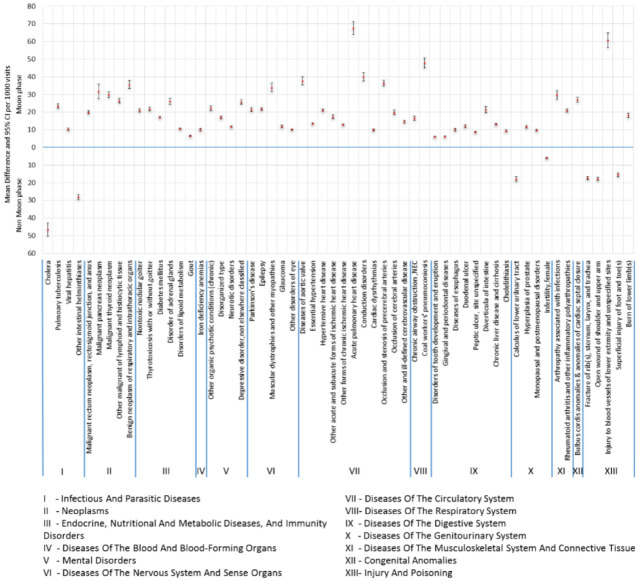
We found 58 diseases that showed statistical differences in number of outpatient visits in the non-moon and moon phases.
The results of our study identified diseases that have significant variations during different lunar phases (non-moon and moon phases) for outpatient visits in the hospital. In order to fully understand the reality of the pervasive myth of lunar effects on human health, behaviors and diseases, more in-depth research investigations are required for providing comprehensive evidence covering all the factors, such as biological, psychological and environmental aspects.
已有大量文献对不同月相对人类健康的关联进行了研究;对于疾病与月相之间的关联与否,存在不同的评价。本研究通过探讨非月相期和月相期门诊就诊率的差异以及流行疾病类型,来调查月相对人类是否存在任何影响。
我们从timeanddate.com网站获取了台湾地区八年(2001年1月1日至2008年12月31日)的非月相期和月相期日期。研究队列由台湾国民健康保险研究数据库(NHIRD)中的100万人组成,随访时间为八年(2001年1月1日至2008年12月31日)。我们使用双侧配对t检验,通过NHIRD记录中的国际疾病分类第九版临床修订本(ICD - 9 - CM)编码,比较1229个满月期日和1074个非满月期日门诊就诊差异的显著性。
我们发现58种疾病在非满月期和满月期的门诊就诊人数上存在统计学差异。
我们的研究结果确定了在医院门诊就诊中,不同月相期(非满月期和满月期)有显著差异的疾病。为了全面了解月相对人类健康、行为和疾病普遍影响这一神话的实际情况,则需要更深入的研究调查,以提供涵盖生物、心理和环境等所有因素的全面证据。