Latrobe Sports Exercise Medicine Research Centre, School of Allied Health, Human Services and Sport, La Trobe University, Bundoora, Victoria, Australia.
MOG Sports Medicine, Melbourne Orthopaedic Group, Windsor, Victoria, Australia.
Hip Int. 2024 Jan;34(1):96-114. doi: 10.1177/11207000231179610. Epub 2023 Jun 12.
Hip dysplasia is a common condition in active adults with hip pain that can lead to joint degeneration. Periacetabular osteotomy (PAO) is a common surgical treatment for hip dysplasia. The effect of this surgery on pain, function and quality of life (QOL) has not been systematically analysed.
In adults with hip dysplasia: (1) evaluate differences in pain, function and QOL in those undergoing PAO and healthy controls; (2) evaluate pre- to post-PAO changes in pain, function and QOL; (3) evaluate differences in pain, function and QOL in those with mild versus severe dysplasia, undergoing PAO; and (4) evaluate differences in pain, function and QOL in those having primary PAO versus those with previous hip arthroscopy.
A comprehensive, reproducible search strategy was performed on 5 different databases. We included studies that assessed pain, function and QOL in adults undergoing PAO for hip dysplasia, using hip-specific patient reported outcomes measures.
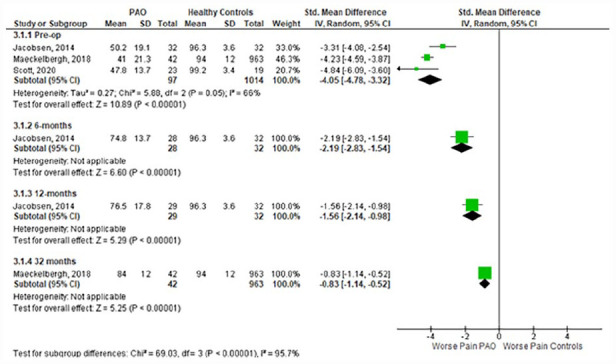
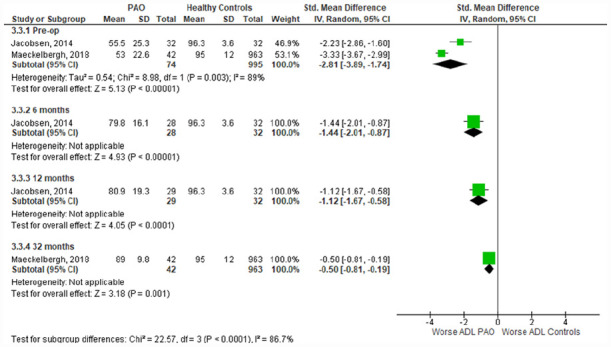
From 5017 titles and abstracts screened, 62 studies were included. Meta-analysis showed PAO patients had worse outcomes pre- and post-PAO compared to healthy participants. Specifically, pain (standardised mean difference [SMD] 95% confidence interval [CI]): -4.05; -4.78 to -3.32), function (-2.81; -3.89 to -1.74), and QOL (-4.10; -4.43 to -3.77) were significantly poorer preoperatively.Meta-analysis found patients experienced improvements following PAO. Pain improved from pre-surgery to 1-year (standardised paired difference [SPD] 1.35; 95% CI, 1.02-1.67) and 2 years postoperatively (1.35; 1.16-1.54). For function, the activities of daily living scores at 1 year (1.22; 1.09-1.35) and 2 years (1.06; 0.9-1.22) and QOL at 1 year (1.36; 1.22-1.5) and 2 years (1.3; 1.1-1.5) all improved. No difference was found between patients undergoing PAO with mild versus severe dysplasia.
Before undergoing PAO surgery, adults with hip dysplasia have worse levels of pain, function and QOL compared to healthy participants. These levels improve following PAO, but do not reach the same level as their healthy participants.
PROSPERO (CRD42020144748).
髋关节发育不良是一种常见的髋部疼痛的活跃成年人的病症,可能导致关节退化。髋臼周围截骨术(PAO)是髋关节发育不良的常见手术治疗方法。这种手术对疼痛、功能和生活质量(QOL)的影响尚未得到系统分析。
在髋关节发育不良的成年人中:(1)评估接受 PAO 治疗和健康对照组之间疼痛、功能和 QOL 的差异;(2)评估术前至术后 PAO 后疼痛、功能和 QOL 的变化;(3)评估轻度与重度发育不良患者接受 PAO 治疗时疼痛、功能和 QOL 的差异;(4)评估初次 PAO 与既往髋关节镜检查患者疼痛、功能和 QOL 的差异。
在 5 个不同的数据库上进行了全面、可重复的搜索策略。我们纳入了使用髋关节特异性患者报告结局测量评估髋关节发育不良患者接受 PAO 治疗后疼痛、功能和 QOL 的研究。
从 5017 篇标题和摘要中筛选出 62 项研究。荟萃分析显示,PAO 患者术前和术后的结果均比健康参与者差。具体来说,疼痛(标准化均数差 [SMD]95%置信区间 [CI]):-4.05;-4.78 至-3.32)、功能(-2.81;-3.89 至-1.74)和 QOL(-4.10;-4.43 至-3.77)在术前明显较差。荟萃分析发现患者在接受 PAO 后有所改善。疼痛从术前到术后 1 年(标准化配对差异 [SPD]1.35;95%CI,1.02-1.67)和 2 年(1.35;1.16-1.54)均有改善。对于功能,1 年(1.22;1.09-1.35)和 2 年(1.06;0.9-1.22)的日常生活活动评分以及 1 年(1.36;1.22-1.5)和 2 年(1.3;1.1-1.5)的 QOL 均有所改善。在接受 PAO 治疗的轻度与重度发育不良患者之间没有差异。
在接受 PAO 手术前,髋关节发育不良的成年人的疼痛、功能和 QOL 水平均较健康参与者差。这些水平在接受 PAO 后得到改善,但仍未达到健康参与者的水平。
PROSPERO(CRD42020144748)。