Department of Psychiatry, The First Affiliated Hospital of Chongqing Medical University, Chongqing, China.
NHC Key Laboratory of Diagnosis and Treatment on Brain Functional Diseases, The First Affiliated Hospital of Chongqing Medical University, Chongqing, China.
Transl Psychiatry. 2023 Jun 12;13(1):200. doi: 10.1038/s41398-023-02486-3.
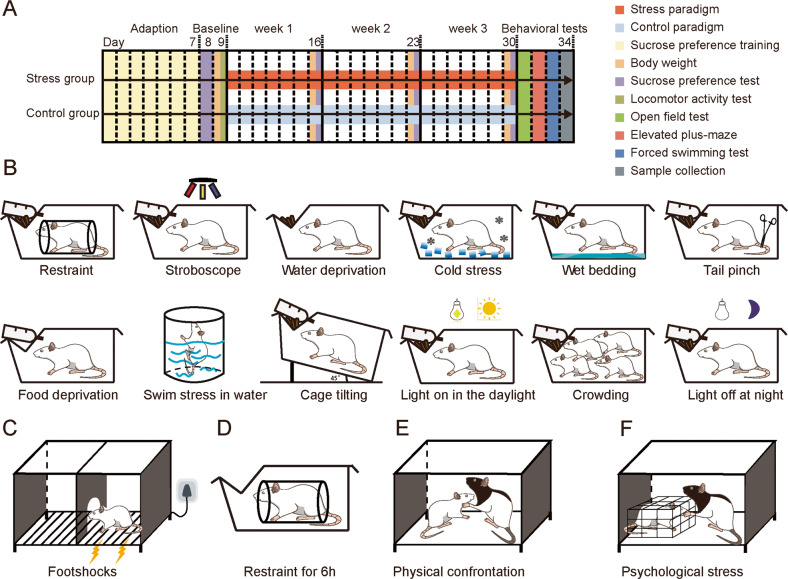
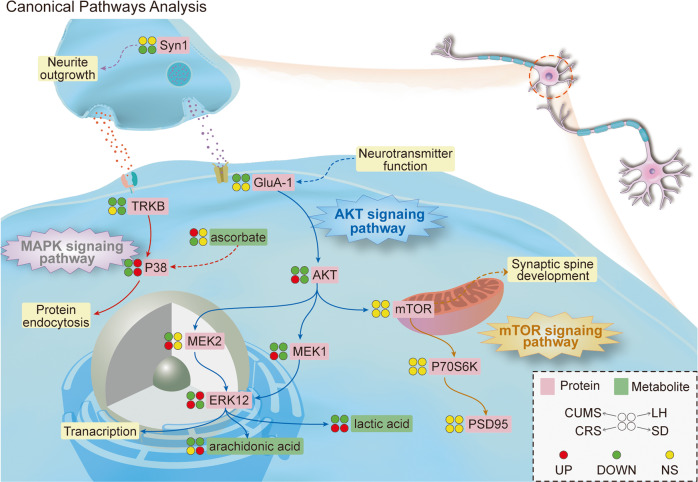
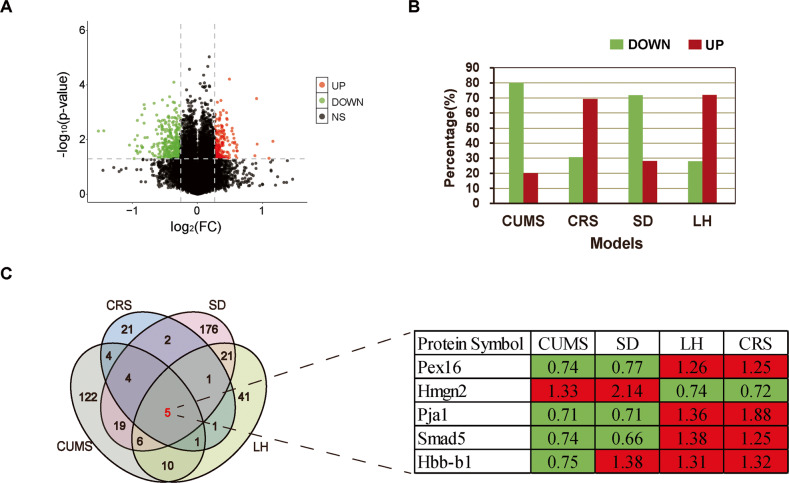
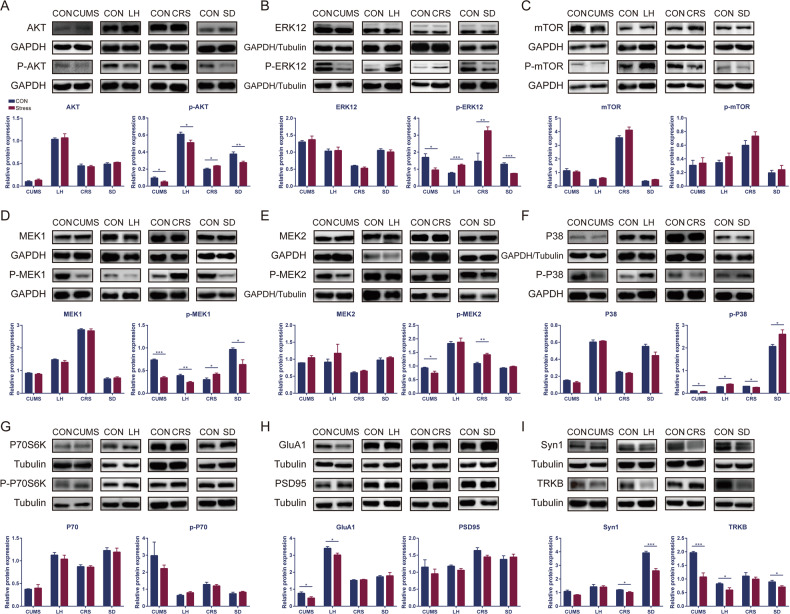
Major depressive disorder (MDD) is a highly heterogeneous psychiatric disorder. The pathogenesis of MDD remained unclear, and it may be associated with exposure to different stressors. Most previous studies have focused on molecular changes in a single stress-induced depression model, which limited the identification of the pathogenesis of MDD. The depressive-like behaviors were induced by four well-validated stress models in rats, including chronic unpredictable mild stress, learned helplessness stress, chronic restraint stress and social defeat stress. We applied proteomic and metabolomic to investigate molecular changes in the hippocampus of those four models and revealed 529 proteins and 98 metabolites. Ingenuity Pathways Analysis (IPA) and Kyoto Encyclopedia of Genes and Genomes (KEGG) analysis identified differentially regulated canonical pathways, and then we presented a schematic model that simulates AKT and MAPK signaling pathways network and their interactions and revealed the cascade reactions. Further, the western blot confirmed that p-AKT, p-ERK12, GluA1, p-MEK1, p-MEK2, p-P38, Syn1, and TrkB, which were changed in at least one depression model. Importantly, p-AKT, p-ERK12, p-MEK1 and p-P38 were identified as common alterations in four depression models. The molecular level changes caused by different stressors may be dramatically different, and even opposite, between four depression models. However, the different molecular alterations converge on a common AKT and MAPK molecular pathway. Further studies of these pathways could contribute to a better understanding of the pathogenesis of depression, with the ultimate goal of helping to develop or select more effective treatment strategies for MDD.
重度抑郁症(MDD)是一种高度异质的精神障碍。MDD 的发病机制仍不清楚,它可能与暴露于不同的应激源有关。大多数先前的研究都集中在单一应激诱导抑郁模型中的分子变化上,这限制了 MDD 发病机制的识别。通过四种经过充分验证的大鼠应激模型诱导抑郁样行为,包括慢性不可预测的轻度应激、习得性无助应激、慢性束缚应激和社会挫败应激。我们应用蛋白质组学和代谢组学研究了这四种模型中海马的分子变化,揭示了 529 种蛋白质和 98 种代谢物。IPA 和 KEGG 分析确定了差异调节的经典途径,然后我们提出了一个模拟 AKT 和 MAPK 信号通路网络及其相互作用的示意图模型,并揭示了级联反应。此外,Western blot 验证了至少一种抑郁模型中发生变化的 p-AKT、p-ERK12、GluA1、p-MEK1、p-MEK2、p-P38、Syn1 和 TrkB。重要的是,p-AKT、p-ERK12、p-MEK1 和 p-P38 在四种抑郁模型中均被鉴定为共同改变。不同应激源引起的分子水平变化在四种抑郁模型之间可能存在显著差异,甚至相反。然而,不同的分子改变都集中在一个共同的 AKT 和 MAPK 分子途径上。进一步研究这些途径有助于更好地理解抑郁症的发病机制,最终目标是帮助开发或选择更有效的 MDD 治疗策略。