Climate Change & Innovation Bureau, Health Canada, Ottawa, ON, Canada.
Institut National de La Recherche Scientifique (Centre Eau-Terre-Environnement), Québec, QC, Canada.
Can J Public Health. 2023 Oct;114(5):726-736. doi: 10.17269/s41997-023-00782-5. Epub 2023 Jun 12.
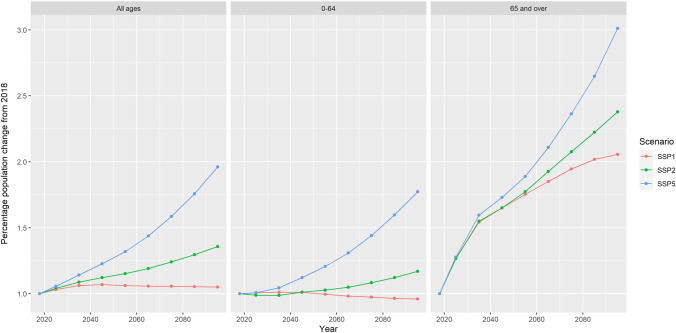
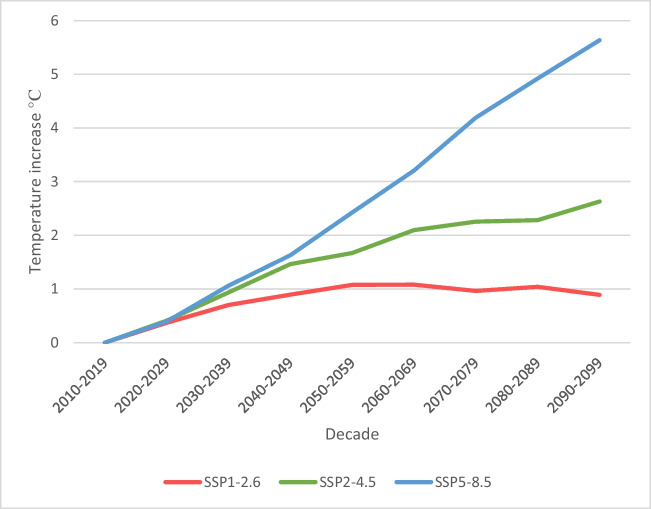
Climate change is expected to increase global temperatures. How temperature-related mortality risk will change is not completely understood, and how future demographic changes will affect temperature-related mortality needs to be clarified. We evaluate temperature-related mortality across Canada until 2099, accounting for age groups and scenarios of population growth.
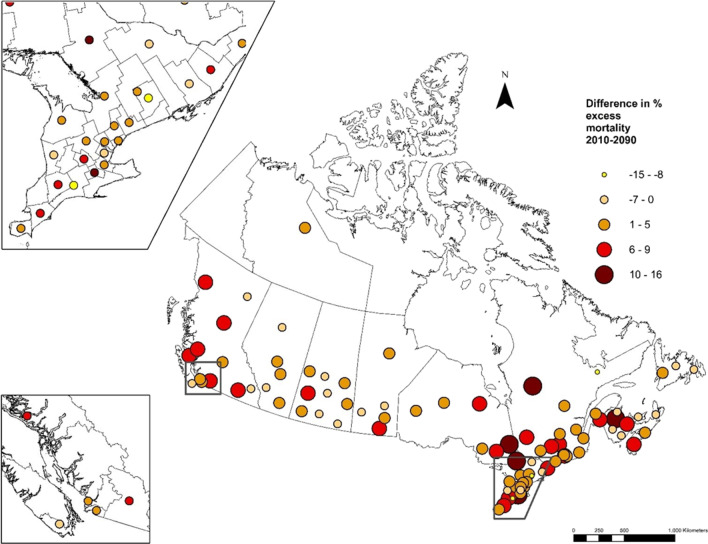
We used daily counts of non-accidental mortality for 2000 to 2015 for all 111 health regions across Canada, incorporating in the study both urban and rural areas. A two-part time series analysis was used to estimate associations between mean daily temperatures and mortality. First, current and future daily mean temperature time series simulations were developed from Coupled Model Inter-Comparison Project 6 (CMIP6) climate model ensembles from past and projected climate change scenarios under Shared Socioeconomic Pathways (SSPs). Next, excess mortality due to heat and cold and the net difference were projected to 2099, also accounting for different regional and population aging scenarios.
For 2000 to 2015, we identified 3,343,311 non-accidental deaths. On average, a net increase of 17.31% (95% eCI: 13.99, 20.62) in temperature-related excess mortality under a higher greenhouse gas emission scenario is expected for Canada in 2090-2099, which represents a greater burden than a scenario that assumed strong levels of greenhouse gas mitigation policies (net increase of 3.29%; 95% eCI: 1.41, 5.17). The highest net increase was observed among people aged 65 and over, and the largest increases in both net and heat- and cold-related mortality were observed in population scenarios that incorporated the highest rates of aging.
Canada may expect net increases in temperature-related mortality under a higher emissions climate change scenario, compared to one assuming sustainable development. Urgent action is needed to mitigate future climate change impacts.
预计气候变化将导致全球气温上升。目前尚不完全清楚与温度相关的死亡风险将如何变化,也需要阐明未来人口变化将如何影响与温度相关的死亡率。我们评估了截至 2099 年加拿大各地与温度相关的死亡率,考虑了年龄组和人口增长情景。
我们使用了加拿大所有 111 个卫生区 2000 年至 2015 年的非意外死亡率的日常数据,研究中既包括城市地区也包括农村地区。采用两部分时间序列分析来估计平均日温度与死亡率之间的关联。首先,从耦合模型比较计划 6(CMIP6)气候模型集合中开发了当前和未来的日平均温度时间序列模拟,该模型集合考虑了过去和预测的气候变化情景下的社会经济共享路径(SSP)下的温室气体排放。接下来,预测了到 2099 年因热和冷导致的超额死亡人数和净差异,同时还考虑了不同地区和人口老龄化情景。
在 2000 年至 2015 年期间,我们确定了 3343311 例非意外死亡。在较高温室气体排放情景下,预计 2090 年至 2099 年加拿大与温度相关的超额死亡人数将净增加 17.31%(95%置信区间:13.99,20.62),这比假设温室气体减排政策水平较强的情景下的负担更大(净增加 3.29%;95%置信区间:1.41,5.17)。在 65 岁及以上的人群中观察到最高的净增长,在人口情景中观察到净增长以及热和冷相关死亡人数的最大增长,这些情景都考虑了最高的老龄化率。
与假设可持续发展的情景相比,加拿大在较高排放气候变化情景下可能会出现与温度相关的死亡人数净增加。需要采取紧急行动来减轻未来气候变化的影响。