Timonin Sergey, Shartova Natalia, Wen Bo, Wu Yao, Andreev Evgeny, Guo Yuming, Ballester Joan
School of Demography, Research School of Social Sciences, The Australian National University, Canberra, ACT, Australia; National Centre for Epidemiology and Population Health, The Australian National University, Canberra, ACT, Australia.
ISGlobal, Barcelona, Spain.
Lancet Planet Health. 2025 May;9(5):e410-e420. doi: 10.1016/S2542-5196(25)00084-1.
Despite a substantial body of evidence on the association between ambient temperature and mortality worldwide, there has not yet been a comprehensive country-wide assessment of the health effects of temperature in Russia. Moreover, there is no consensus on the effect of non-optimal temperatures on age-specific and sex-specific mortality. Our study aimed to provide the first analysis of temperature-related mortality in a large assembly of cities located in different geographical and socioeconomic zones of Russia.
We analysed 19 044 538 non-accidental deaths in the 300 most populated cities in Russia between 2000 and 2019. A two-stage analysis strategy was used. First, a quasi-Poisson time-series model with distributed lag non-linear model was fitted to estimate city-specific associations. Second, these associations were pooled with multivariate multilevel meta-regression, from which we also calculated temperature-attributable mortality.
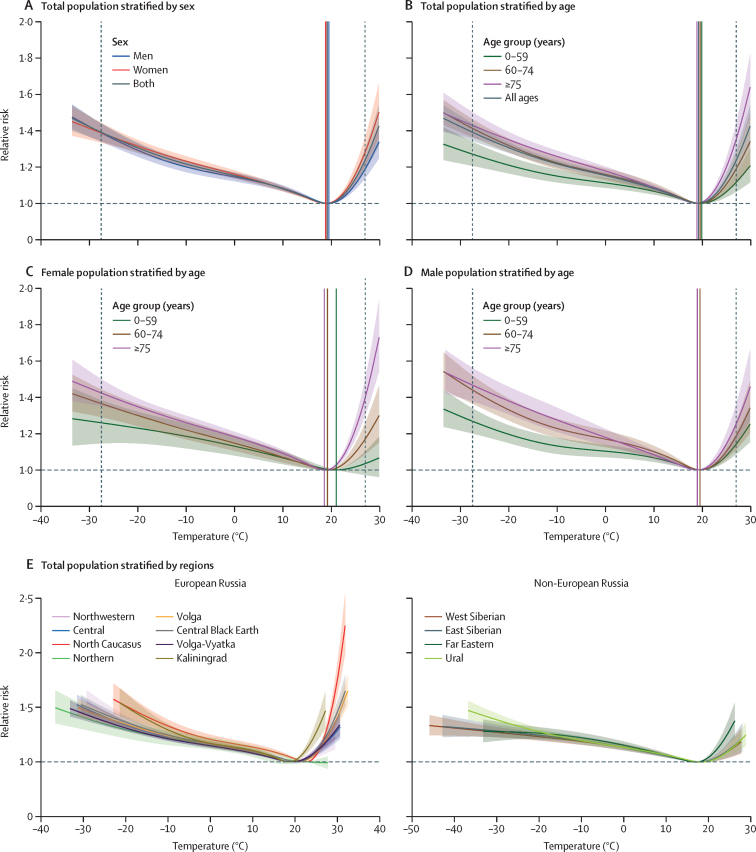
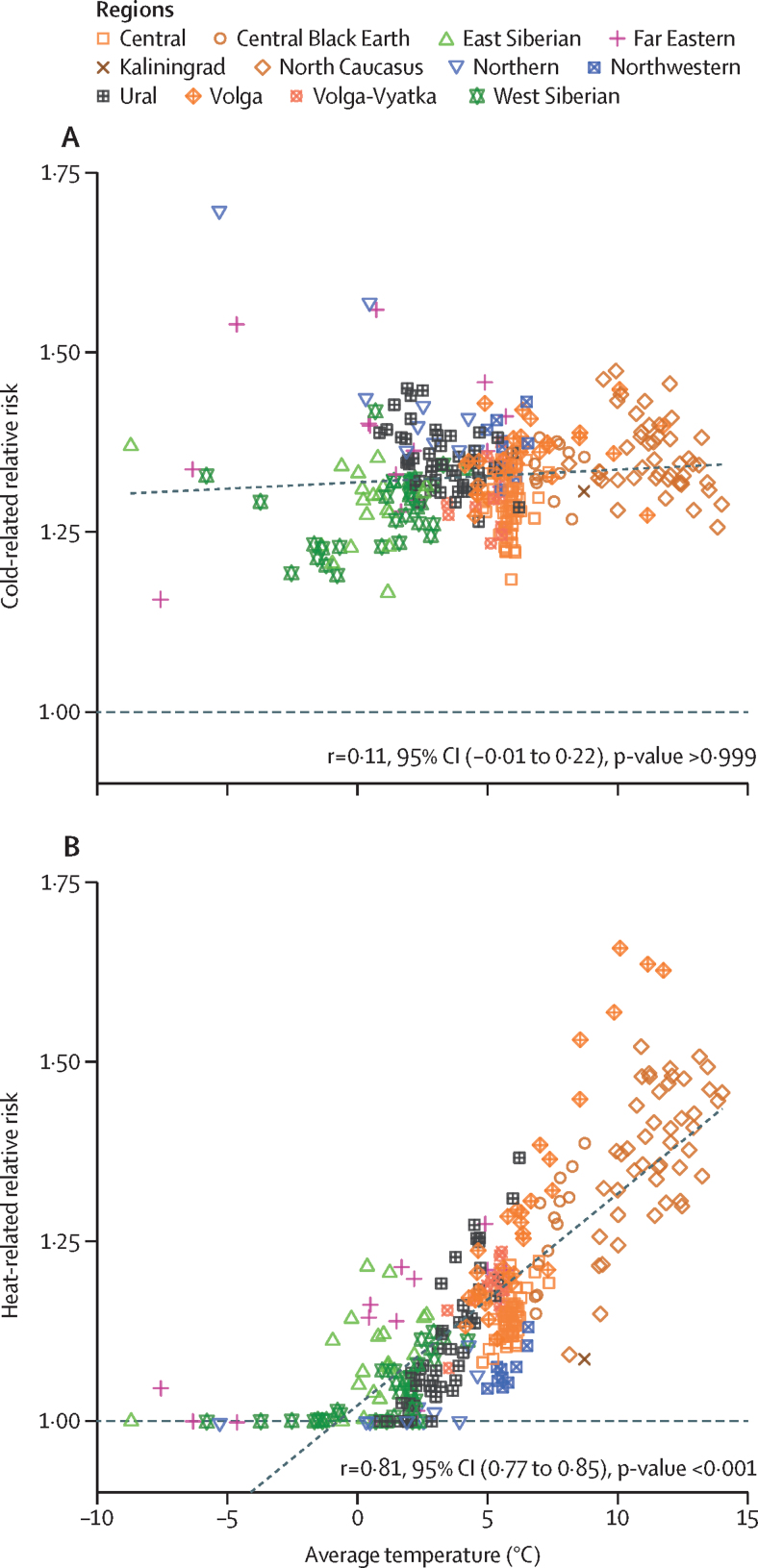
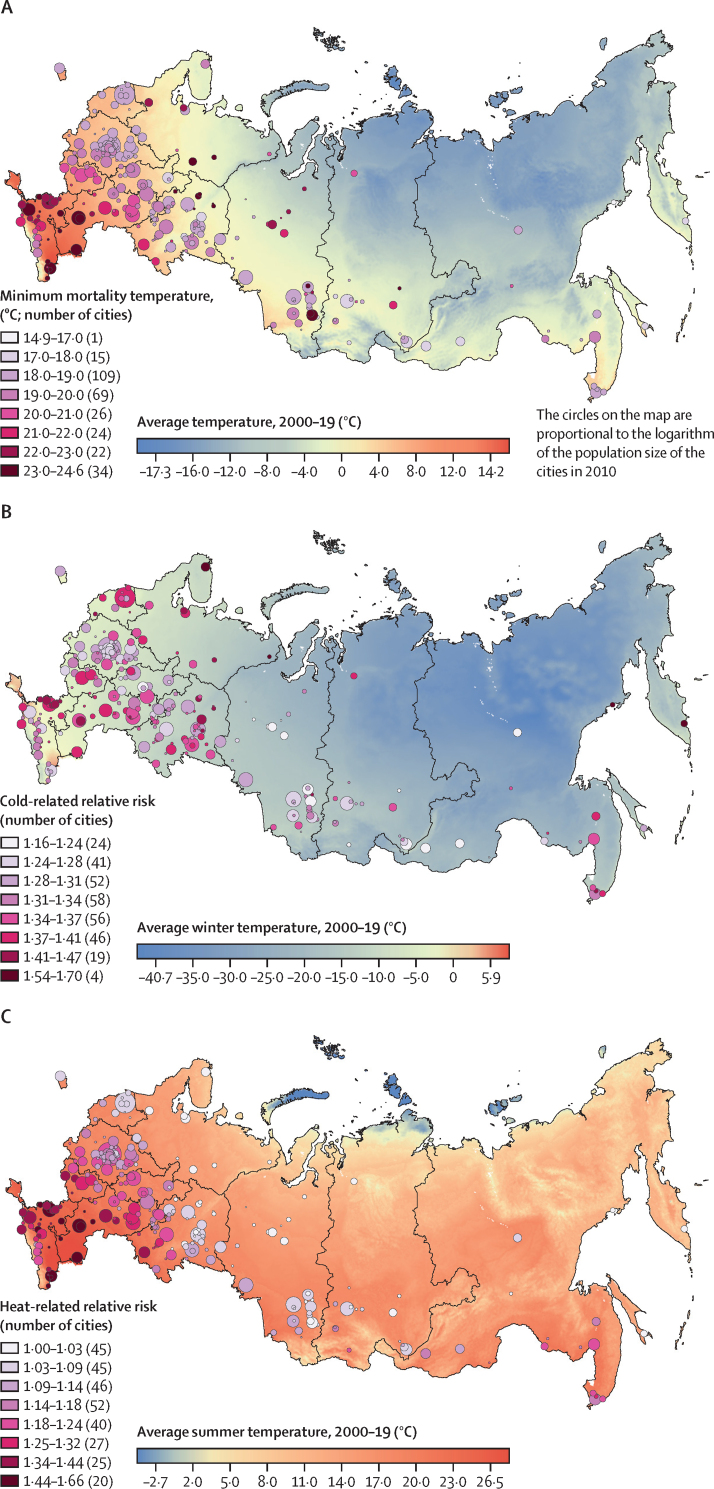
Relative risks were generally higher for cold than for heat, except for cities in southern European Russia. Cold had a similar effect in both sexes, with a varying age gradient across cities. Although the effect of heat was generally stronger in women than in men, with the relative risk increasing steadily with age in both sexes, men younger than 60 years had a significantly higher risk of dying from heat than women of the same age. With a total of 106 007 (95% empirical CI [eCI]: 88 942-121 318) temperature-attributable deaths, there was a higher mortality attributable fraction for cold (10·74%, 95% eCI 8·80-11·99) than for heat (0·67%, 0·42-0·88).
Russia has a high temperature-related mortality burden, with large differences in risk between cities and subpopulations. This information should be taken into account when planning public health interventions.
European Research Council, National Health and Medical Research Council, and Australian Research Council.
尽管全球已有大量关于环境温度与死亡率之间关联的证据,但俄罗斯尚未对全国范围内温度对健康的影响进行全面评估。此外,关于非适宜温度对特定年龄和性别的死亡率的影响尚无共识。我们的研究旨在首次分析俄罗斯不同地理和社会经济区域的大量城市中与温度相关的死亡率。
我们分析了2000年至2019年俄罗斯人口最多的300个城市中的19044538例非意外死亡病例。采用两阶段分析策略。首先,拟合具有分布滞后非线性模型的准泊松时间序列模型,以估计特定城市的关联。其次,将这些关联与多变量多层次元回归进行汇总,我们还从中计算了温度归因死亡率。
除俄罗斯欧洲部分南部的城市外,寒冷导致的相对风险通常高于炎热。寒冷对男女的影响相似,但不同城市的年龄梯度有所不同。尽管炎热对女性的影响通常比男性更强,且男女的相对风险均随年龄稳步增加,但60岁以下的男性因炎热死亡的风险显著高于同龄女性。温度归因死亡总数为106007例(95%经验置信区间[eCI]:88942 - 121318),寒冷导致的死亡率归因比例(10.74%,95% eCI 8.80 - 11.99)高于炎热(0.67%,0.42 - 0.88)。
俄罗斯的温度相关死亡率负担较高,不同城市和亚人群之间的风险存在很大差异。在规划公共卫生干预措施时应考虑这些信息。
欧洲研究理事会、国家卫生与医学研究理事会和澳大利亚研究理事会。