
优化结核病治疗效果:比较标准方案与含莫西沙星方案。
Optimizing tuberculosis treatment efficacy: Comparing the standard regimen with Moxifloxacin-containing regimens.
机构信息
Department of Microbiology and Immunology, University of Michigan Medical School, Ann Arbor, Michigan, United States of America.
Department of Chemical Engineering, University of Michigan, Ann Arbor, Michigan, United States of America.
出版信息
PLoS Comput Biol. 2023 Jun 15;19(6):e1010823. doi: 10.1371/journal.pcbi.1010823. eCollection 2023 Jun.
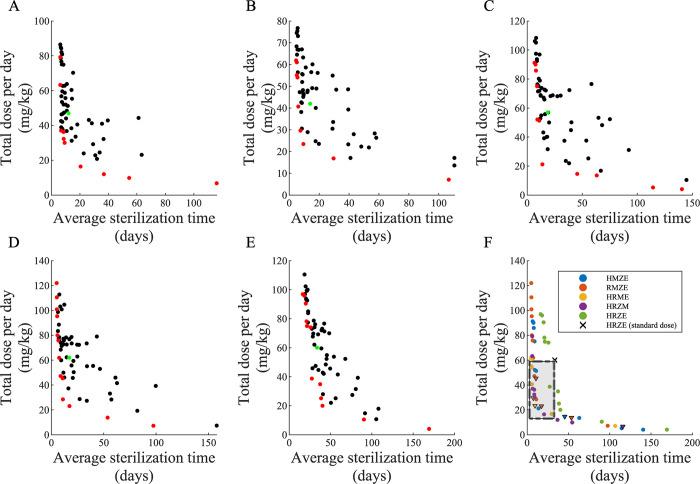
Tuberculosis (TB) continues to be one of the deadliest infectious diseases in the world, causing ~1.5 million deaths every year. The World Health Organization initiated an End TB Strategy that aims to reduce TB-related deaths in 2035 by 95%. Recent research goals have focused on discovering more effective and more patient-friendly antibiotic drug regimens to increase patient compliance and decrease emergence of resistant TB. Moxifloxacin is one promising antibiotic that may improve the current standard regimen by shortening treatment time. Clinical trials and in vivo mouse studies suggest that regimens containing moxifloxacin have better bactericidal activity. However, testing every possible combination regimen with moxifloxacin either in vivo or clinically is not feasible due to experimental and clinical limitations. To identify better regimens more systematically, we simulated pharmacokinetics/pharmacodynamics of various regimens (with and without moxifloxacin) to evaluate efficacies, and then compared our predictions to both clinical trials and nonhuman primate studies performed herein. We used GranSim, our well-established hybrid agent-based model that simulates granuloma formation and antibiotic treatment, for this task. In addition, we established a multiple-objective optimization pipeline using GranSim to discover optimized regimens based on treatment objectives of interest, i.e., minimizing total drug dosage and lowering time needed to sterilize granulomas. Our approach can efficiently test many regimens and successfully identify optimal regimens to inform pre-clinical studies or clinical trials and ultimately accelerate the TB regimen discovery process.
结核病(TB)仍然是世界上最致命的传染病之一,每年导致约 150 万人死亡。世界卫生组织启动了一项终结结核病战略,旨在到 2035 年将与结核病相关的死亡人数减少 95%。最近的研究目标集中在发现更有效、更适合患者的抗生素药物方案,以提高患者的依从性并减少耐药结核病的出现。莫西沙星是一种有前途的抗生素,通过缩短治疗时间可能改善当前的标准方案。临床试验和体内小鼠研究表明,含有莫西沙星的方案具有更好的杀菌活性。然而,由于实验和临床限制,在体内或临床上测试每一种可能的含有莫西沙星的组合方案都是不可行的。为了更系统地确定更好的方案,我们模拟了各种方案(含或不含莫西沙星)的药代动力学/药效学,以评估疗效,然后将我们的预测与这里进行的临床试验和非人类灵长类动物研究进行比较。我们使用我们成熟的基于代理的混合模型 GranSim 来完成这项任务,该模型可模拟肉芽肿的形成和抗生素治疗。此外,我们使用 GranSim 建立了一个多目标优化管道,以根据感兴趣的治疗目标(即最小化总药物剂量和降低使肉芽肿无菌所需的时间)发现优化方案。我们的方法可以有效地测试许多方案,并成功地确定最佳方案,为临床前研究或临床试验提供信息,并最终加速结核病方案的发现过程。


 Zotero 插件