Biswal Basanta Kumar, Balasubramanian Rajasekhar
Department of Civil and Environmental Engineering, National University of Singapore, Singapore, Singapore.
Front Microbiol. 2023 May 31;14:1197081. doi: 10.3389/fmicb.2023.1197081. eCollection 2023.
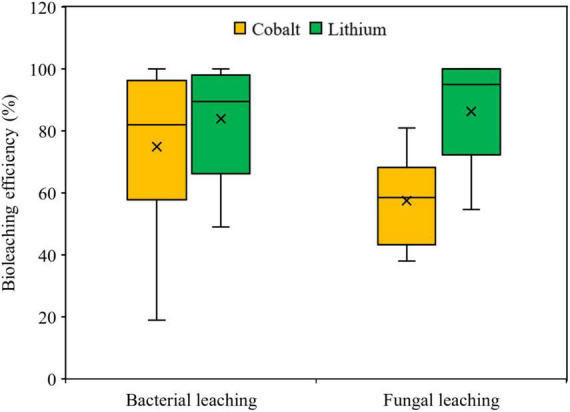
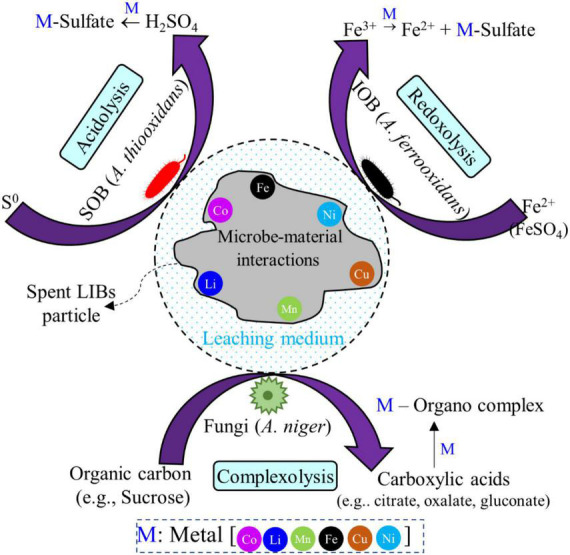
Spent lithium-ion batteries (LIBs) are increasingly generated due to their widespread use for various energy-related applications. Spent LIBs contain several valuable metals including cobalt (Co) and lithium (Li) whose supply cannot be sustained in the long-term in view of their increased demand. To avoid environmental pollution and recover valuable metals, recycling of spent LIBs is widely explored using different methods. Bioleaching (biohydrometallurgy), an environmentally benign process, is receiving increased attention in recent years since it utilizes suitable microorganisms for selective leaching of Co and Li from spent LIBs and is cost-effective. A comprehensive and critical analysis of recent studies on the performance of various microbial agents for the extraction of Co and Li from the solid matrix of spent LIBs would help for development of novel and practical strategies for effective extraction of precious metals from spent LIBs. Specifically, this review focuses on the current advancements in the application of microbial agents namely bacteria (e.g., and ) and fungi (e.g., ) for the recovery of Co and Li from spent LIBs. Both bacterial and fungal leaching are effective for metal dissolution from spent LIBs. Among the two valuable metals, the dissolution rate of Li is higher than Co. The key metabolites which drive the bacterial leaching include sulfuric acid, while citric acid, gluconic acid and oxalic acid are the dominant metabolites in fungal leaching. The bioleaching performance depends on both biotic (microbial agents) and abiotic factors (pH, pulp density, dissolved oxygen level and temperature). The major biochemical mechanisms which contribute to metal dissolution include acidolysis, redoxolysis and complexolysis. In most cases, the shrinking core model is suitable to describe the bioleaching kinetics. Biological-based methods (e.g., bioprecipitation) can be applied for metal recovery from the bioleaching solution. There are several potential operational challenges and knowledge gaps which should be addressed in future studies to scale-up the bioleaching process. Overall, this review is of importance from the perspective of development of highly efficient and sustainable bioleaching processes for optimum resource recovery of Co and Li from spent LIBs, and conservation of natural resources to achieve circular economy.
由于锂离子电池(LIBs)在各种能源相关应用中的广泛使用,废旧锂离子电池的产生量日益增加。废旧锂离子电池含有多种有价值的金属,包括钴(Co)和锂(Li),鉴于其需求不断增加,其供应无法长期维持。为避免环境污染并回收有价值的金属,人们广泛探索使用不同方法对废旧锂离子电池进行回收利用。生物浸出(生物湿法冶金)是一种环境友好型工艺,近年来受到越来越多的关注,因为它利用合适的微生物从废旧锂离子电池中选择性浸出钴和锂,且具有成本效益。对近期关于各种微生物制剂从废旧锂离子电池固体基质中提取钴和锂性能的研究进行全面而关键的分析,将有助于开发从废旧锂离子电池中有效提取贵金属的新颖实用策略。具体而言,本综述重点关注微生物制剂,即细菌(如 和 )和真菌(如 )在从废旧锂离子电池中回收钴和锂方面的应用现状。细菌浸出和真菌浸出对从废旧锂离子电池中溶解金属均有效。在这两种有价值的金属中,锂的溶解速率高于钴。驱动细菌浸出的关键代谢产物包括硫酸,而柠檬酸、葡萄糖酸和草酸是真菌浸出中的主要代谢产物。生物浸出性能取决于生物因素(微生物制剂)和非生物因素(pH值、矿浆密度、溶解氧水平和温度)。导致金属溶解的主要生化机制包括酸解、氧化还原解和络合解。在大多数情况下,收缩核模型适用于描述生物浸出动力学。基于生物的方法(如生物沉淀)可用于从生物浸出溶液中回收金属。未来研究在扩大生物浸出工艺规模时,应解决几个潜在的操作挑战和知识空白。总体而言,本综述从开发高效可持续的生物浸出工艺以实现从废旧锂离子电池中最佳回收钴和锂资源以及保护自然资源以实现循环经济的角度来看具有重要意义。