Amzat Jimoh, Razum Oliver, Kanmodi Kehinde K
Department of Sociology Usmanu Danfodiyo University Sokoto Nigeria.
Department of Sociology University of Johannesburg Johannesburg South Africa.
Health Sci Rep. 2023 Jun 14;6(6):e1339. doi: 10.1002/hsr2.1339. eCollection 2023 Jun.
Polio eradication efforts including polio-philanthropy have been coordinated and sustained since 1988, with the introduction of the Global Polio Eradication Initiative (GPEI). The polio fight is sustained in the name of evidence-based benevolence or beneficent philanthropy from which Africa has benefited immensely. With the recorded polio cases as of 2023, more efforts and funds are required to eradicate polio. Hence, it is not yet "Uhuru." Using the Mertonian lens, this study examines polio-philanthropy in Africa, its unintended consequences, and crucial dilemmas, which could impact the polio fight and polio-philanthropy.
This is a narrative review that relies on secondary sources obtained through a thorough literature search. Only studies published in English were utilized. The study synthesized relevant literature in line with the study objective. The following databases were consulted: PubMed, philosopher's index, web of knowledge, Google Scholar, and Sociological Abstracts. Both empirical and theoretical studies were utilized for the study.
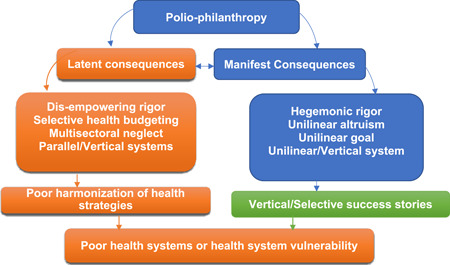
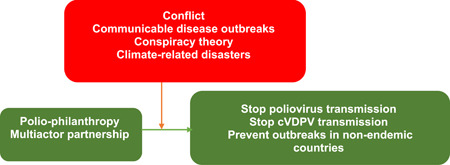
Despite significant achievements, the global initiative has shortcomings when examined through the Mertonian lens of manifest and latent functions. The GPEI sets a unilinear goal within multiple challenges. The activities of the philanthropic giants manifest in disempowering rigor, multisectoral neglect, and parallel (health) systems, sometimes, inimical to the national health system. Most philanthropic giants often operate vertically. It is observed that, apart from funding, the last phase of polio-philanthropy will be defined by some crucial factors, the 4Cs: Communicable disease outbreaks, Conflict, Climate-related disasters, and Conspiracy theory, which could impact the prevalence or resurgence of polio.
The polio fight will benefit from the persistent drive to reach the finish line as scheduled. The latent consequences or dysfunctions are general lessons for GPEI and other global health initiatives. Therefore, decision-makers should calculate the net balance of consequences within global health philanthropy for appropriate mitigation.
自1988年全球根除脊髓灰质炎行动(GPEI)启动以来,包括脊髓灰质炎慈善事业在内的根除脊髓灰质炎工作得到了协调和持续推进。脊髓灰质炎防治工作以循证善举或慈善性慈善事业的名义得以持续,非洲从中受益匪浅。截至2023年,鉴于已记录的脊髓灰质炎病例情况,根除脊髓灰质炎需要付出更多努力和资金。因此,现在还未到“大功告成之时”。本研究运用默顿理论视角,审视非洲的脊髓灰质炎慈善事业、其意外后果及关键困境,这些可能会影响脊髓灰质炎防治工作和脊髓灰质炎慈善事业。
这是一项叙述性综述,依赖于通过全面文献检索获取的二手资料。仅使用英文发表的研究。该研究根据研究目标对相关文献进行了综合。查阅了以下数据库:PubMed、哲学家索引、知识网络、谷歌学术和社会学文摘。实证研究和理论研究均用于本研究。
尽管取得了重大成就,但从默顿的显功能和潜功能视角审视,该全球行动存在不足之处。全球根除脊髓灰质炎行动在多重挑战中设定了单一目标。慈善巨头的活动表现为削弱严谨性、多部门忽视以及平行(卫生)系统,有时还对国家卫生系统不利。大多数慈善巨头往往垂直运作。据观察,除了资金外,脊髓灰质炎慈善事业的最后阶段将由一些关键因素决定,即4C:传染病爆发、冲突、气候相关灾害和阴谋论,这些可能会影响脊髓灰质炎的流行或死灰复燃。
脊髓灰质炎防治工作将受益于如期冲过终点线的持续动力。潜在后果或功能失调是全球根除脊髓灰质炎行动和其他全球卫生倡议的普遍教训。因此,决策者应计算全球卫生慈善事业中后果的净平衡,以进行适当的缓解。