Radboud Institute for Health Sciences, Department for Health Evidence, Radboud University Medical Center, Nijmegen, Netherlands.
Department of Internal Medicine, Division of Endocrinology, Radboud University Medical Center, Nijmegen, Netherlands.
Front Endocrinol (Lausanne). 2023 May 31;14:1162537. doi: 10.3389/fendo.2023.1162537. eCollection 2023.
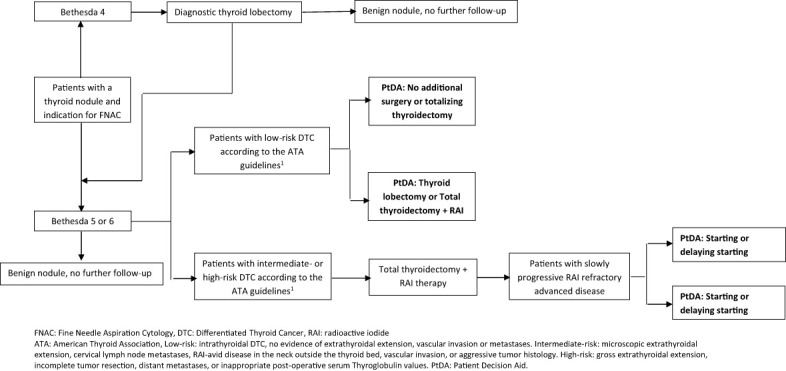
Patient decision aids (PtDAs) are structured clinical tools that facilitate shared decision-making. Two important treatment decisions for patients with differentiated thyroid cancer (DTC), which could benefit from PtDAs, are as follows (1): the extent of surgery decision in patients with low-risk DTC and (2) the decision to start or delay starting the treatment with tyrosine kinase inhibitors (TKIs) in patients with advanced tumors.
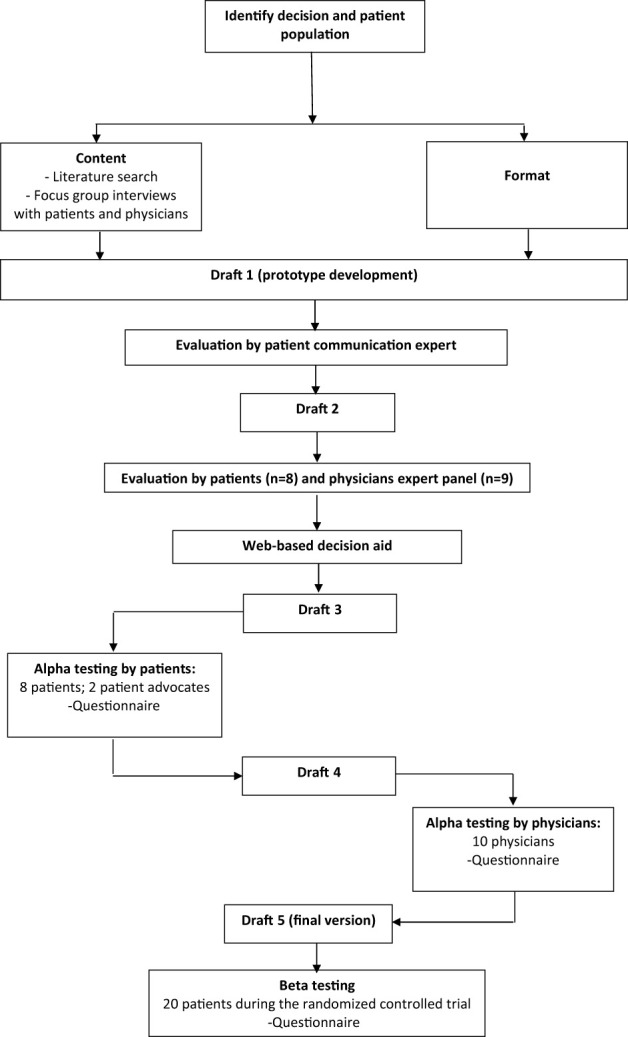
PtDAs for these two decisions were developed using the International Patient Decision Aids Standards (IPDAS) quality criteria in an iterative process of prototype development alpha and beta testing by patients and physicians. The information content of the PtDAs was based on the available literature, current guidelines, and patient's needs, preferences, and values.
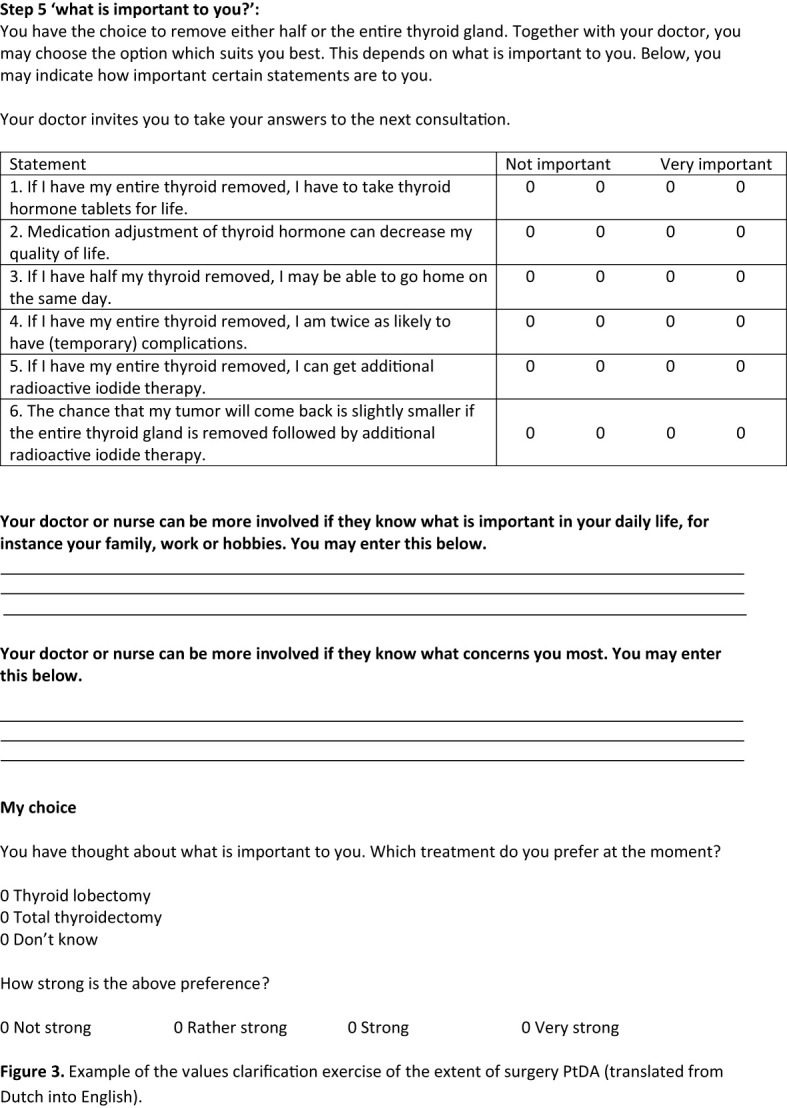
The web-based PtDAs underwent two rounds of alpha testing, revisions, and beta testing. The PtDAs have the same structure, consisting of six steps: a general introduction, information about the treatment options, comparing the treatment options, knowledge questions, a values clarification exercise, and saving the information. The alpha testing ( = 8 patients, = 10 physicians) showed that the PtDAs were highly acceptable and usable for decision-making. Results of the beta testing in 20 patients showed that two patients did not use the PtDA; the other 18 patients found that the PtDAs were readable ( = 17) and helpful ( = 14) for decision-making. All patients recommend using the PtDAs.
Evidence-based PtDAs were created for patients with DTC for two different treatment decisions. Our final version was judged to be clear, balanced, and helpful in decision-making.
患者决策辅助工具(PtDAs)是促进共同决策的结构化临床工具。对于分化型甲状腺癌(DTC)患者,有两个重要的治疗决策可以从 PtDAs 中受益,如下所述:(1)低危 DTC 患者手术范围的决策,以及(2)晚期肿瘤患者开始或延迟开始酪氨酸激酶抑制剂(TKIs)治疗的决策。
这些两个决策的 PtDAs 是使用国际患者决策辅助工具标准(IPDAS)质量标准,通过患者和医生的原型开发、α测试和β测试的迭代过程开发的。PtDAs 的信息内容基于现有文献、当前指南和患者的需求、偏好和价值观。
基于网络的 PtDAs 经历了两轮α测试、修订和β测试。PtDAs 具有相同的结构,由六个步骤组成:一般介绍、治疗选择信息、治疗选择比较、知识问题、价值观澄清练习和保存信息。α测试(=8 名患者,=10 名医生)表明,PtDAs 非常适合决策使用。20 名患者的β测试结果显示,两名患者未使用 PtDA;其他 18 名患者认为 PtDAs 易于阅读(=17)且有助于决策(=14)。所有患者都推荐使用 PtDAs。
为 DTC 患者创建了基于证据的 PtDAs,用于两种不同的治疗决策。我们的最终版本被认为在决策方面清晰、平衡且有帮助。