Department of Family and Community Medicine, Qassim University, College of Medicine, Buraidah, Saudi Arabia.
PHC Physician, Ministry of Health, Qassim, Saudi Arabia.
Medicine (Baltimore). 2023 Jun 16;102(24):e33938. doi: 10.1097/MD.0000000000033938.
This study aimed to summarize the current literature regarding the prevalence of renal stones in patients with inflammatory bowel disease (IBD). Moreover, we aimed to evaluate the risk factors of urolithiasis in patients with IBD and the difference between patients with IBD and healthy controls in terms of urinary profile.
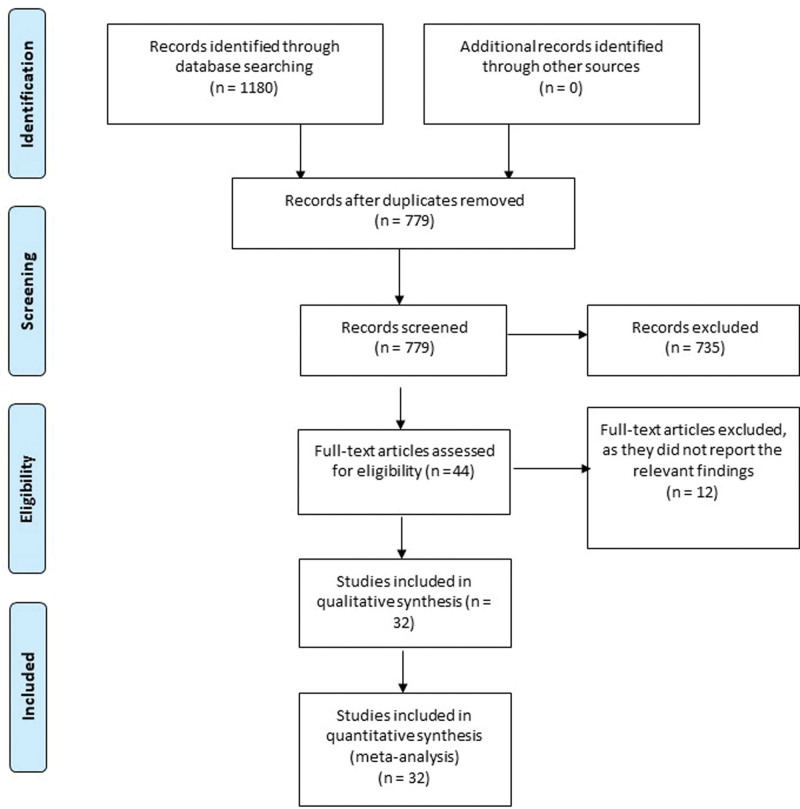
On February 23, 2022, a computerized search was conducted on PubMed, OVID via MEDLINE, Web of Science, and Scopus using relevant keywords. Three independent reviewers performed 2-stage screening and data extraction. The National Institutes of Health tools were employed for quality assessment. Review Manager 5.4 software was used to calculate the mean difference (MD) between IBD patients and non-IBD in terms of urine profile using the Inverse-variance model and to estimate the odds ratio of reported risk factors for renal stones with the Generic Inverse-Variance model.
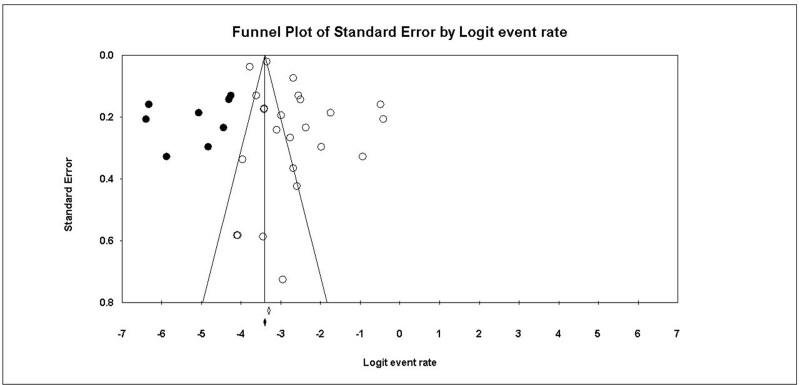
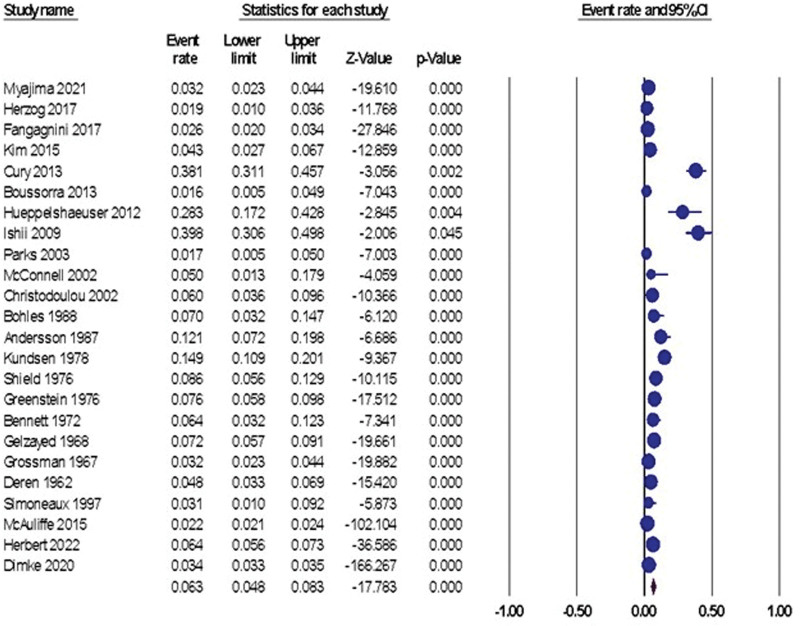
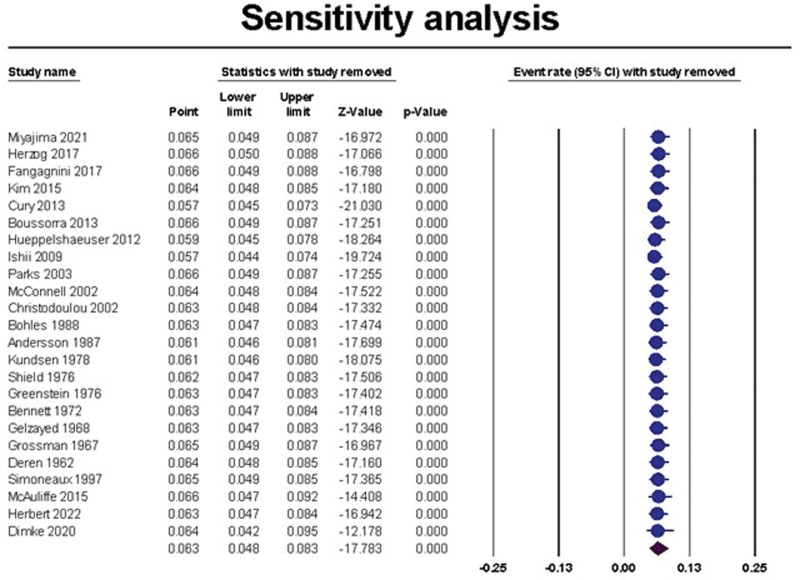
Thirty-two articles (n = 13,339,065 patients) were included. The overall prevalence of renal stones in patients with IBD was 6.3%, 95% Confidence interval (4.8%-8.3%). The prevalence of urolithiasis was more common in Chron's disease vs Ulcerative colitis (7.9% vs 5.6%) and in old studies (1964-2009) than in more recent studies (2010-2022) (7.3% vs 5.2%), respectively. Compared to non-IBD patients, patients with IBD were associated with significantly lower urine volume (MD = -518.84 mL/day, P < .00001), calcium 24-hour urine (MD = -28.46 mg/day, P < .0001), citrate 24-hour urine (MD = -144.35 mg/day, P < .00001), sodium 24-hour urine (MD = -23.72 mg/day, P = .04), and magnesium 24-hour urine (MD = -33.25 mg/day, P < .00001).
The overall prevalence of renal stones in patients with IBD was comparable to the general population. Patients with Chron's disease were associated with a higher prevalence of urolithiasis compared to Ulcerative colitis. Drugs that induce renal calculi should be stopped in high-risk patients.
本研究旨在总结目前关于炎症性肠病(IBD)患者肾结石患病率的文献。此外,我们旨在评估 IBD 患者尿石症的风险因素,以及 IBD 患者与健康对照组在尿谱方面的差异。
2022 年 2 月 23 日,我们在 PubMed、OVID 通过 MEDLINE、Web of Science 和 Scopus 上使用相关关键词进行了计算机检索。三名独立的审查员进行了 2 阶段筛选和数据提取。采用美国国立卫生研究院工具进行质量评估。使用 Review Manager 5.4 软件,采用Inverse-variance 模型计算 IBD 患者和非 IBD 患者尿谱的均数差(MD),采用 Generic Inverse-Variance 模型估计报告的肾结石危险因素的比值比。
共纳入 32 篇文章(n=13339065 例患者)。IBD 患者肾结石的总体患病率为 6.3%,95%置信区间(4.8%-8.3%)。与溃疡性结肠炎相比,克罗恩病患者的尿石症患病率更高(7.9%比 5.6%),与较早期的研究(1964-2009 年)相比,近期研究(2010-2022 年)的患病率更高(7.3%比 5.2%)。与非 IBD 患者相比,IBD 患者的尿容量显著较低(MD=-518.84 mL/天,P<0.00001),24 小时尿钙(MD=-28.46 mg/天,P<0.0001)、24 小时尿枸橼酸(MD=-144.35 mg/天,P<0.00001)、24 小时尿钠(MD=-23.72 mg/天,P=0.04)和 24 小时尿镁(MD=-33.25 mg/天,P<0.00001)。
IBD 患者肾结石的总体患病率与一般人群相当。与溃疡性结肠炎相比,克罗恩病患者的尿石症患病率更高。应停止使用导致肾结石的药物。