Mustafa Mujahed I, Mohammed Ahmed
Department of Biotechnology, College of Applied and Industrial Sciences, University of Bahri, Khartoum, Sudan.
Department of biotechnology, school of life sciences and technology, Omdurman Islamic university, Omdurman, Sudan.
Biotechnol Rep (Amst). 2023 Jun 7;39:e00803. doi: 10.1016/j.btre.2023.e00803. eCollection 2023 Sep.
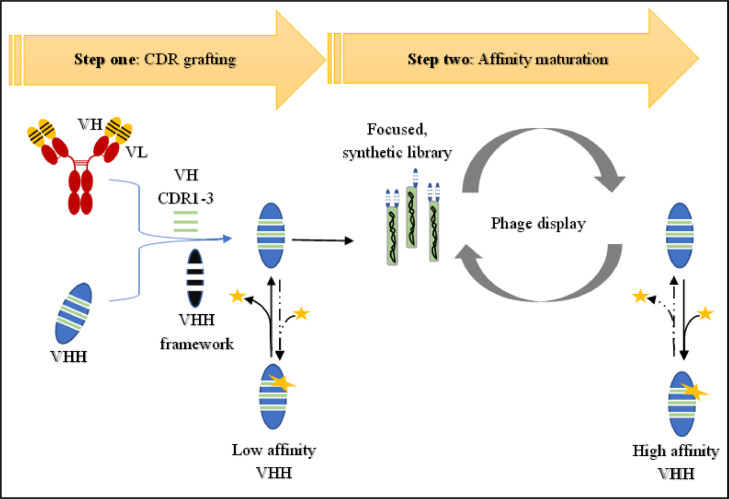
As the world continues to grapple with infectious diseases, scientists are constantly searching for effective ways to combat these deadly pathogens. One promising avenue of research is the use of nanobodies as neutralization agents. These small proteins, derived from camelid antibodies, have several unique advantages over traditional antibodies, including their small size. Nanobodies are much smaller than conventional antibodies, typically weighing in at around 15 kDa compared to the 150 kDa of a typical human antibody. This small size allows them to penetrate into tight spaces that larger molecules cannot reach, such as the crevices on the surface of viruses or bacteria. This makes them highly effective at neutralizing viruses by binding to and blocking their key functional sites. In this mini-review we discuss the construction approaches of nanobodies, and some methods to increase the half-life of nanobodies. Moreover, we discuss Nanobodies and their therapeutic potential for infectious agents.
随着世界继续应对传染病,科学家们一直在不断寻找对抗这些致命病原体的有效方法。一个有前景的研究途径是使用纳米抗体作为中和剂。这些源自骆驼科动物抗体的小蛋白质,与传统抗体相比具有几个独特优势,包括它们的小尺寸。纳米抗体比传统抗体小得多,典型的纳米抗体重量约为15千道尔顿,而典型的人类抗体为150千道尔顿。这种小尺寸使它们能够渗透到较大分子无法到达的狭窄空间,例如病毒或细菌表面的缝隙。这使得它们通过结合并阻断病毒的关键功能位点来高效中和病毒。在这篇小型综述中,我们讨论了纳米抗体的构建方法以及一些延长纳米抗体半衰期的方法。此外,我们还讨论了纳米抗体及其对感染因子的治疗潜力。