Aquino Grace V, Dabi Amjad, Odom Gabriel J, Lavado Ramon, Nunn Kaitlin, Thomas Kathryn, Schackmuth Bennett, Shariff Nazeel, Jarajapu Manogna, Pluto Morgan, Miller Sara R, Eller Leah, Pressley Justin, Patel Rishi R, Black Jeffrey, Bruce Erica D
Department of Environmental Science, Baylor University, 101 Bagby Ave, Waco, TX 76707, USA.
Department of Bioinformatics and Computational Biology, University of North Carolina Chapel Hill, 120-Mason Farm Rd, Chapel Hill, NC 27514, USA.
Curr Res Toxicol. 2023 Jun 6;4:100107. doi: 10.1016/j.crtox.2023.100107. eCollection 2023.
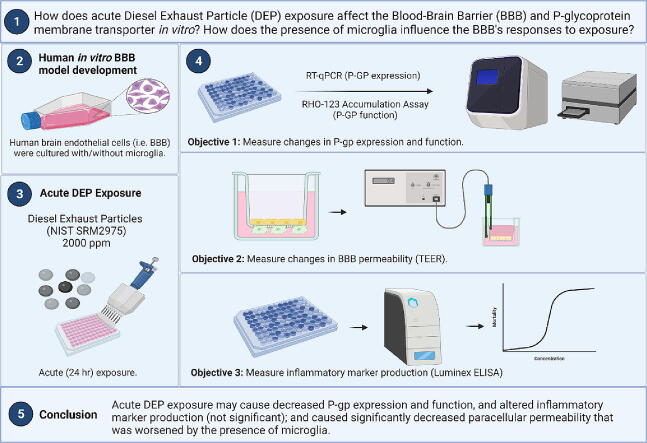
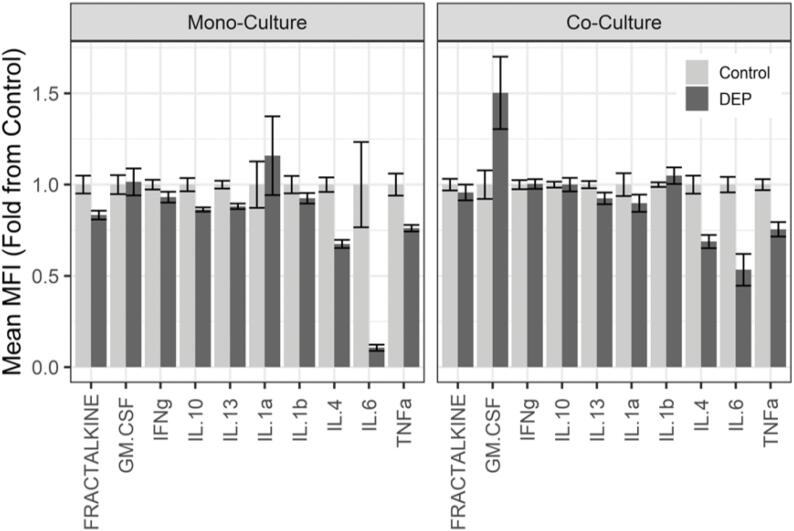
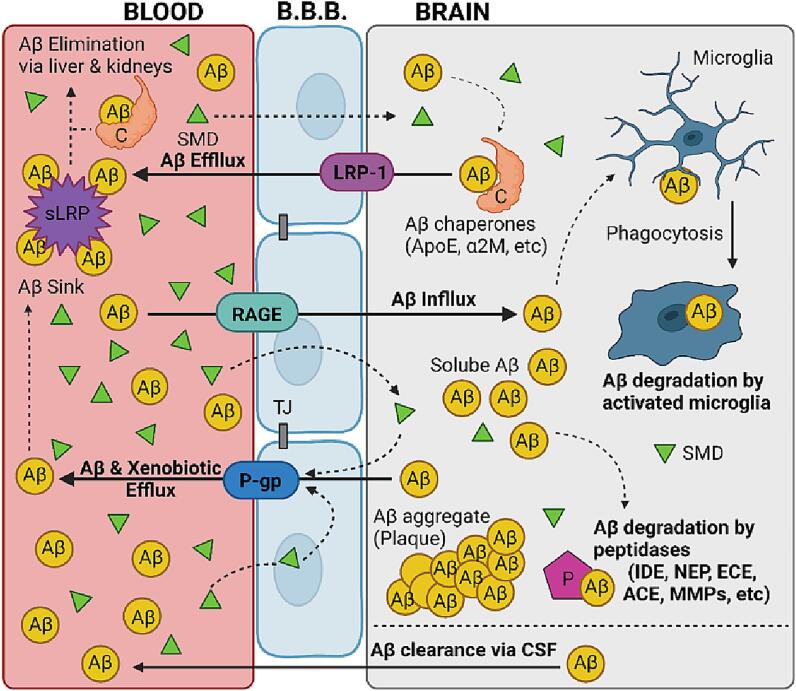
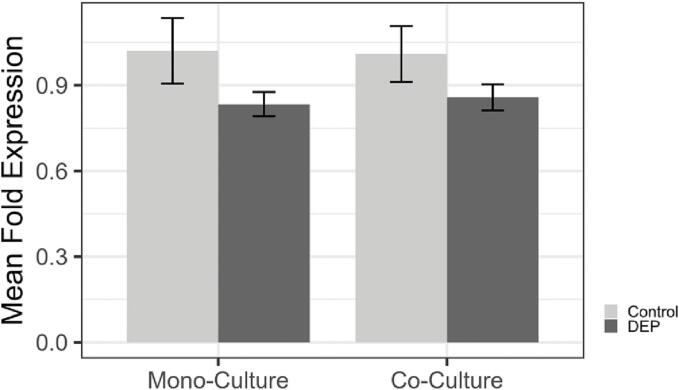
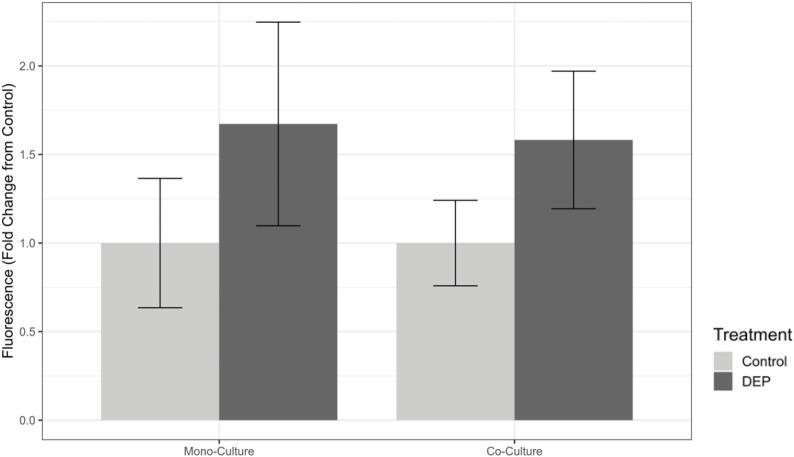
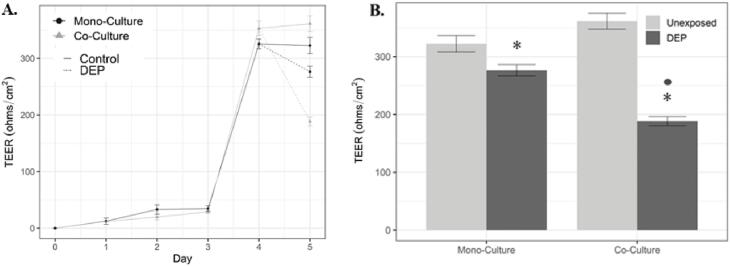
A growing public health concern, chronic Diesel Exhaust Particle (DEP) exposure is a heavy risk factor for the development of neurodegenerative diseases like Alzheimer's (AD). Considered the brain's first line of defense, the Blood-Brain Barrier (BBB) and perivascular microglia work in tandem to protect the brain from circulating neurotoxic molecules like DEP. Importantly, there is a strong association between AD and BBB dysfunction, particularly in the Aβ transporter and multidrug resistant pump, P-glycoprotein (P-gp). However, the response of this efflux transporter is not well understood in the context of environmental exposures, such as to DEP. Moreover, microglia are seldom included in BBB models, despite their significance in neurovascular health and disease. Therefore, the goal of this study was to evaluate the effect of acute (24 hr.) DEP exposure (2000 μg/ml) on P-gp expression and function, paracellular permeability, and inflammation profiles of the human BBB model (hCMEC/D3) with and without microglia (hMC3). Our results suggested that DEP exposure can decrease both the expression and function of P-gp in the BBB, and corroborated that DEP exposure impairs BBB integrity (i.e. increased permeability), a response that was significantly worsened by the influence of microglia in co-culture. Interestingly, DEP exposure seemed to produce atypical inflammation profiles and an unexpected general downregulation in inflammatory markers in both the monoculture and co-culture, which differentially expressed IL-1β and GM-CSF. Interestingly, the microglia in co-culture did not appear to influence the response of the BBB, save in the permeability assay, where it worsened the BBB's response. Overall, our study is important because it is the first (to our knowledge) to investigate the effect of acute DEP exposure on P-gp in the human BBB, while also investigating the influence of microglia on the BBB's responses to this environmental chemical.
慢性接触柴油尾气颗粒(DEP)日益引起公众对健康的关注,它是诸如阿尔茨海默病(AD)等神经退行性疾病发展的一个重大风险因素。血脑屏障(BBB)和血管周围小胶质细胞被视为大脑的第一道防线,它们协同工作以保护大脑免受诸如DEP等循环神经毒性分子的侵害。重要的是,AD与BBB功能障碍之间存在密切关联,尤其是在Aβ转运体和多药耐药泵P-糖蛋白(P-gp)方面。然而,在诸如接触DEP等环境暴露的背景下,这种外排转运体的反应尚未得到充分了解。此外,尽管小胶质细胞在神经血管健康和疾病中具有重要意义,但在BBB模型中很少将其纳入考虑。因此,本研究的目的是评估急性(24小时)接触DEP(2000μg/ml)对有或无微胶质细胞(hMC3)的人BBB模型(hCMEC/D3)中P-gp表达和功能、细胞旁通透性以及炎症谱的影响。我们的结果表明,接触DEP可降低BBB中P-gp的表达和功能,并证实接触DEP会损害BBB的完整性(即通透性增加),在共培养中,小胶质细胞的影响会使这种反应显著恶化。有趣的是,接触DEP似乎会产生非典型的炎症谱,并且在单培养和共培养中炎症标志物出现意外的普遍下调,其中IL-1β和GM-CSF的表达存在差异。有趣的是,共培养中的小胶质细胞似乎并未影响BBB的反应,不过在通透性测定中除外,在该测定中它会使BBB的反应恶化。总体而言,我们的研究很重要,因为据我们所知,它是首次研究急性接触DEP对人BBB中P-gp的影响,同时还研究了小胶质细胞对BBB对这种环境化学物质反应的影响。