Norwegian Radiation and Nuclear Safety Authority, P.O. box 55, 1332 Østerås, Norway.
Vestfold and Telemark County Council, Fylkeshuset, Svend Foynsgt. 9, 3110 Tønsberg, Norway.
Radiat Prot Dosimetry. 2023 Jul 21;199(12):1284-1294. doi: 10.1093/rpd/ncad178.
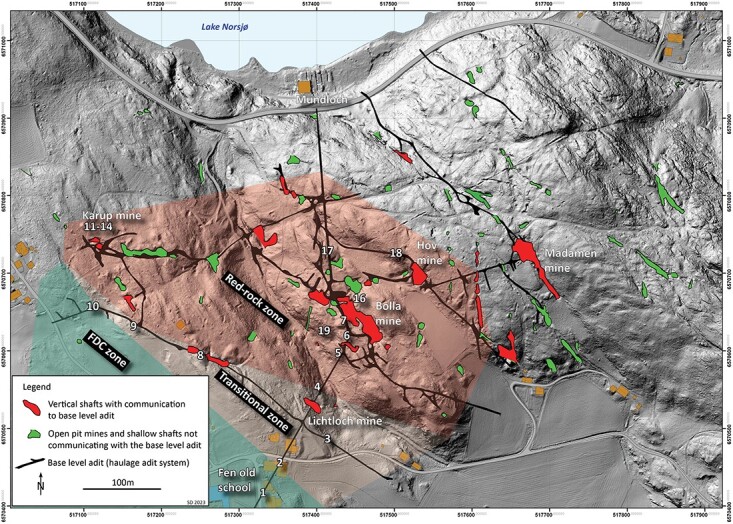
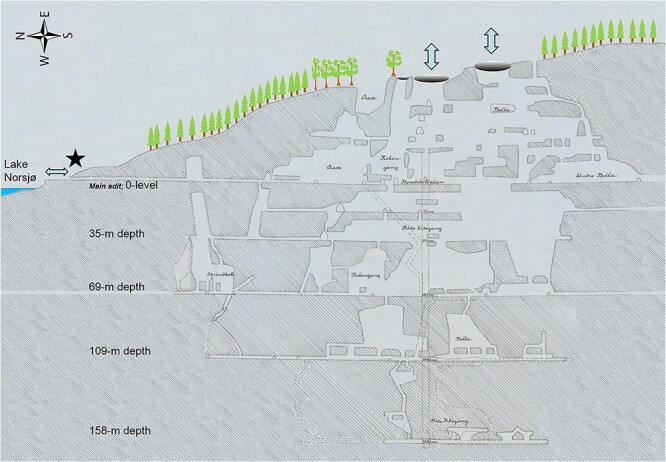
In areas with high natural background radiation, underground cavities tend to have high levels of airborne radionuclides. Within mines, occupancy may involve significant exposure to airborne radionuclides like radon (222Rn), thoron (220Rn) and progeny. The Fen carbonatite complex in Norway has legacy mines going through bedrock with significantly elevated levels of uranium (238U) and especially thorium (232Th), and significant levels of their progeny 222Rn and 220Rn. There are also significantly elevated levels of gamma radiation in these mines. These mines are naturally chimney ventilated and release large volumes of air to the outdoors giving a large local outdoor impact. We placed alpha track detectors at several localities within these mines to measure airborne radionuclides and measured gamma radiation of bedrock at each locality. The bedrock within the mines shows levels up to 1900 Bq kg-1 for 238U, 12 000 Bq kg-1 for 232Th and gamma dose rates up to 11 μSv h-1. Maximum levels of airborne radionuclides were 45 000 Bq m-3 for 220Rn and 6900 Bq m-3 for 222Rn. In addition, we measured levels of thoron progeny (TnP). In order to estimate radiation dose contribution, TnP should be assessed rather than 220Rn, but deposition-based detectors may be biased by the airflow of mine-draft. We present dose rate contributions using UNSCEAR dose conversion factors, and correcting for airflow bias, finding a combined cold season dose rate within these mines of 17-24 μSv h-1. Interestingly, fractional dose rate contributions vary from 0.02 to 0.6 for gamma, 0.33 to 0.95 for radon and 0.1 to 0.25 for TnP.
在天然本底辐射水平较高的地区,地下洞穴空气中的放射性核素水平往往较高。在矿山中,工作人员可能会因吸入氡(222Rn)、钍(220Rn)及其子体等放射性核素而受到显著照射。挪威的 Fen 碳酸岩杂岩体中有历史遗留的矿山,穿过基岩,铀(238U)含量明显升高,尤其是钍(232Th)含量明显升高,其子体 222Rn 和 220Rn 的含量也很高。这些矿山中的γ辐射水平也显著升高。这些矿山是自然通风烟囱,向室外释放大量空气,对当地产生了很大的影响。我们在这些矿山的几个地点放置了α径迹探测器,以测量空气中的放射性核素,并测量每个地点基岩的γ辐射。矿山内的基岩中 238U 的含量高达 1900 Bq/kg,232Th 的含量高达 12000 Bq/kg,γ剂量率高达 11 μSv/h。空气中放射性核素的最高水平为 220Rn 的 45000 Bq/m3和 222Rn 的 6900 Bq/m3。此外,我们还测量了钍射气子体(TnP)的水平。为了估计辐射剂量贡献,应该评估 TnP,而不是 220Rn,但基于沉积的探测器可能会因矿山气流而产生偏差。我们使用 UNSCEAR 剂量转换系数来表示剂量率贡献,并对气流偏差进行修正,发现这些矿山在冬季寒冷季节的综合剂量率为 17-24 μSv/h。有趣的是,γ射线的分剂量率贡献范围为 0.02-0.6,氡的分剂量率贡献范围为 0.33-0.95,TnP 的分剂量率贡献范围为 0.1-0.25。