State Key Laboratory of Molecular Oncology, National Cancer Center/National Clinical Research Center for Cancer/Cancer Hospital, Chinese Academy of Medical Sciences and Peking Union Medical College, Beijing, China.
Medical Research Center, Peking Union Medical College Hospital, Peking Union Medical College and Chinese Academy of Medical Sciences, Beijing, China.
Cancer Med. 2023 Jul;12(13):13912-13927. doi: 10.1002/cam4.5946. Epub 2023 Jun 19.
Circulating tumor cells (CTCs), an indispensable liquid biopsy classifier, can provide extra information for the diagnosis and prognosis of hepatocellular carcinoma (HCC).
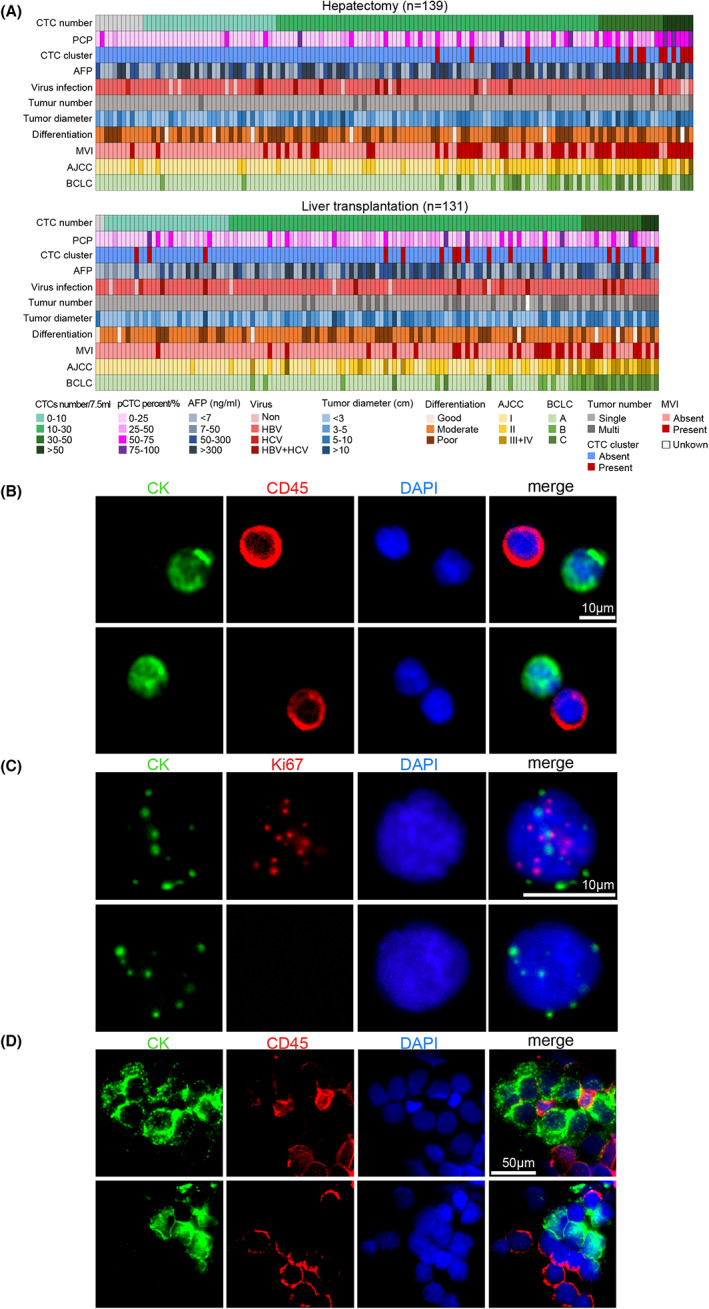
We systematically analyzed the peripheral blood of preoperative HCC patients (n = 270) for CTC number, Ki67 index reflecting the proliferative CTC percentage (PCP), and CTC clusters correlated with the characteristics of malignant HCC tumors.
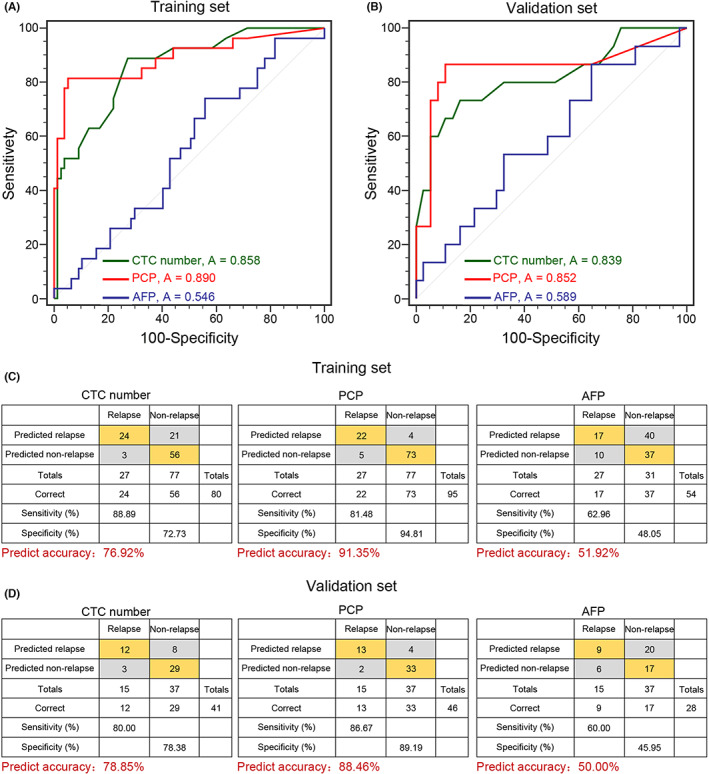
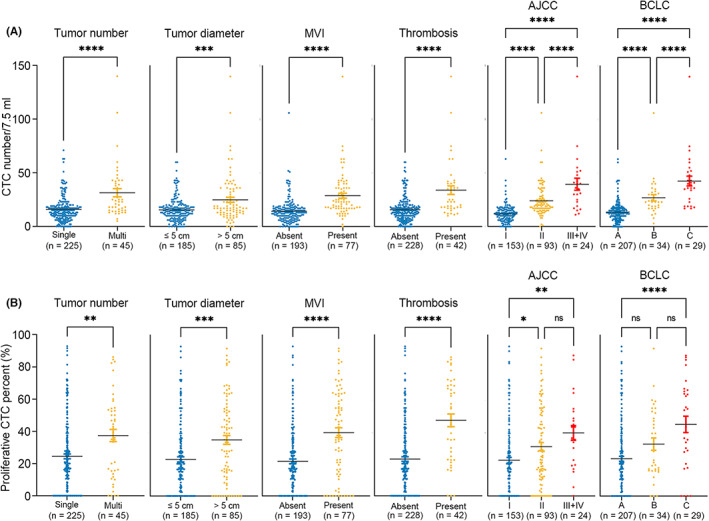
Driver gene mutations were found with high levels of consistency between CTCs and primary tumors (n = 73). CTC number and PCP were associated with tumor size, microvascular invasion (MVI), presence or absence of multiple tumors, and thrombosis significantly. CTC number and PCP robustly separated patients with and without relapse, with a sensitivity of 88.89%/81.48% and a specificity of 72.73%/94.81% in the training set (n = 104) and corresponding values of 80.00%/86.67% and 78.38%/89.19% in the validation set (n = 52), showing a better performance than that associated with the alpha-fetoprotein (AFP) level. CTC number, PCP, CTC clusters, and MVI were independent significant risk factors for HCC recurrence (P = 0.0375, P < 0.0001, P = 0.0017, and P = 0.0157). A nomogram model based on these risk factors showed a considerable prediction ability for HCC recurrence (area under the curve = 0.947). PCP (training: log-rank P < 0.0001; hazard ratio [HR] 30.13, 95% confidence interval [CI] = 11.12-81.62; validation: log-rank P < 0.0001; HR 25.73, 95% CI = 5.28-106.60) and CTC clusters (training: log-rank P < 0.0001; HR 17.34, 95% CI = 7.46-40.30; validation: log-rank P < 0.0001; HR 9.92, 95% CI = 2.55-38.58) were more significantly correlated with worse recurrence-free survival than CTC number (training: log-rank P < 0.0001; HR 14.93, 95% CI = 4.48-49.78; validation: log-rank P = 0.0007; HR 9.03, 95% CI = 2.53-32.24).
PCP and CTC clusters may predict HCC recurrence and improve the performance of the serum biomarker AFP.
循环肿瘤细胞(CTC)是一种不可或缺的液体活检分类器,可为肝细胞癌(HCC)的诊断和预后提供额外信息。
我们系统地分析了术前 HCC 患者(n=270)的外周血中 CTC 数量、反映增殖性 CTC 百分比的 Ki67 指数(PCP)以及与恶性 HCC 肿瘤特征相关的 CTC 簇。
在 73 例患者中发现了驱动基因突变,CTC 与原发肿瘤之间的一致性很高。CTC 数量和 PCP 与肿瘤大小、微血管侵犯(MVI)、是否存在多个肿瘤以及血栓形成显著相关。CTC 数量和 PCP 可灵敏地将复发患者与无复发患者区分开来,在训练组(n=104)中的灵敏度分别为 88.89%/81.48%和特异性为 72.73%/94.81%,在验证组(n=52)中的相应值分别为 80.00%/86.67%和 78.38%/89.19%,其性能优于甲胎蛋白(AFP)水平。CTC 数量、PCP、CTC 簇和 MVI 是 HCC 复发的独立显著危险因素(P=0.0375、P<0.0001、P=0.0017 和 P=0.0157)。基于这些危险因素的列线图模型对 HCC 复发具有良好的预测能力(曲线下面积=0.947)。PCP(训练:对数秩 P<0.0001;风险比 [HR]30.13,95%置信区间 [CI] 11.12-81.62;验证:对数秩 P<0.0001;HR 25.73,95%CI 5.28-106.60)和 CTC 簇(训练:对数秩 P<0.0001;HR 17.34,95%CI 7.46-40.30;验证:对数秩 P<0.0001;HR 9.92,95%CI 2.55-38.58)与 CTC 数量相比,与较差的无复发生存率更显著相关(训练:对数秩 P<0.0001;HR 14.93,95%CI 4.48-49.78;验证:对数秩 P=0.0007;HR 9.03,95%CI 2.53-32.24)。
PCP 和 CTC 簇可预测 HCC 复发,并提高血清标志物 AFP 的性能。