School of Informatics, University of Edinburgh, Edinburgh EH8 9AB, U.K.
The Alan Turing Institute, London NW1 2DB, U.K.
ACS Synth Biol. 2023 Jul 21;12(7):2073-2082. doi: 10.1021/acssynbio.3c00120. Epub 2023 Jun 20.
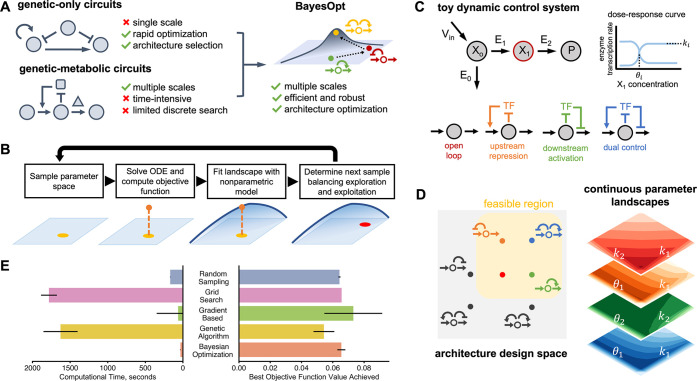
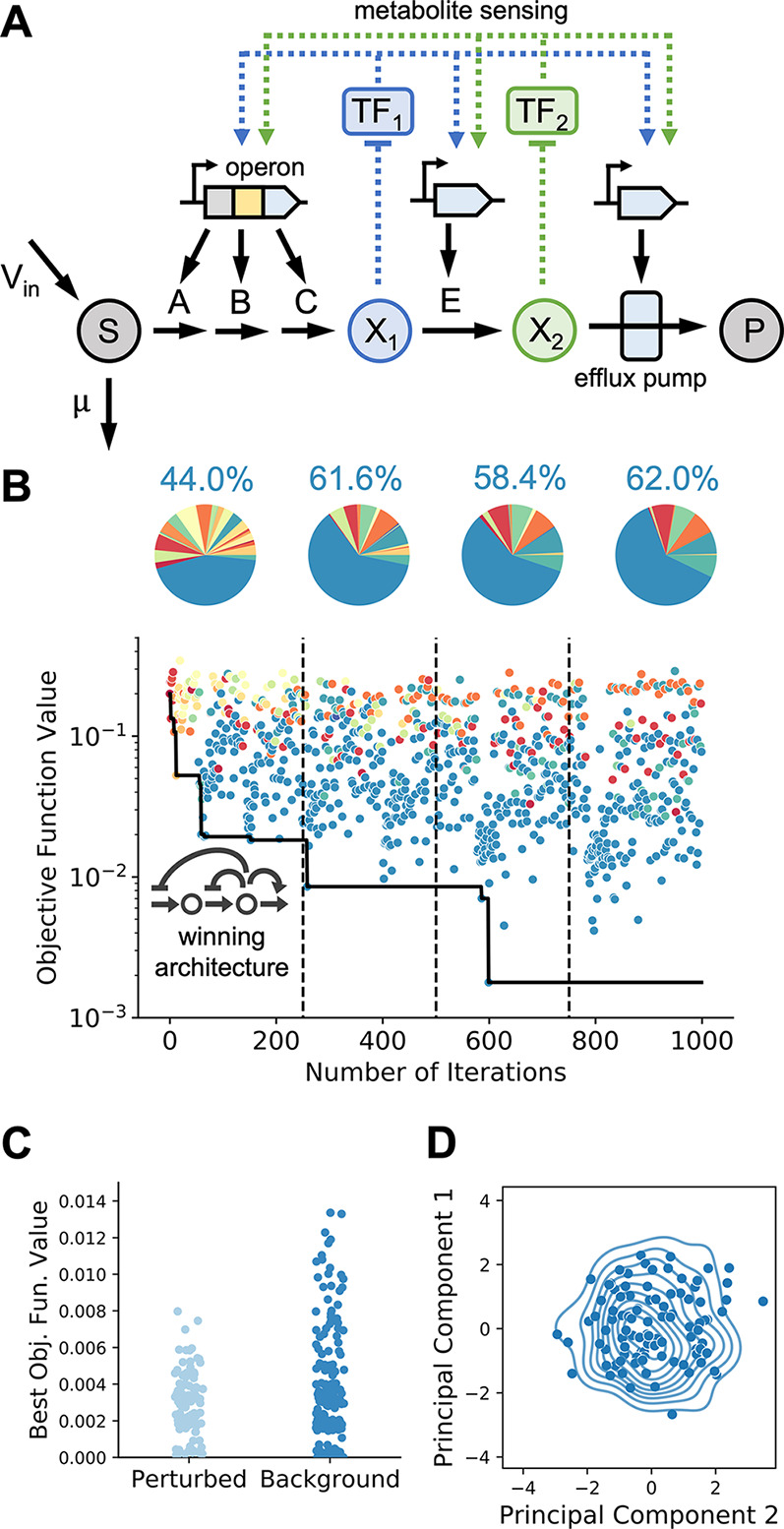
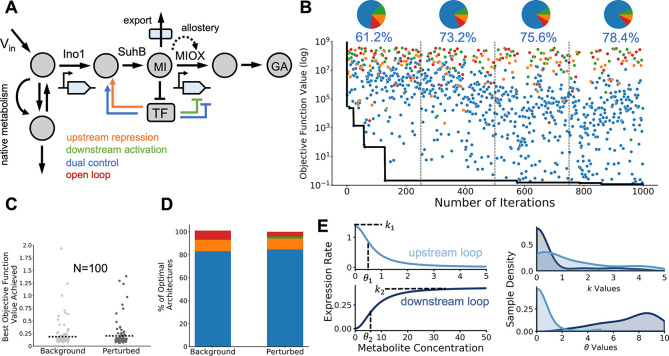
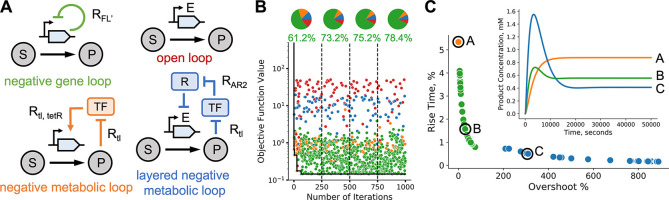
Recent advances in synthetic biology have enabled the construction of molecular circuits that operate across multiple scales of cellular organization, such as gene regulation, signaling pathways, and cellular metabolism. Computational optimization can effectively aid the design process, but current methods are generally unsuited for systems with multiple temporal or concentration scales, as these are slow to simulate due to their numerical stiffness. Here, we present a machine learning method for the efficient optimization of biological circuits across scales. The method relies on Bayesian optimization, a technique commonly used to fine-tune deep neural networks, to learn the shape of a performance landscape and iteratively navigate the design space toward an optimal circuit. This strategy allows the joint optimization of both circuit architecture and parameters, and provides a feasible approach to solve a highly nonconvex optimization problem in a mixed-integer input space. We illustrate the applicability of the method on several gene circuits for controlling biosynthetic pathways with strong nonlinearities, multiple interacting scales, and using various performance objectives. The method efficiently handles large multiscale problems and enables parametric sweeps to assess circuit robustness to perturbations, serving as an efficient screening method prior to experimental implementation.
最近,合成生物学的进展使得构建能够在多个细胞组织尺度上运作的分子电路成为可能,例如基因调控、信号通路和细胞代谢。计算优化可以有效地辅助设计过程,但目前的方法通常不适合具有多个时间或浓度尺度的系统,因为由于数值刚性,这些系统的模拟速度较慢。在这里,我们提出了一种用于跨尺度有效优化生物电路的机器学习方法。该方法依赖于贝叶斯优化,这是一种常用于微调深度神经网络的技术,用于学习性能曲面的形状,并迭代地在设计空间中导航,以找到最优电路。这种策略允许同时优化电路结构和参数,并提供了一种可行的方法来解决混合整数输入空间中的高度非凸优化问题。我们将该方法应用于几个基因电路,这些电路用于控制具有强非线性、多个相互作用尺度的生物合成途径,并使用各种性能目标。该方法能够有效地处理大规模多尺度问题,并能够进行参数扫描以评估电路对扰动的鲁棒性,从而在实验实施之前作为一种有效的筛选方法。