Department of Biotechnology, College of Science, University of Tehran, P.O. Box 14155-6455, Tehran, Iran.
Department of Biology, Faculty of Sciences, University of Maragheh, Maragheh, Iran.
Sci Rep. 2023 Jun 20;13(1):9963. doi: 10.1038/s41598-023-36162-9.
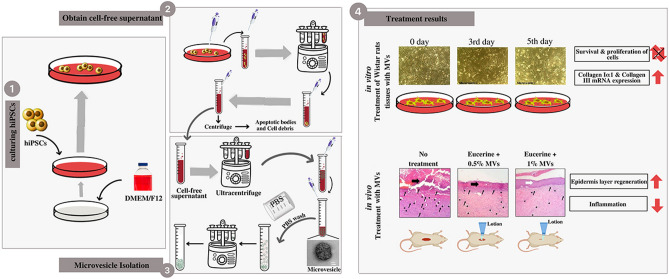
The skin undergoes the formation of fine lines and wrinkles through the aging process; also, burns, trauma, and other similar circumstances give rise to various forms of skin ulcers. Induced pluripotent stem cells (iPSCs) have become promising candidates for skin healing and rejuvenation due to not stimulating inflammatory responses, low probability of immune rejection, high metabolic activity, good large-scale production capacity and potentials for personalized medicine. iPSCs can secrete microvesicles (MVs) containing RNA and proteins responsible for the normal repairing process of the skin. This study aimed to evaluate the possibility, safety and effectiveness of applying iPSCs-derived MVs for skin tissue engineering and rejuvenation applications. The possibility was assessed using the evaluation of the mRNA content of iPSC-derived MVs and the behavior of fibroblasts after MV treatment. Investigating the effect of microvesicle on stemness potential of mesenchymal stem cells was performed for safety concerns. In vivo evaluation of MVs was done in order to investigate related immune response, re-epithelialization and blood vessel formation to measure effectiveness. Shedding MVs were round in shape distributed in the range from 100 to 1000 nm in diameter and positive for AQP3, COL2A, FGF2, ITGB, and SEPTIN4 mRNAs. After treating dermal fibroblasts with iPSC-derived MVs, the expressions of collagens Iα1 and III transcripts (as the main fibrous extracellular matrix (ECM) proteins) were upregulated. Meanwhile, the survival and proliferation of MV treated fibroblasts did not change significantly. Evaluation of stemness markers in MV treated MSCs showed negligible alteration. In line with in vitro results, histomorphometry and histopathology findings also confirmed the helpful effect of MVs in skin regeneration in the rat burn wound models. Conducting more investigations on hiPSCs-derived MVs may lead to produce more efficient and safer biopharmaceutics for skin regeneration in the pharmaceutical market.
皮肤会随着衰老过程形成细小的皱纹和皱纹;烧伤、创伤和其他类似情况会导致各种形式的皮肤溃疡。诱导多能干细胞(iPSCs)由于不刺激炎症反应、免疫排斥的可能性低、高代谢活性、良好的大规模生产能力和个性化药物的潜力,已成为皮肤愈合和再生的有前途的候选者。iPSCs 可以分泌含有负责皮肤正常修复过程的 RNA 和蛋白质的微泡(MVs)。本研究旨在评估应用 iPSCs 衍生的 MVs 进行皮肤组织工程和再生应用的可能性、安全性和有效性。通过评估 iPSC 衍生的 MVs 的 mRNA 含量和 MV 处理后成纤维细胞的行为来评估可能性。为了安全考虑,研究了微泡对间充质干细胞干性潜能的影响。为了研究相关的免疫反应、再上皮化和血管形成,以衡量有效性,对 MVs 进行了体内评估。释放的 MVs 呈圆形,分布在 100 到 1000nm 直径范围内,AQP3、COL2A、FGF2、ITGB 和 SEPTIN4 mRNAs 均为阳性。用 iPSC 衍生的 MVs 处理真皮成纤维细胞后,Ⅰ型和Ⅲ型胶原转录物(作为主要的纤维细胞外基质(ECM)蛋白)的表达上调。同时,MV 处理的成纤维细胞的存活和增殖没有明显变化。MV 处理的 MSC 中干性标志物的评估显示出可忽略的变化。与体外结果一致,组织形态计量学和组织病理学结果也证实了 MVs 在大鼠烧伤创面模型中对皮肤再生的有益作用。对 hiPSCs 衍生的 MVs 进行更多的研究可能会导致在制药市场上生产更有效和更安全的生物制药产品,用于皮肤再生。