Department of Population Science, Jatiya Kabi Nazrul Islam University, Trishal, Mymensingh, Bangladesh.
Centre for Women's Health Research, University of Newcastle, Sydney, Australia.
Sci Rep. 2023 Aug 24;13(1):13814. doi: 10.1038/s41598-023-41049-w.
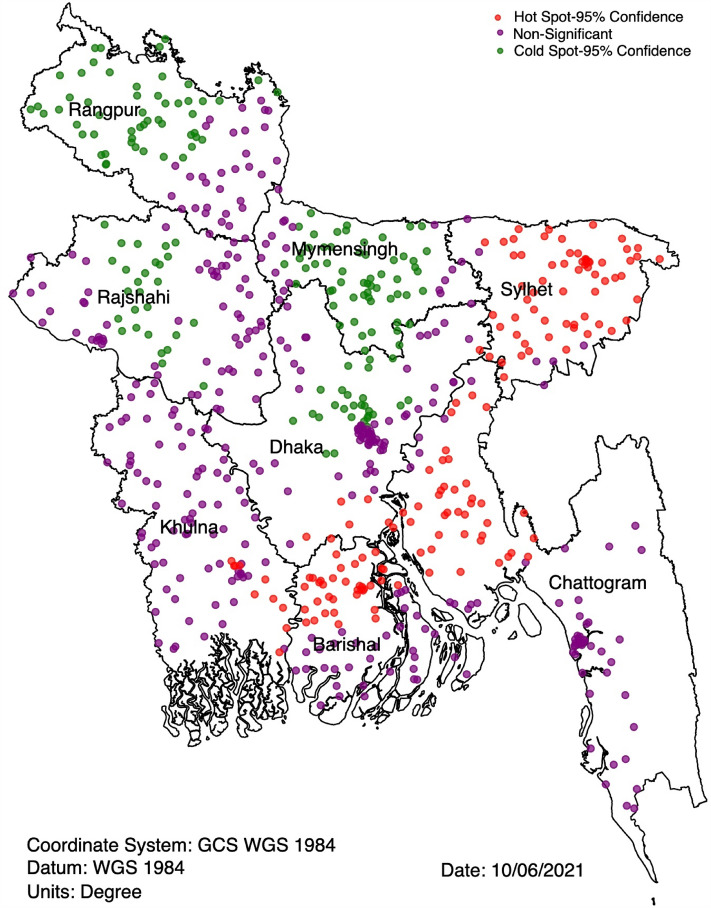
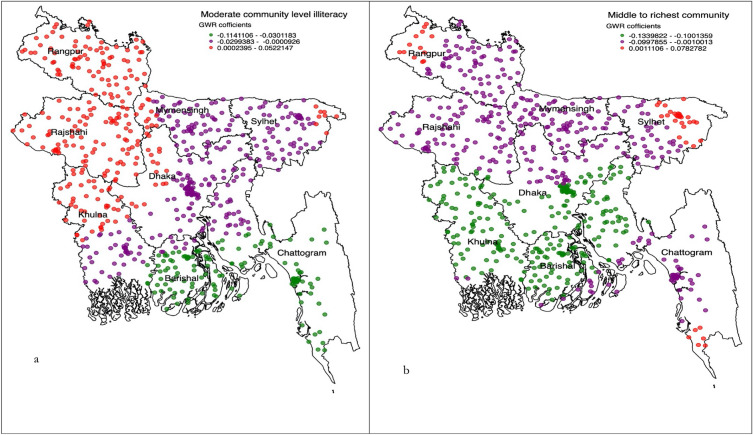
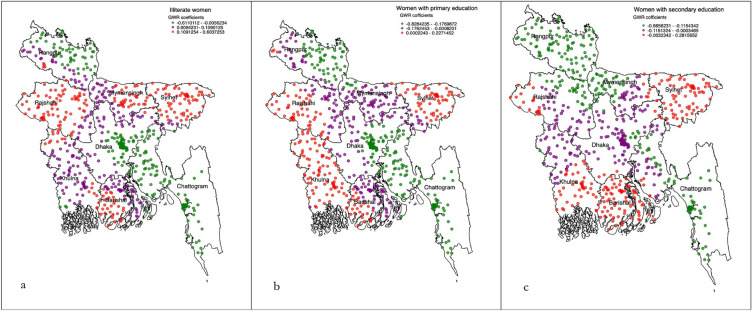
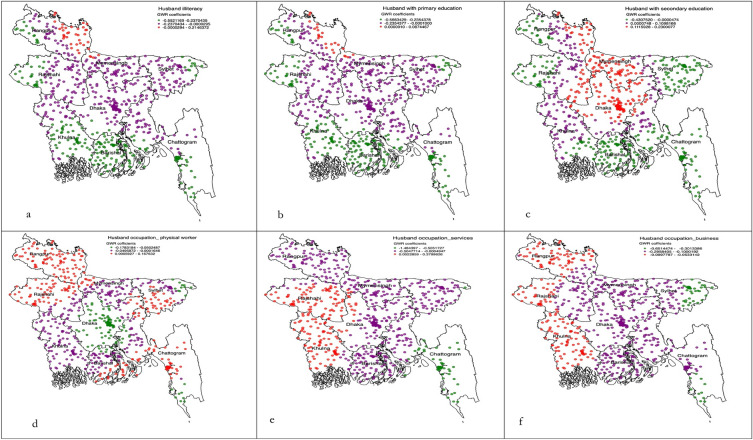
This study aimed to investigate spatial variations in the non-use of modern contraception in Bangladesh and identify associated individual, household, and community-level factors. The analysis utilized data from 16,135 women, extracted from the 2017/18 Bangladesh Demographic and Health Survey. The study's main outcome was the prevalence of non-use of modern contraception (yes or no), while the explanatory variables included factors at the individual, household, and community level. To assess geographical heterogeneity in non-use of modern contraception, Moran's I statistics were applied. Additionally, the Gettis-Ord Gi* was calculated to measure spatial autocorrelation differences across various study locations. The relationship between non-use of modern contraception and location was further explored using a geographically weighted regression model at the cluster level. The results indicated that 42.8% (95% CI 41.6-43.8) of respondents reported non-use of modern contraception in Bangladesh, with significant variation across geographical locations (p < 0.001). Hot spots of high non-use were predominantly identified in the Sylhet, Barishal, and some areas of the Chattogram divisions, while cold spots of low use were concentrated in the Rangpur, Mymensingh, and some areas Rajshahi divisions. Notably, the likelihood of non-use was highest among women and partners with low levels of education. The analysis of other risk factors, such as partner occupation, community-level illiteracy, and poverty, revealed varying effects on non-use of modern contraception across different locations (clusters) within the country. The study's findings underscore the importance of targeted, area-specific policies and programs aimed at promoting knowledge and uptake of modern contraception in Bangladesh.
本研究旨在探讨孟加拉国现代避孕方法未使用率的空间差异,并确定相关的个人、家庭和社区层面的因素。分析使用了来自 2017/18 年孟加拉国人口与健康调查的 16135 名女性的数据。研究的主要结果是现代避孕方法未使用率(是或否),而解释变量包括个人、家庭和社区层面的因素。为了评估现代避孕方法未使用率的地理异质性,应用了 Moran's I 统计量。此外,还计算了 Gettis-Ord Gi*,以衡量不同研究地点的空间自相关差异。还通过聚类水平的地理加权回归模型进一步探讨了现代避孕方法未使用率与位置之间的关系。结果表明,42.8%(95%CI 41.6-43.8)的受访者报告在孟加拉国未使用现代避孕方法,且地理位置之间存在显著差异(p<0.001)。高未使用率的热点主要集中在锡尔赫特、巴里萨尔和吉大港的一些地区,而低使用率的冷点则集中在朗布尔、迈门辛和拉杰沙希的一些地区。值得注意的是,教育程度低的妇女及其伴侣未使用现代避孕方法的可能性最高。对其他风险因素(如伴侣职业、社区一级文盲和贫困)的分析表明,这些因素对全国不同地区(集群)的现代避孕方法未使用率有不同的影响。研究结果强调了在孟加拉国制定有针对性、特定区域的政策和方案以促进现代避孕方法知识普及和采用的重要性。