MMWR Morb Mortal Wkly Rep. 2023 Jun 23;72(25):678-682. doi: 10.15585/mmwr.mm7225a2.
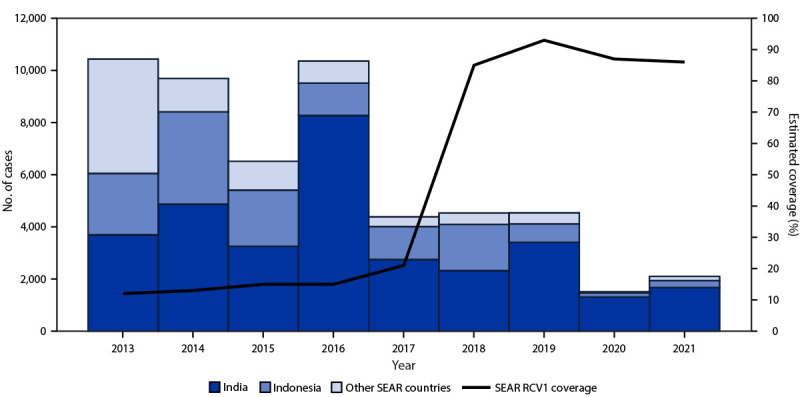
During 2013, the 11 countries of the World Health Organization (WHO) South-East Asia Region* (SEAR) adopted the goals of measles elimination and rubella and congenital rubella syndrome (CRS) control by 2020. During 2019, SEAR countries declared a broader goal for eliminating both measles and rubella by 2023 (1). Before 2013, only five SEAR countries had introduced rubella-containing vaccine (RCV). This report updates a previous report and describes progress toward rubella elimination in SEAR during 2013-2021 (2). During 2013-2021, six SEAR countries introduced RCV; all countries in the Region now use RCV in routine immunization. Routine immunization coverage with the first dose of a rubella-containing vaccine (RCV1) increased >600%, from 12% during 2013 to 86% during 2021, and an estimated 515 million persons were vaccinated via RCV supplementary immunization activities (SIAs) during 2013-2021. During this time, annual reported rubella incidence declined by 80%, from 5.5 to 1.1 cases per million population. Maldives and Sri Lanka are verified as having achieved rubella elimination; Bhutan, North Korea, and Timor-Leste have halted endemic transmission of rubella virus for >36 months. SEAR has made substantial progress toward rubella elimination; however, intensified measures are needed to achieve elimination.
2013 年,世界卫生组织(世卫组织)东南亚区域*(SEA)的 11 个国家通过了到 2020 年消除麻疹和风疹以及先天性风疹综合征(CRS)的目标。2019 年,SEA 国家宣布了到 2023 年消除麻疹和风疹的更广泛目标(1)。在此之前,只有五个 SEA 国家引入了含风疹疫苗(RCV)。本报告更新了之前的报告,描述了 2013 年至 2021 年 SEA 区域消除风疹的进展情况(2)。2013 年至 2021 年期间,有六个 SEA 国家引入了 RCV;该区域所有国家现在都在常规免疫中使用 RCV。含风疹疫苗(RCV1)的第一剂常规免疫接种覆盖率提高了>600%,从 2013 年的 12%增加到 2021 年的 86%,估计在 2013 年至 2021 年期间有 5.15 亿人通过 RCV 补充免疫活动(SIAs)接种了疫苗。在此期间,每年报告的风疹发病率下降了 80%,从每百万人口 5.5 例降至 1.1 例。马尔代夫和斯里兰卡已被证实已消除风疹;不丹、朝鲜和东帝汶已停止风疹病毒的地方性传播达 36 个月以上。SEA 区域在消除风疹方面取得了重大进展;然而,需要采取更强化的措施来实现消除目标。